News for hackers. Stuff that matters.
Re:15 uncoupled simple pendulums of increasing lengths dance... by no_gravity on Saturday August 27, 2011 @06:55AM (#2931269)
This made curious what patterns emerge when the objects move along circles instead. So I made this 10 minute hack to simulate it:

http://www.gibney.org/spiral_clock

Re:15 uncoupled simple pendulums of increasing lengths dance... by kmm on Saturday August 27, 2011 @07:08AM (#2931280)
Very pretty. It's a lot less crowdy if you change line 105 in your script to

  var speed =(nr_elements - i)/1000;
Re:15 uncoupled simple pendulums of increasing lengths dance... by no_gravity on Saturday August 27, 2011 @07:16AM (#2931284)
Yeah, then the inner objects move faster and the outer objects move slower. I find it hard to say, which version I prefer.
Re:15 uncoupled simple pendulums of increasing lengths dance... by Someone on Saturday August 27, 2011 @03:22PM (#2932221)
Physics prefers that change, at least when gravity drives the motions.

If you adjust the periods as distance^1/3, you get a simple model for a solar system.

Re:15 uncoupled simple pendulums of increasing lengths dance... by ataggart on Sunday August 28, 2011 @12:20AM (#2933279)
Interesting visual side-effect: watch the spiraling to completion, then flip back to HN and watch the text swirl.
Re:15 uncoupled simple pendulums of increasing lengths dance... by blahedo on Saturday August 27, 2011 @08:32PM (#2932937)
This version is nice because it's even clearer what's going on at integer-divisor points in the process, with different numbers of "arms" on the pattern.
Re:15 uncoupled simple pendulums of increasing lengths dance... by T-hawk on Sunday August 28, 2011 @01:13PM (#2934355)
Wow, it is beautiful. I'm trying to wrap my mind around the scheduling and the scale. It looks like it's calibrated to run an entire cycle in an hour, so if you see 6 arms (say) at the center, it's been running for 1/6 of an hour.

I'm trying to grok how the outward propagation works. It seems that a structure at the core propagates outward, while the core reorganizes itself into the next integral division (say 1/5). So you can get 5 arms at the core and 6 arms near the outer edges at the same time.

Check out this capture image. 4-way symmetry at the core, 5-way symmetry in the clusters halfway out, 6-way symmetry (faint but recognizable) at the outermost edge. http://www.dos486.com/misc/spiral-clock.gif
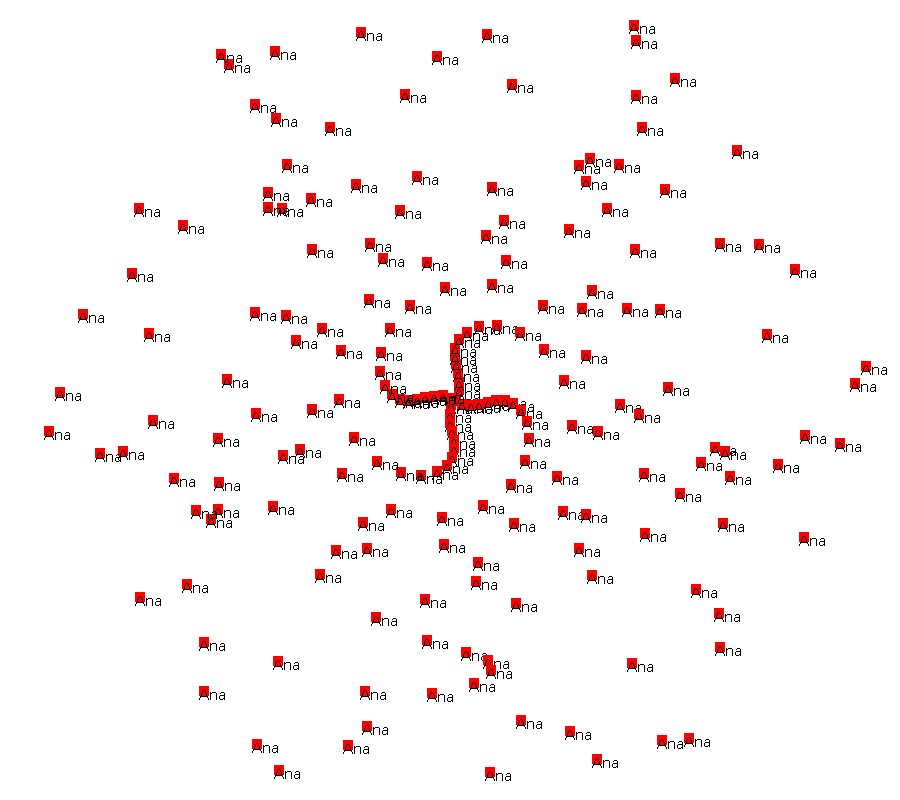
You also get recognizable structure for non-integral divisions, say 2/5. These structures are shorter-lived because each element is passing by an element two spins away instead of one so they converge and diverge faster.