"Original Antigenic Sin: How First Exposure Shapes Lifelong Anti–Influenza Virus Immune Responses"
And in case it is not clear, in this thread I am not advocating neither for or against vaccines, so we can end it here unless you have something of substance to add.
In terms of long term protection, I don't think we really know yet.
In terms of long term side effects - do we know of any past vaccines with notable side effects that only became known after 12+ months? Genuine question.
A picture from a recent preprint of 600k veterans over 6 months shows troubling VE against infection curves. J&J VE against infection is gone. Pfizer curve is just 2 months behind, at 53% and dropping.
https://www.medrxiv.org/content/medrxiv/early/2021/10/14/202...
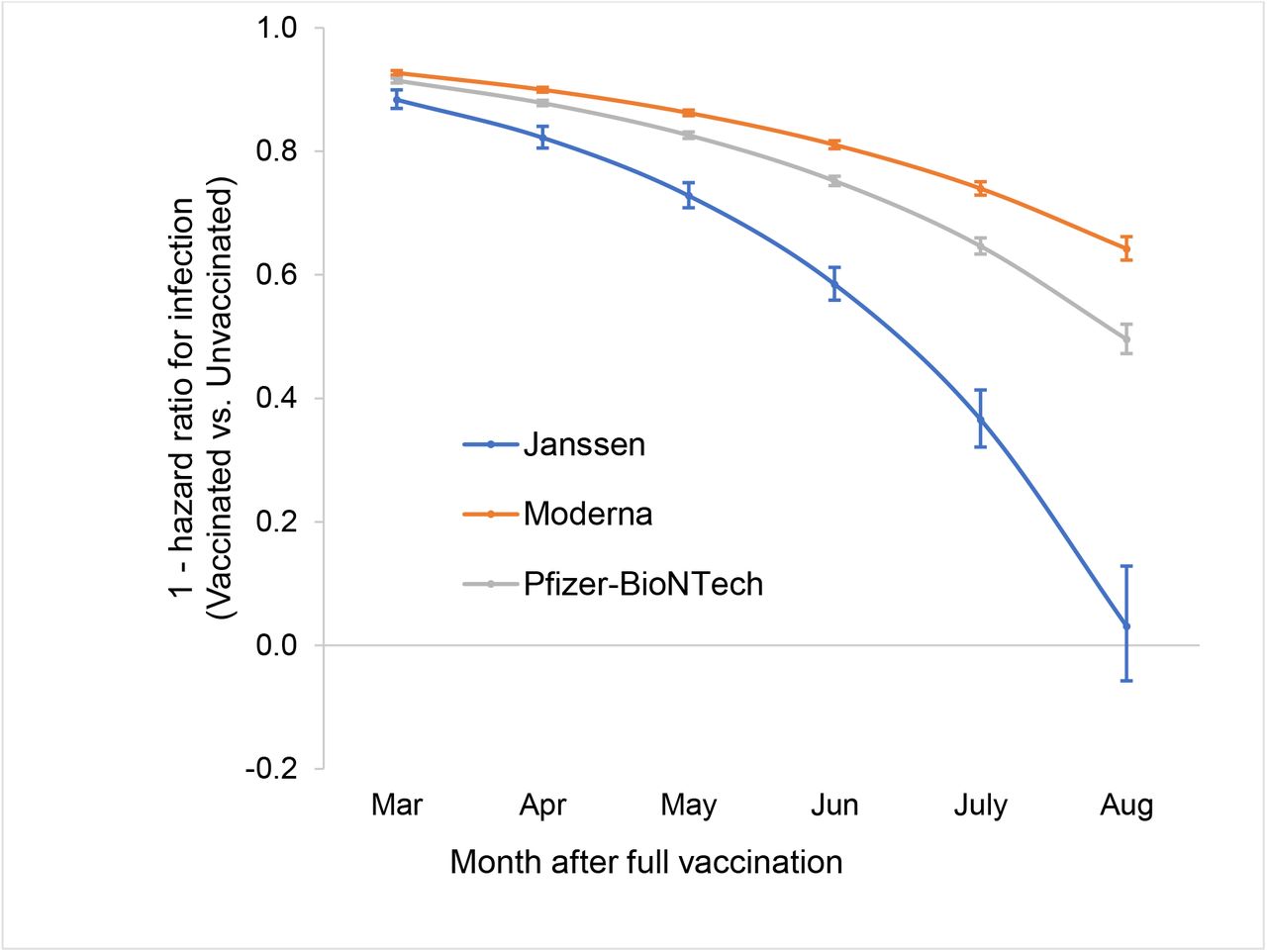
https://www.medrxiv.org/content/10.1101/2021.10.13.21264966v...
Fortunately VE against severe infection holds much better at 77% Pfizer for June-Sept 2021 time period. The clinical trials claimed 94%, so there is a drop there. Nobody knows what will be the VE against sever infection a year from now, and we appear to have decided to preemptively boost so we might never know.
https://www.cdc.gov/mmwr/volumes/70/wr/pdfs/mm7037e2-H.pdf
https://www.pfizer.com/news/press-release/press-release-deta...
-----
Alas, none of this takes in account future virus variants and their interaction with OAS. OAS means that building an immune response against the virus today will prove ineffective for a virus variant 10 years down the line. The worst known scenario was encountered with dengue fever. An excerpt from a 2011 paper summarizing the dengue situation:
"Original antigenic sin has the advantage that a response can be rapidly mobilized from memory. However, the downside is that in some cases, such as dengue, the response is dominated by inferior-quality antibody. In influenza, original antigenic sin has been shown to reduce the effectiveness of vaccination (13, 34, 51). In dengue, the effect of original antigenic sin has considerable bearing on vaccine strategies. Once a response has been established, it is unlikely that repeat boosting will be able to change its scope, meaning that balanced responses against the four virus serotypes will need to be established with the first vaccine dose."
The clinical trials were run against the original version, while the data you presented seems to be overlapping with the spread of Delta, yet you never mention Delta in your comment.
Let's look at the weekly UK vaccine surveillance report, week 36 vs. week 42, afaik both within the UK Delta wave. For VE against severe disease, let's look at 'Deaths within 28 days of first positive COVID-19 test by date of death' tables. Let's pick age group 40-49 (older parents) and compute VE = 1 - vax_ratio / unvax_ratio.
  week 36, VE = 1 - 0.4 / 3.1 = 87%
  week 42, VE = 1 - 0.5 / 2.0 = 75%
FWIW, none of this makes me any happy. I wish the vaccines were holding effectiveness, that we didn't need a booster within 1 year of the initial shots and that the pandemic was over. Alas, reality does not cooperate.
https://assets.publishing.service.gov.uk/government/uploads/...
https://assets.publishing.service.gov.uk/government/uploads/...
> These data should be considered in the context of vaccination status of the population groups shown in the rest of this report. The vaccination status of cases, inpatients and deaths is not the most appropriate method to assess vaccine effectiveness and there is a high risk of misinterpretation. Vaccine effectiveness has been formally estimated from a number of different sources and is described earlier in this report.
In particular, the reduction of death rates among non vaccinated over time may be caused by natural selection, i.e. the weak died already while the remaining ones have unusually strong immune system (aka survivorship bias [2]).
There may be other unaccounted confounders, too, such as a change of behaviour over time where the degree of change is dependent on the age group and/or vaccination status. For example, an apparent reduction of effectiveness for younger people may be caused by them going back to work/study, thus increasing their probability of getting infected, while older folks staying in care homes as before.
Funnily enough, both Simpson's paradox and uncorrected confounders can result in observed correlations that are opposite to the real causality effect.
And to clarify, I'm not saying your VE numbers there are wrong, just warning readers about the dangers of statistics.
OTOH this is not an isolated data point. We have: the booster push (why?), the veteran study, the PHE data. Something doesn't add up. For whatever reasons, the observed epi VE, after all the confouding factors are accounted by reality, is fading for both infection and severe infection, though VE agains severe infection is fading at a slower rate. To the point of J&J VE against infection (the weakest of the bunch) being almost gone in 6 months. I don't have a time machine, but I'm really interested to see how the Jan 2022 VE numbers hold up across the board.
Given OAS concerns (please re-read the dengue study excerpt I already quoted), near zero covid risk for kids, rapidly fading VE against infection and the general lack of long term data about covid & immune system (no time machines), what exactly is the rush to vaccinate kids against the original variant?! And why do we pretend we can just tweak vaccines to any new variant, when, while technologically we can concoct any protein we like, the immune system doesn't turn on a dime?
> Despite the persistent connotation of “sin” as a negative attribute, it is clear that OAS-like responses are neither inherently “good” nor “bad.” The desirability of OAS responses is instead context dependent
It doesn't really seem from that article like we have the means to predict what OAS will be most beneficial in the future, so I think everyone are just flipping a coin here. Either you get OAS from some random vaccine available at some point in time, or you get it from randomly catching some random virus at some point in time.
Yes, we all know that. Follow the scientific literature and you will find updated vaccine assessments soon after a concerning variant is noticed.
> "We have built a process that within 95 days from the day that we identify a variant as a variant of concern, we will be able to have a vaccine tailor-made against this variant," [Pfizer CEO] Bourla said.
That's likely closely guarded IP, so I don't think there is hard evidence for that statement. But the phase I clinical trials for Moderna's [1] and Pfizer's [2] started respectively in February and April 2020, just a few months after covid became a problem. This is IMHO reasonable evidence that 95 days is a plausible lead time.
[1] https://clinicaltrials.gov/ct2/show/NCT04283461
[2] https://clinicaltrials.gov/show/NCT04368728