If I have $10 and you have $10, and then someone prints $10 and gives it to you. You went from having the same purchasing power as me to double mine, without any change to the available goods and services.
> lenders have always had a way out in this situation: investing
Yeah, that's why we're investing in a fairer monetary system, where this power to create money arbitrarily doesn't exist.
My point is that equity: public or private, has always been an alternative everytime lending money isn't worth the while.
Bitcoin brought nothing to the table.
Prices are a function of money supply and velocity. Inflation can rage while no money is printed because velocity surges. Just as deflation can fester while central banks print as velocity toys with absolute zero.
You want a little bit anyway. Simplistically, if all you have in your economy is 10 dollars and 10 hamburgers, then hamburgers will probably be worth something like a dollar each. If you go to 20 hamburgers but stay at 10 dollars, now hamburgers are worth $0.50, which is great for dollar holders, not so great for hamburger makers. A healthy economy, however, is not one in which actors are incentivized to hoard currency. You want economic actors to be incentivized to produce goods and services. If you grow to 20 dollars and 20 hamburgers, that is price neutral, but you don't really want price neutrality. You want it to be more lucrative to produce goods and services than to hoard currency.
There is some valid concern that this can harm retired savers, but we developed a solution to that a long time ago that doesn't require deflationary currencies. We split ownership shares of the companies that produce goods and services and trade them publicly so people can get a cut of the wealth growth without needing to become producers themselves. Retirees can own appreciating assets by buying stock in companies that make stuff, rather than holding their life savings as cash under a mattress.
What are some good examples of this? Historically it seems to me like major inflation issues usually coincide with an expanding money supply, not the other way around
I think the difference is Japan is a a country with all its needs met. People already had enough money to spend on basic needs (unlike post WW1 Germany or Zimbabwe recently) so additional money didn't change that but there was a housing bubble.
[1] https://lazardfreresgestion-tribune.fr/wp-content/uploads/20...
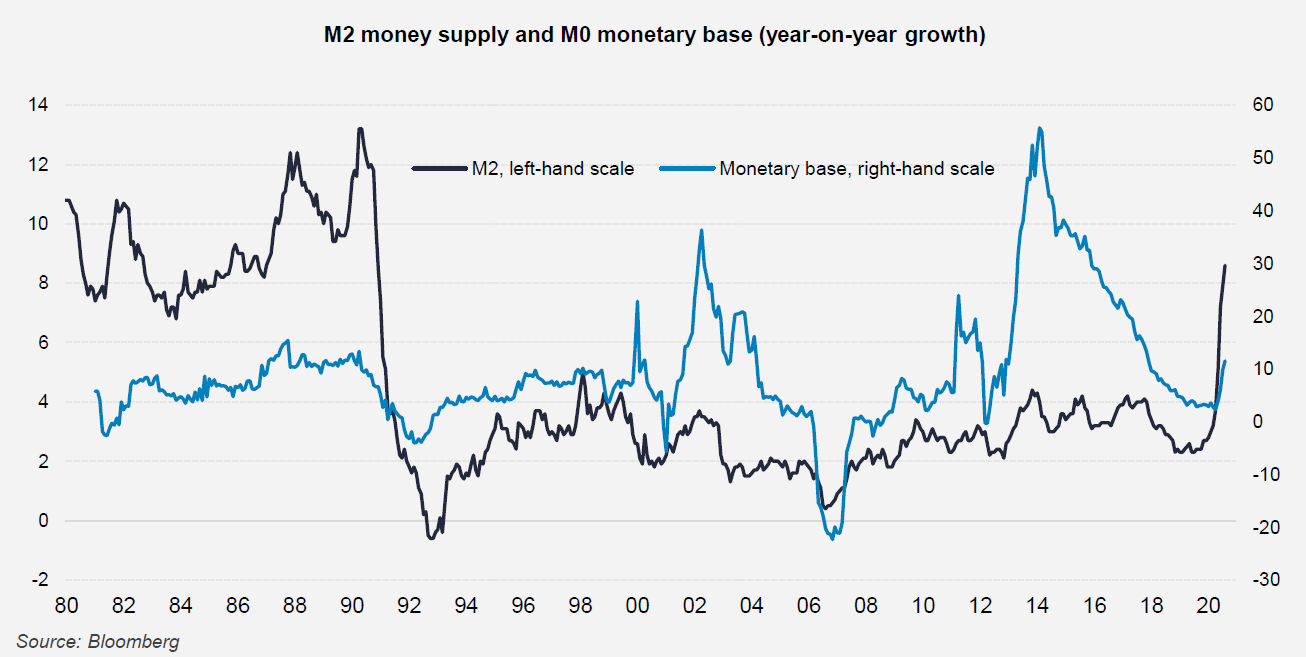
Literally the only way to increase the money supply is increasing the underlying assets' value overall.
It's because people are somehow led into believing that the government can arbitrarily print money, everything that's normal seems like mental gymnastics.
Suppose the government prints one dollar and shortly thereafter everyone goes bankrupt and collapses the money multiplier. This will definitely result in net deflation.
OK, that's extreme, but it should prove a point in extremis. But it is possible that the government could print money and suddenly people stop... paying off their debts, or something. Maybe they start thinking that dollar-denominated-capitalism is pointless because it's all cronies that get it anyways, and just exit the economy. Or like, screwing the poor through inflation triggers some sort of revolution and all the banks selectively are levelled by anarchist activists.
So "printing money" could definitely cause deflation in some scenarios. You probably don't want to be participating in an economy that takes that turn.
Inflation rate higher than the deposit interest rate (negative real interest rate) is causes the wealth transfer.
"Savers", in reality, lenders have always had a way out in this situation: investing.
As in every investment boom, there are Ponzi schemes and during this one it happens to be Bitcoin.