News for hackers. Stuff that matters.
Re:How to seem good at everything: Stop doing stupid shit by arctangent on Thursday August 04, 2011 @08:31PM (#2848430)
The possibility of making game-ending blunders is one of the main reasons I don't play competitive chess any more.

Of course, it's very frustrating to make a "simple" error in a game of chess that might have already taken up a couple of hours of time and which may lose the match for your team, which represents a large geographic region.

But after a lot of reflection it became apparent to me that this kind of frustration is very much an inherent property of the game of chess.

It turns out (once you play enough games and get pretty damn good at it) that it's actually quite a limited and simple game. Once you're down half a pawn or so there aren't many possibilities to generate a counterattack on another part of the board to make it possible to win without relying on your opponent making a subsequent simple mistake.

I did play quite a bit of Go at university and for a while I was confident that I could get good. If I'd stuck at it I would certainly be a low-ranking amateur dan by now but I decided to spend the majority of my spare time learning more about IT.

One reason for my early enthusiasm in the game of Go was because it's such a complex game it's not really clear when a "simple" strategic error has been made. Perhaps more importantly, because both players experience much more difficulty choosing moves than in chess, there's usually a reason to play on when you've made a mistake even when playing a highly competent player.

This has been a long reply. I'm trying to illustrate that the secret to seeming good at everything is to participate in activities which are intrinsically difficult and where your intelligence will have the chance to shine through rather than to participate in activities where one foolish blunder can allow a person of much lesser ability to beat you.

Re:How to seem good at everything: Stop doing stupid shit by dfan on Thursday August 04, 2011 @09:22PM (#2848573)
"It turns out (once you play enough games and get pretty damn good at it) that it's actually quite a limited and simple game. Once you're down half a pawn or so there aren't many possibilities to generate a counterattack on another part of the board to make it possible to win without relying on your opponent making a subsequent simple mistake."

I do not find this to be the case. Even with games involving the top few players in the world (rated 2700+ FIDE) you will often find that players come back from a computer evaluation significantly below -0.50.

Also, you can be at a significant disadvantage and still be able to draw the game. It is really rare that one mistake can decide the game. -0.50 is well within the drawing range.

"One reason for my early enthusiasm in the game of Go was because it's such a complex game it's not really clear when a "simple" strategic error has been made. Perhaps more importantly, because both players experience much more difficulty choosing moves than in chess, there's usually a reason to play on when you've made a mistake even when playing a highly competent player."

On the other hand, chess endgames can often stay up in the air for a really long time, with two or even three results possible. Go endgames (almost by definition) consist of both players grubbing out a point or two here and a point or two there, with all group life and death already decided, so it is rare that the game is decided late.

(If it helps ground any of my assertions, my USCF chess rating is 1870 and my AGA Go rating is 4 kyu. I don't know whether I would certainly be a low-ranking amateur dan by now if I had stuck with it.)

By the way, I note that Josh Infiesto does not appear in the USCF rating list, so either he did all his playing before 1991 when they started keeping computerized records, or his games in which he wiped the floor with 1500-level players were informal non-tournament games.

Re:How to seem good at everything: Stop doing stupid shit by jinfiesto on Thursday August 04, 2011 @09:33PM (#2848604)
dfan, you are correct. I've never played in any formal tournaments. However, I do have lots of friends that do, and many are rated ~ 1500. I know that beating people in informal games isn't really a great measurement of skill, but it's enough to illustrate my point. Additionally, I was born in 1991. I certainly wasn't playing chess before then.

edit For the record, I haven't engaged in any serious study of chess end games. I'm not really qualified to comment on how end games might evolve.

Re:How to seem good at everything: Stop doing stupid shit by dfan on Thursday August 04, 2011 @10:41PM (#2848760)
Well, your main point is certainly right that a large part of playing chess well is simply avoiding blunders; it is surprising how many games even at the 2000+ level are determined because one player blundered, rather than because the other player made any spectacular moves. Of course, those "blunders" get a bit more subtle as you improve. But it is true that the fastest way to improve (below 2000 or so) is to learn how to stop making stupid mistakes rather than learn new tricky moves.
Re:How to seem good at everything: Stop doing stupid shit by jc123 on Saturday August 06, 2011 @04:17AM (#2853391)
The precision of decimal computer evaluations for chess is mildly interesting. It would be much more interesting if the authors depicted and broke down at least some of the major components inherent in their evaluations. Example: points for material, points for king safety, points for pawn structure, points for piece activity, etc. This list could go on and on, but at least some of the major ones could be interesting. Has there been a program that has attempted to do that?
Re:How to seem good at everything: Stop doing stupid shit by arctangent on Thursday August 04, 2011 @10:24PM (#2848720)
I'd argue that if you're able (with perfect play) to force a draw from a position P with fewer pieces on the table then a proper evaluation of the game at position P would be that it's even.
Re:How to seem good at everything: Stop doing stupid shit by dfan on Thursday August 04, 2011 @10:33PM (#2848736)
Oh, absolutely; the proper (omnipotent) evaluation of any position should just be win, draw or loss. But as fallible humans (and computers!) we use terms like your "down half a pawn or so" to denote situations like "White can draw but he's going to have to play pretty well to do it." My point was that the "drawing margin" in chess (how bad a position a player can find himself in and still be able to draw with best play) is surprisingly large, even for grandmasters. Here's a striking example from last year, involving two of the top five players in the world: http://www.chessgames.com/perl/chessgame?gid=1602565
Re:How to seem good at everything: Stop doing stupid shit by jinfiesto on Thursday August 04, 2011 @08:55PM (#2848503)
This is true. Chess punishes you mercilessly for blundering. I've noticed that on the whole, chess games seem to evolve pretty predictably. Obviously this makes it difficult to recover a lost strategic advantage as so much of chess play is really just systematically advancing a position while avoiding blunders.

On another note, I've never really grokked Go. The rules seem so simple I'm never really sure if I'm playing right. Additionally, It's really difficult for me to evaluate a Go board and see who's winning. On the other hand, I've never invested much effort in understanding Go.
Re:How to seem good at everything: Stop doing stupid shit by MikeTaylor on Thursday August 04, 2011 @09:04PM (#2848534)
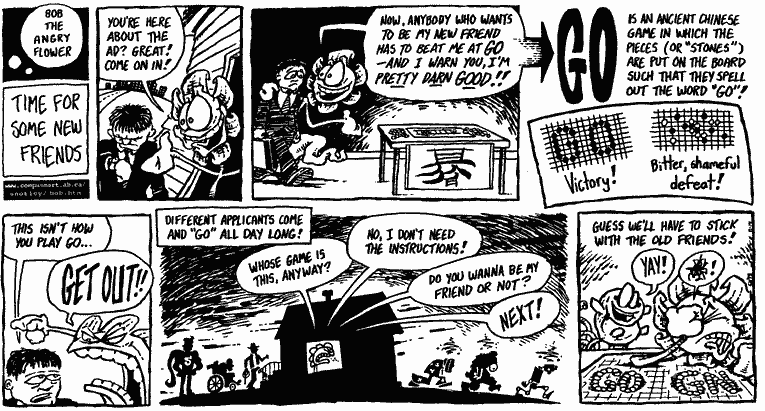
The rules of Go are explained here: http://www.angryflower.com/timefo.gif
Re:How to seem good at everything: Stop doing stupid shit by i5ao on Thursday August 04, 2011 @09:58PM (#2848664)
> The possibility of making game-ending blunders is one of the main reasons I don't play competitive chess any more.

This is the point of TFA... if you want to get really good, stop blundering. Until then you're making excuses. You've chosen other pursuits "rather than to participate in activities where one foolish blunder can allow a person of much lesser ability to beat you."

You've selectively defined ability to not include things you don't think are important-- but they do matter objectively.

Hope this doesn't sound harsh. We all do that.

Re:How to seem good at everything: Stop doing stupid shit by arctangent on Thursday August 04, 2011 @10:18PM (#2848710)
My reply is structured so as to initially acknowledge the main point of the article and then offer an alternative, i.e. choosing different situations/environments where minor mistakes do not have such a large effect. This is a valid strategy for "how to seem good at everything".
Re:How to seem good at everything: Stop doing stupid shit by nandemo on Friday August 05, 2011 @12:39AM (#2848975)
I don't think Go is substantially different from chess in that respect. Sometimes you make a blunder and fail to save a big group in midgame. You lose. At this point a weaker player might keep on playing, hoping that the opponent makes a bigger blunder along the way, but that's considered bad form.