The one unreplicated, not peer-reviewed blog post relied on for this assertion by HN participants who are not formally trained in social science research does not inspire confidence in this conclusion. I have lived in other countries, and I have worked with public school teachers in a country outside the United States.
The TIMSS studies
are the best international dataset on the issue, and no competent professional analyst of the TIMSS data has ever reached that conclusion. A recent analysis of the PISA studies conducted by the OECD
http://www.pisa.oecd.org/pages/0,2987,en_32252351_32235731_1...
is a different international dataset, and its data suggest that the United States is underperforming in mathematics education of the most able mathematics students in the United States.
http://news.ycombinator.com/item?id=2773391
Also, could you define "competent professional analyst"?
Additionally data I've seen puts the US at the 75%ile once you adjust demographically for whites (http://3.bp.blogspot.com/_-EMpadQx4hM/TRKVzaSdWnI/AAAAAAAAAY...). That means the US isn't bad, but it's certainly not stellar. Considering how often I see on the news people saying the US is the best country in the world I'd think we'd rank above Germany, Canada, and Switzerland. And we're not even playing the same sport as Finland.
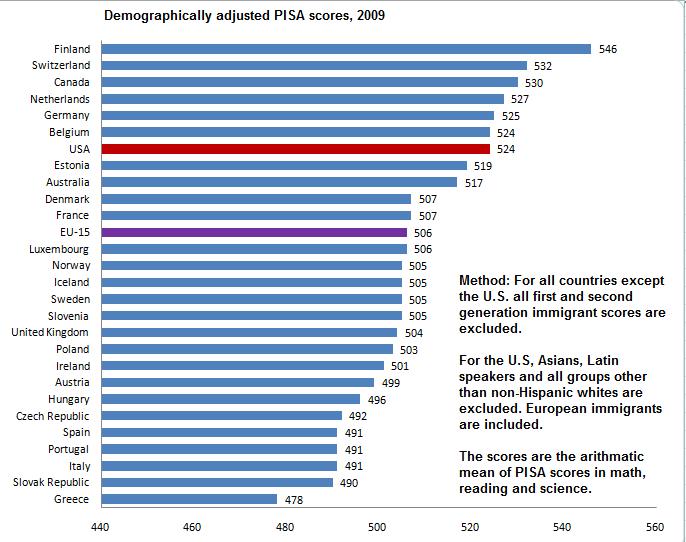
Judging teachers without accounting for the students they happen to teach is rather unfair. But because race and ethnicity are totally essential to understanding this it's unmentionable.
Who doesn't talk about race? Every major conference I've seen on this issue discusses race. After unions, it's probably the single biggest issue discussed among policy makers in ths US.
Rankings make sporting events exciting because they exaggerate small differences. They are less useful when looking at statistics for the same reason.
Maybe the OP was suggesting that the typical discussion of race focuses on the racial achievement gap, while ignoring the performance difference between American immigrants of an individual race and their fellow students in their native countries.
Slide 34 is most relevant. This is a presentation deck used by KIPP, one of the more successful charter schools in NY.
Family background matters a lot in how well students perform, but it doesn't help that low-income minorities tend to get the worst teachers. Teacher quality is more closely associated with educational outcomes than any other school-related factor, including curriculum, budget, and class size.
Just search his posting history with relevant keywords and you'll come up with a lot.
Judging teachers without accounting for the students they happen to teach is rather unfair. But because race and ethnicity are totally essential to understanding this it's unmentionable.