If I were to publish an article that is a word for word copy of another article, with proper attribution, would I not be accused of plagiarism?
I think the lawyers of the NYT may have a different opinion about that.
The fact is, Buzzfeed was able to get away with stealing content from reddit and selling ads on it because no reddit user was ever going to hire a lawyer to sue them over it.
Also, I've certainly seen Buzzfeed content that was taken from Reddit without attribution.
I would even call it stealing content. But plagiarism is about passing someone else's work off as yours.
But also, when you post content to Reddit, you've granted them a (non-exclusive) license to reproduce it as they please. If Reddit's okay with Buzzfeed's reprinting, then I don't think it would legally been seen as stealing either.
In any case, your objection seems to be that plagiarism and repurposing of content (legal or not) fulfills the same evil end: profit from the labor of others. Sure, I'm not necessarily arguing against that. But I'm pointing out there's an additional element to plagiarism, which is the implication of independent, original reporting. To use a screenshot from the investigative article, which shows the Reuters and the Snopes version of a Supreme Court ruling:
https://img.buzzfeed.com/buzzfeed-static/static/2021-08/13/0...
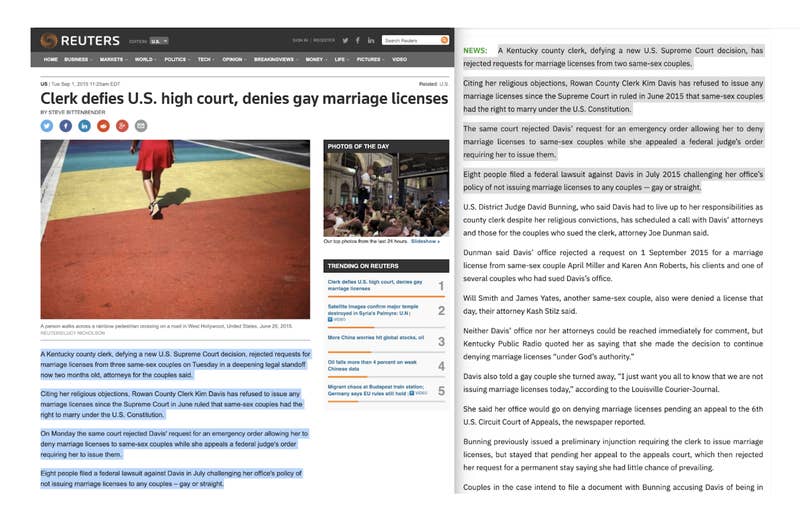
By restating Reuters' assertions without attribution, Snopes implicitly implies that it has done the independent reporting and research (e.g. calling up the attorneys, downloading and reading the court docket). And the apparent "fact" that this Kentucky court clerk is denying licenses based on her religious beliefs becomes significantly more established "fact" when two different journalism outlets have independently confirmed it.
Snopes ostensible speciality is gathering and summarizing established facts, which includes filtering through the noise of fakery and also, redundant information. Committing plagiarism is not just immoral, but a direct attack on Snopes' reason for existence, and that what makes this situation especially notable beyond "Doesn't everyone do growth hacks?"
It's explicitly not stealing content.
The original r/AskReddit thread ("What feels illegal, but isn't?"): https://www.reddit.com/r/AskReddit/comments/aszfh3/what_feel...
The Buzzfeed repurposing of that thread ("19 Things That FEEL Illegal Even Though They Definitely Aren't"): https://www.buzzfeed.com/stephenlaconte/if-you-have-a-guilty...
And a r/mildlyinfuriating thread about Buzzfeed's repurposing ("Buzzfeed blatantly copying their articles from AskReddit threads"): https://www.reddit.com/r/mildlyinfuriating/comments/axb6cw/b...
As the r/mildlyinfuriating discussion points out, the Buzzfeed article is both prefaced with the origin — i.e. "This week, a Reddit thread asked users that very question..." — and a link to that source. And each item (i.e. Reddit comment) is attributed to the Reddit user (e.g. "Walking out of the store without buying anything." —lassissal), and a link back to the user comment. Plagiarism is the act of claiming authorship for someone else's content. Buzzfeed's profit-by-curation may be distasteful, but it's not plagiarism.
In any case, I think the average person understands that Buzzfeed is an aggregator, with a mission to get clicks and to entertain. Stealing content is wrong no matter what, but it isn't a direct contradiction of Buzzfeed's purported core purpose. Snopes' purported core purpose is to "have the real facts", and that purpose is directly undermined by lying about others' work being your own.