Here's a comment I wrote in response to a similar point addressing the topic: https://news.ycombinator.com/item?id=26767280
I don't disagree that programming itself did significantly shift, but it's been perpetually getting easier, not more difficult, to work professionally at.
https://developers.hp.com/sites/default/files/Intl%20Womens%...
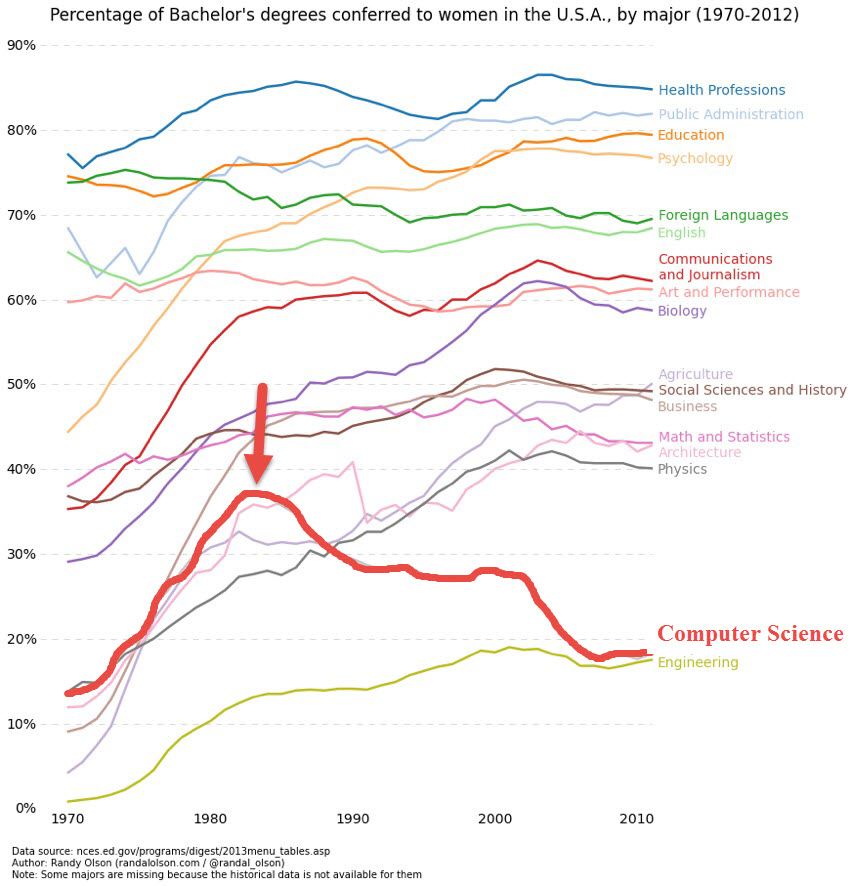
It's not just perception; "Computers" used to refer to employees performing calculations manually for numerical methods. Then "Computer Operators" were secretaries translating assembly instructions written on paper into the correct octal code to punch on cards to feed the machine. They got the instructions from engineers. The teletype made their work obsolete, but you can still see the demographic shift in "Computer Related Occupations" as aggregated on government data.
It’s not even a valid comparison at that point, it’s too different. CS back then was completely different than today or even the recent past. As one example, computational complexity wasn’t even a thing until the 1960s with Hartmanis and Stearns.
There was a lot more time spent on inputting programs and data than today.
For instance, Knuth was seen as an anomaly because he would operate the keypunch as fast as the secretaries and would keypunch his own programs.