Looking at this graph, if annual emissions stay roughly constant (around WW2) then CO2 levels also stay roughly constant, even though cumulative emissions are rising:
https://www.climate.gov/sites/default/files/CO2_emissions_vs...
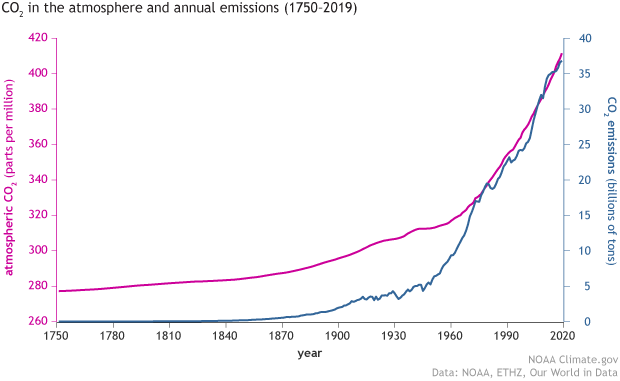
You can argue that at current levels of annual emissions this isn't the case, but then I would like to see some evidence.
I can (sort of) make sense of it the other way around: The rise in atmospheric CO2 is the derivative of emissions per unit of time. This isn't true, but maybe it works as a model. It then follows that the derivative of a constant function (i.e. emissions over time stay constant because growth has stopped naturally) is zero (i.e. there is no rise in concentration). In that case, we simply agree.
This is modulo natural sources and syncs, of course, but CO2's half-life in the atmosphere is long enough that on the immediate timescale those influences can be ignored. We're not going to reach a new steady-state for some time even if emissions remain constant; rather than constant emissions resulting in constant concentration, constant emissions will result in concentration rising at a constant rate on any near-term (< century) timescale.
On the immediate time scale, anything can be ignored. Climate change is not about what's going to happen immediately.
Excess CO2 "officially" has a half-life of around 20 years, but this begs the question as to what "excess" actually means. If an increase in CO2 leads to an increase in plant growth and therefore an increased capacity of further uptake down the road, that excess may now in fact be required to maintain plant growth. Those "excess plants" can't wait for all the other plants to decompose and return to the carbon cycle, because that happens on a much longer timescale.
I don't see that this aspect is accounted for in the IPCC models: https://gmd.copernicus.org/articles/11/1887/2018/