News for hackers. Stuff that matters.
Re:Groundbreaking new bridge design could transform rail cro... by Someone on Monday June 28, 2021 @06:30PM (#27669110)
Using Fibre-Reinforced Polymer for pedestrian bridges isn’t new, is it?

A few minutes of googling gives me https://www.fibercore-europe.com/en/projects/, which has dozens of FRP bridges. I doubt that’s the only producer in the world. I don’t see what’s special about this one (but feel free to educate me)

That leaves the shape. I would guess the corners in the road are there to avoid having to use land that isn’t owned by the railway. If so, what’s left is the specific design. That’s nice, but other nice designs are possible.

Now, as to the idea of making a pedestrian bridge over a railway: it’s better than no pedestrian connection, but the stairs on such bridges necessarily are fairly high. Train tracks often lie above ground level, and even if they don’t, the total height to the top of the overhead line, plus some safety, plus the height of the bridge’s deck means you’re easily going two floors up and down.

Re:Groundbreaking new bridge design could transform rail cro... by stuaxo on Monday June 28, 2021 @06:46PM (#27669276)
In the UK pretty much all stations have bridges, so this will mainly be about being able to put them in place much more quickly when you are making changes to a station, or putting a new bridge in somewhere (i.e. there may not be one that's inside the ticket barriers on some smaller stations).
Re:Groundbreaking new bridge design could transform rail cro... by notahacker on Monday June 28, 2021 @06:53PM (#27669343)
Looks more like a design for footpaths in open countryside or between housing estates. Stations have a lot more to build around and on even if existing bridges need replacing
Re:Groundbreaking new bridge design could transform rail cro... by teamonkey on Monday June 28, 2021 @07:22PM (#27669626)
If you travel by train in the UK you'll soon realise how many stations are in fact in open countryside or between housing estates
Re:Groundbreaking new bridge design could transform rail cro... by gsnedders on Monday June 28, 2021 @07:37PM (#27669747)
No, these are very much for rural applications, hence why they don't need to include any provision for ramps or lifts (which most new crossings must), given the paths they connect are themselves typically at best a mud track (and often just a scarcely marked crossing of grazing land).
Re:Groundbreaking new bridge design could transform rail cro... by chrisseaton on Monday June 28, 2021 @07:52PM (#27669855)
Nobody here understands this lol. They either haven’t been to the UK or haven’t been outside London.
Re:Groundbreaking new bridge design could transform rail cro... by gsnedders on Monday June 28, 2021 @08:01PM (#27669905)
Eh, unless you spend much time walking in parts of the UK anywhere near a train line, it's not too hard to be totally unaware of such bridges (or even just footpath level crossings).
Re:Groundbreaking new bridge design could transform rail cro... by kersplody on Monday June 28, 2021 @08:15PM (#27670012)
Also very few level crossings due to a live 3rd rail on many lines. Crossing tracks safely and legally can be a many mile detour.
Re:Groundbreaking new bridge design could transform rail cro... by blibble on Monday June 28, 2021 @08:33PM (#27670174)
only a relatively small percentage of the UK network is electrified using a third rail (it is essentially a deprecated technology)

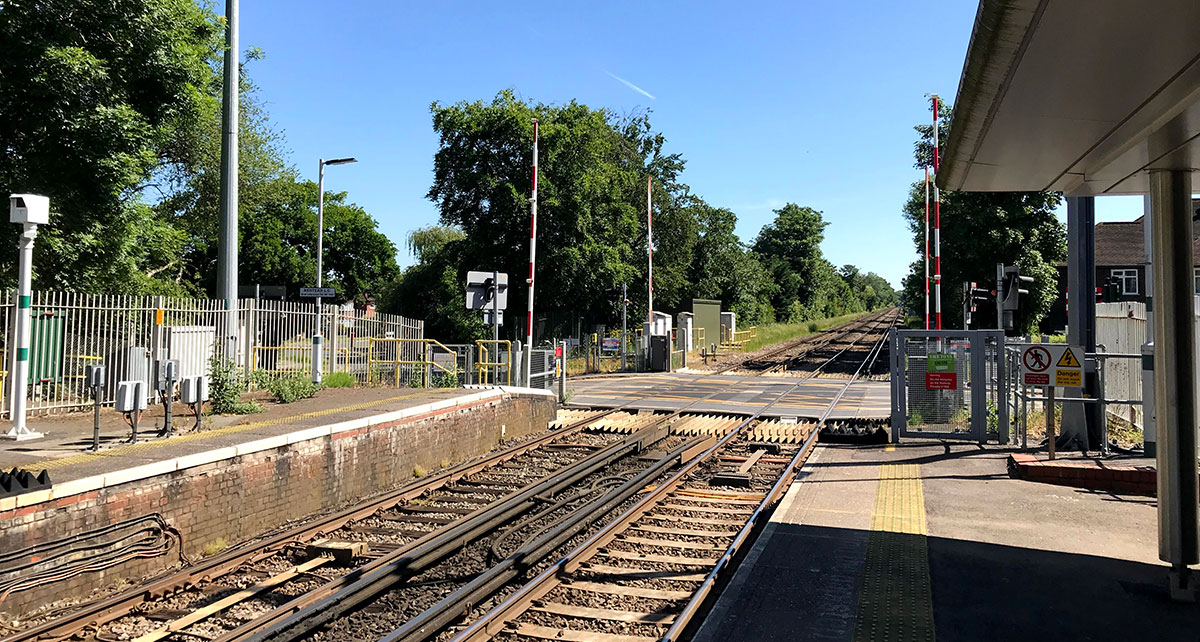
regardless, level crossings work perfectly well: they simply have a gap in the electrified rail over the crossing (and the train is longer than the gap)

if you look closely here you can see it: https://www.networkrail.co.uk/wp-content/uploads/2020/07/Ash...
Re:Groundbreaking new bridge design could transform rail cro... by chrisseaton on Monday June 28, 2021 @07:21PM (#27669617)
I think these are for footpaths not stations.
Re:Groundbreaking new bridge design could transform rail cro... by pmyteh on Tuesday June 29, 2021 @03:16AM (#27672829)
It's not new (not even new in rail applications).

One of the key drivers for cheaper and easier footbridges is to close level crossings. In the UK we have tons of crossings - footpath, private road, and highway - dating back to Victorian times, and Network Rail would like them gone. They're one of the biggest remaining sources of injuries and deaths on the network, especially on 125mph fast lines, and are operationally awkward.

They got rid of a bunch of private farm crossings during our Foot and Mouth Disease outbreak by going door to door with desperate farmers and offering wedges of cash to give up their private crossings. They care a lot.

Re:Groundbreaking new bridge design could transform rail cro... by Glawen on Tuesday June 29, 2021 @02:10AM (#27672422)
It is new and groundbreaking once it is discovered/used by the UK, never mind that the stuff is used in continental Europe for decades.
Re:Groundbreaking new bridge design could transform rail cro... by rualca on Tuesday June 29, 2021 @08:12AM (#27674731)
I don't feel like the downvotes are justified. Composite structures using FRP is hardly new or novel.

A quick search on Google Scholar showed up this article on FRP footbridges, which mentions that the first FRP footbridge in the Netherlands was constructed in 1995.

https://www.sciencedirect.com/science/article/pii/S209580991...