Thermodynamic efficiencies mean that you need to have 2-3x less primary energy to get the same amount of final energy when your primary energy is already electric generation.
The UK went from 2% to 42% electrical generation from renewable sources (not including nuclear) and almost half of that increase happened between 2015 and 2020. That's only electricity, of course, but a good chunk of transportation is going to come off of fossil fuels in the next 10 years as well.
Most likely transitions will take a logistic curve, slow ramp-up, followed by a fast phase, followed by a slowing as the hardest problems are tackled.
https://www.e-education.psu.edu/earth104/sites/www.e-educati...
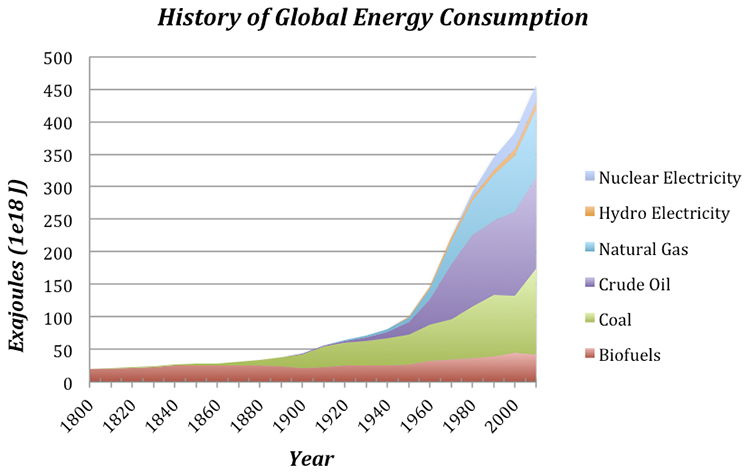
It will take a long time because it will take a long time! So don’t even try!
No - it is entirely up to humans to decide how long it takes.
Energy generation is a huge industry. Emphasis on industry. And no wishful thinking from some climate-justice-hardliners will change that. There are literally the lives of billions of human beings depending on the availability of useful energy. Engineering and hard science has brought us to the point of cheap, renewable energy. Now we have to build up that capacity, but that takes time.
Your statement reads like a Maoist decree, putting ideological wants over practical realities. You read like you wish for hard, radical measures (that, of course, will only hurt the "class enemy") while you cannot be bothered with the details of how a solar panel or a wind turbine even works, let alone how it is produced and installed at scale.
So let me put that straight for you: It is not entirely up to humans to decide how long decarbonization takes. This is NOT some capitalist conspiracy. Building factories takes time and there is a limit of how many PV factories and offshore wind plants we can build today. Especially, when you want to do it in some environmentally friendly manner. We can of course accelerate the buildup for the next decade, and I would bet money on the fact that we already do exactly that.
The 200-300GW of capacity should translate to 200-600TWh/year of generated energy. That's a 5-10% growth of yearly generated renewable energy. If we can keep it at 5% yoy, it will take 112 years to replace that total energy consumption. At 10% it would take about 60 years.
I don't think it would be smart to bet on a linear-only growth. If course, a 100+ year exponential growth might be too optimistic. But I think we did not see the end of the hocky stick so far.
We also need to consider that we're talking about a global infrastructure project, so timescales of centuries are to be expected. Whoever thinks we could replace our global energy consumption completely within a couple of decades needs to reconsider.