Not holding inventory is great for a lot of reasons, but it is a calculated risk...Toyota learned from experience that if they want to do it, they need to understand risk all the way up their supply chain. They largely aren't having this problem. They de-risked certain things because they really treat TPS and everything associated with it as a philosophy not a set of heuristics that should just be implemented blindly. Manufacturing something is all tradeoffs...there is (almost) nothing with a universal upside. Sure I want to hold less inventory, but JIT is actually about manufacturing time, not inventory. If I have NO inventory and NO ability to get inventory my manufacturing time goes up while I wait with my thumb in the fertilizer pipe.
I've worked with a couple of manufacturing plants (and consultants...) that treat 'JIT' inventory management as something that can simply be pushed off to vendors and then the upside of less inventory enjoyed. They have specs and forms and certification and paperwork...but nobody looks at it. Those are the companies struggling now. They outsourced without fully understanding the risk of the outsourcing. Usually this doesn't bite the world, it bites one or two companies that relied on a certain part (someone misses an EOL notice) or a certain vendor (who goes bust because the owner's grandson ran the thing into the ground). It's like my students who make choices in the first week of the semester that seem minor...and then are frustrated when it effects their grade at the end of the semester (sorry, too much grading this week)
[0] https://www.autoblog.com/2021/03/09/toyota-how-it-avoided-se...
Wouldn't toyota model essentially set a required buffer size in kanban, essentially ensuring a certain level of stock decided upon by risk management?
The pull flow would then ensure that the stock fluctuates around that value instead of being driven to 0, because taking a "card" out of stock might trigger purchasing of more stock?
The question isn't how stock is tracked or risked, its who is responsible for it.
For example this report from March 2020 was highly influential and predicted 2.2 million deaths in the US in an 'unmitigated epidemic' scenario:
https://www.imperial.ac.uk/media/imperial-college/medicine/s...
When in reality the official COVID death count in the USA was 580,000. And meanwhile the best public health response seems to have been... to do nothing, given that Sweden has a lower COVID death toll per capita than countries which did lockdown and use masks, and is overall merely #27 in the world for COVID deaths per capita:
https://www.statista.com/statistics/1104709/coronavirus-deat...
With deaths there in 2020 being only 6% higher than 2018 (and deaths in 2019 were 4% lower than 2018, suggesting mortality displacement explains much of that increase):
https://www.statista.com/statistics/525353/sweden-number-of-...
These sort of mega-flus come and go once a decade (look at 2009 Swine Flu, 1993 Flu, 1988 Flu, 1976 Flu, the Asian flus of the 50s and 60s - all basically forgotten):
https://swprs.org/wp-content/uploads/2020/10/sweden-monthly-...
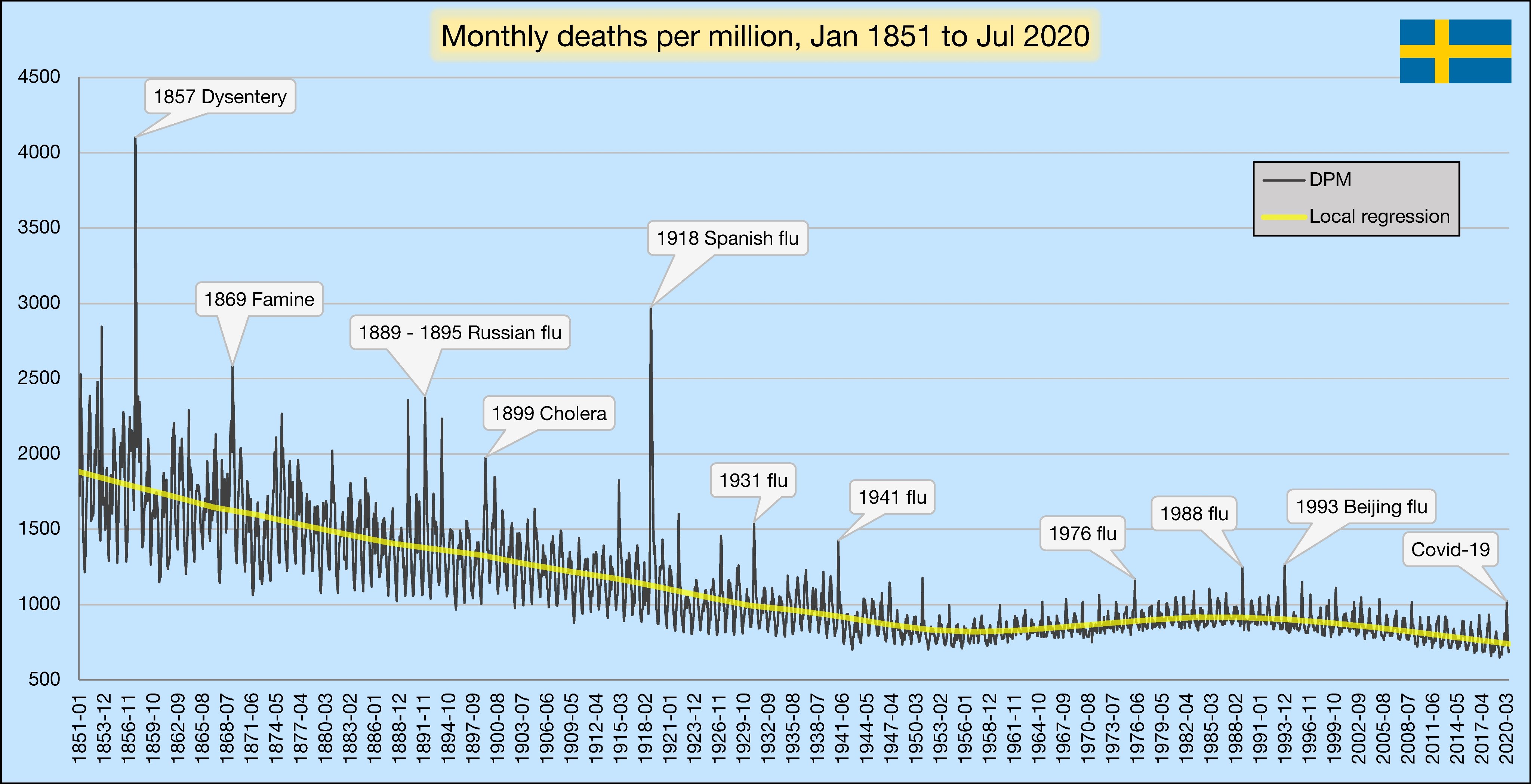
But there were political factors in 2020 (a major re-election year in the USA) which drove the completely unusual and unjustified lockdown response. Its unfair to blame JIT manufacturing.
You just said yourself that the 2.2 million was the "do nothing" scenario, and as we've seen in India it could've easily been that. You also just said said we did many things — "unusual and unjustified" things, in your opinion — therefore mitigating that worst-case projection. I personally lost the point you were trying in these self-contradictions, but I am curious where you were going.
For that we need to look at all the data. People have done that. The predictions were always completely wrong in every case. Here's an article that examines the track record of that group at ICL:
https://www.aier.org/article/imperial-college-predicted-cata...
Re: "do nothing". Both ICL and a separate Swedish team applied the Ferguson model to Sweden and got a prediction of around 90,000 COVID deaths. True total: 98,000 deaths of all causes in total, and that was after 2019 was the year with the lowest mortality on record. Age adjusted, Swedish excess mortality matches that in 2012.
That's one famous example but again, all-data analysis shows the same thing. Lockdowns don't seem to affect the course of the disease:
https://thelancet.com/journals/eclinm/article/PIIS2589-5370(...
Epidemiology has developed a culture of bad science, presenting unvalidated models as indisputable fact and worst of all, pathological lying. Ferguson was recently caught doing it again:
https://www.telegraph.co.uk/news/2021/05/04/uks-covid-reopen...
As pandemic revisionism goes, it was really quite extraordinary. Asked on BBC Radio Four’s Today Programme about the latest data showing Britain is enjoying an eight-month low in coronavirus deaths and infections, Professor Neil Ferguson said on Tuesday: “The data is very encouraging, and very much in line with what we expected.” As it was on the radio it was impossible to tell whether this was said with a straight face, but we must assume it was ...
... Prof Ferguson’s team [had] warned: “A return to higher transmissibility levels after non-pharmaceutical interventions are lifted will also lead to a third wave of hospitalisations comparable in magnitude to the current wave” and called for mask wearing and hand hygiene to continue after full lifting. Under the February modelling which informed the roadmap, hospitalisations should be starting to tick up around now, but there is no evidence of that happening, with cases down 11 per cent in the past week ...
... The team warned there was no way out of a devastating third wave, with modellers arguing that even the slowest release in August would result in “substantial additional deaths” of around 56,900 by June 2022 ... One of the main errors in much of the modelling seems to have arisen from a misjudgement of how much schools would impact the reproduction number
The predictions of epidemiologists, not just Ferguson, were wrong by orders of magnitude and wrong in a way that has caused global supply chain disruptions. We should care more about the effects they had on restricting access to healthcare, because those actually killed people rather than just disrupting electronics supplies. But this story is about the latter. That's why it is wrong to vote down someone speaking the truth about the root cause: exceptionally bad science and our societies apparent inability to detect it or reckon with it.
I'm very interested to understand what part did the US 2020 election played in the (still continuing in some parts) lockdowns in Europe...
This guy is like Nostradamus compared to the people at NASA doing project life estimates for the rovers.
This one is obviously caused by setting "bare minimum" to "actual expected average time".
Mission exceeding minimum plan is much better that very expensive hardware failing before supposed end of mission.
Companies hate holding on to inventory. Most companies now don’t hold on to any extra stock needed to manufacture their products.
This is great for your finances in normal times. But don’t complain when there is a shortage and you literally have zero slack for delays and your factory sits idle — that’s the well-known drawback.