I tested different sites in 2018, but it's harder to see the performance impact of an extension, because variability between tests is larger for more complex pages. https://www.debugbear.com/blog/measuring-the-performance-imp...
Generally the site you're on doesn't matter. Ad blockers are different, since they have a positive impact on sites with ads. Some extensions are site-specific, e.g. Wikiwand. I'm also mentioning Avira as a special case. If I tested each extension on the top 1000 sites I could identify more examples, but don't think it's worth the effort/cost.
> The assumption one might make is that these extensions stack up but I could imagine there could be non-linear effects combining extensions (unless there’s prior research indicating it is linear in all or almost all cases?).
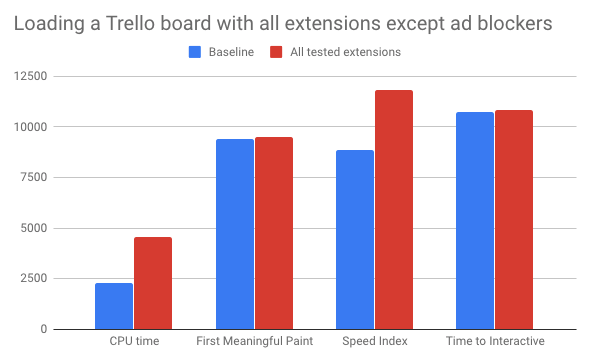
Yeah, if you different extensions add more JavaScript bundles the performance impact just adds up. I've not looked at this in depth, but the 2018 post takes a quick look at combining multiple extensions. https://www.debugbear.com/public/blog/chrome-extension-perfo...
> The Avira Browser Safety extension contains a website allowlist with 30k+ regular expressions. When the user navigates to a new page Avira checks if the page URL is in that allowlist.
Though I think the author might not have the time to run this on more sites, and what's "representative" anyway? Every user visits different sites.
That would let you understand the impact of these extensions on different website types.
Another issue with the methodology is the lack of any combination of extensions, although they may not have the data to build the experiment for that. The assumption one might make is that these extensions stack up but I could imagine there could be non-linear effects combining extensions (unless there’s prior research indicating it is linear in all or almost all cases?).
Overall though it’s an impressive undertaking. Kudos to the author.