Why?
Do the math on weight, and you'll quickly see that you can't fit enough batteries in a Semi to give them the range that they need for long haul, while still being able to carry any appreciable amount of goods (There's a 40T limit on the roads in Europe, YMMV).
Together with Green Kerosine for Airplanes, and you've got Carbon-neutral transport: Electric Cars, Hydrogen Trucks and Trains, and (Green) Kerosine Airplanes.
There is a small amount of very long range trucking where there 'might' be a competition. However, I believe even that will quickly go electric.
So, even current generation trucks could do 80% of trucking. From there year by year they will be able to do more of the jobs. Hydrogen will lose against Diesel until BEV trucks will be good enough. In 5 years nobody will question if BEV trucks can do everything.
A properly engineered electric Semi is not actually that much heavier then a Diesel truck.
Toyota Mirai 2 curb weight 1925 kg vs Tesla P100 curb weight 2241 kg. Both have the range of 500 to 507 km. But with a Mirai, given that the infra for filling up would exist, I’d spend 5 minutes filling up instead of 40 at a charging station. My math is okay.
> more wind turbines everywhere (that people already hate)
Yeah, I have dozens of those around. But you know what, more battery cars also need those so it’s not like we will be removing these soon.
On most weeks, an EV owner spends zero hours on fuel ups since they plug in at home. They will also save significantly on power since it's much cheaper to distribute power to your home than to drive hydrogen all over the countryside.
I'll put it a bit differently though. Setting aside environmental concerns, why would you buy a hydrogen car as opposed to a regular old gasoline car?
Charging from home is a substantial benefit of EVs, performance is another. The Mirai is neither a particularly performant car, nor can you charge from home. Why would you switch to a car with a non-existent fuel network? Even once the network exists, why switch?
Obviously, the environmental issues still exist, but right now that is the only reason you'd buy the Mirai instead of many less expensive non H2 options. The Tesla is interesting even without the environmental aspects.
No I don't. I abhor getting into the car and realizing I need to stop at the gas station before I can drive to the trail head and ride with my friends. The idea of having a car that is ready to perform at maximum every time I step out the front door has a tremendous appeal. I hate gas stations, they stink, they are a waste of my time, often when I don't have time to spare.
Maybe you want to replicate that experience. I'll pass.
If it really bothers you, then you probably be able to refuel your fuel cell car at home at some point in the future. So you can avoid the refueling station altogether with fuel cell cars too.
I have a pretty good handle on my driving. Its been over a year since I've driven more than 300 miles in a day. Even when I was driving 500 miles 20 times a year, that's still only 20 Supercharger stops versus easily twice as many stops for gas that I've made during those same years.
> If it really bothers you, then you probably be able to refuel your fuel cell car at home at some point in the future.
I won't have to bother, by the time those are affordable and efficient enough to make sense, batteries will be a fraction of their current weight. So there will still be no point in some arbitrary extra steps cutting into efficiency.
Fuel cells of the future will also be superior to fuel cells of today. That likely includes a dramatic increase in efficiency that will great reduce or eliminate this issue.
*Edit: also, compare the price.
Mirai 2 will cost €63900. Basic Model S is €81200+ (even 10% tariffs are not getting it close) and P100d is what, €130k+? Nuts.
https://global.toyota/pages/news/images/2020/12/09/1200/005....
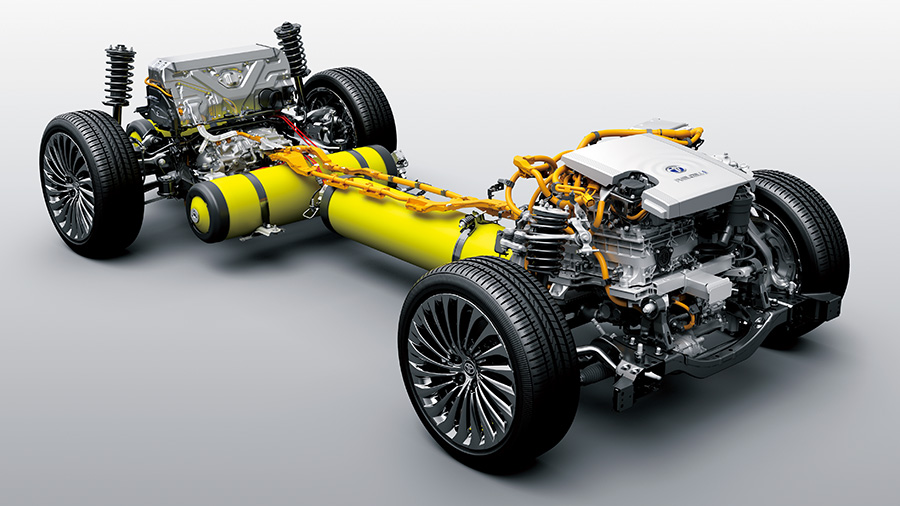
compared to:
https://468y981o84o43v2wo2600a0gcj-wpengine.netdna-ssl.com/w...

And one of these cars is incredibly fast, the other is a not a performance car. I can't find good data on Mirai 2 but I think the S is a considerably bigger car.
At least in comparison between the Mirai and the Model 3, the Model 3 is lighter.
Of course, the reality is that batteries are getting lighter fast.
> Yeah, I have dozens of those around. But you know what, more battery cars also need those so it’s not like we will be removing these soon.
Again, the simply fact is fuel cells are considerably less efficient. Therefore you need more of them.
https://img.drivemag.net/media/default/0001/96/Battery-elect...
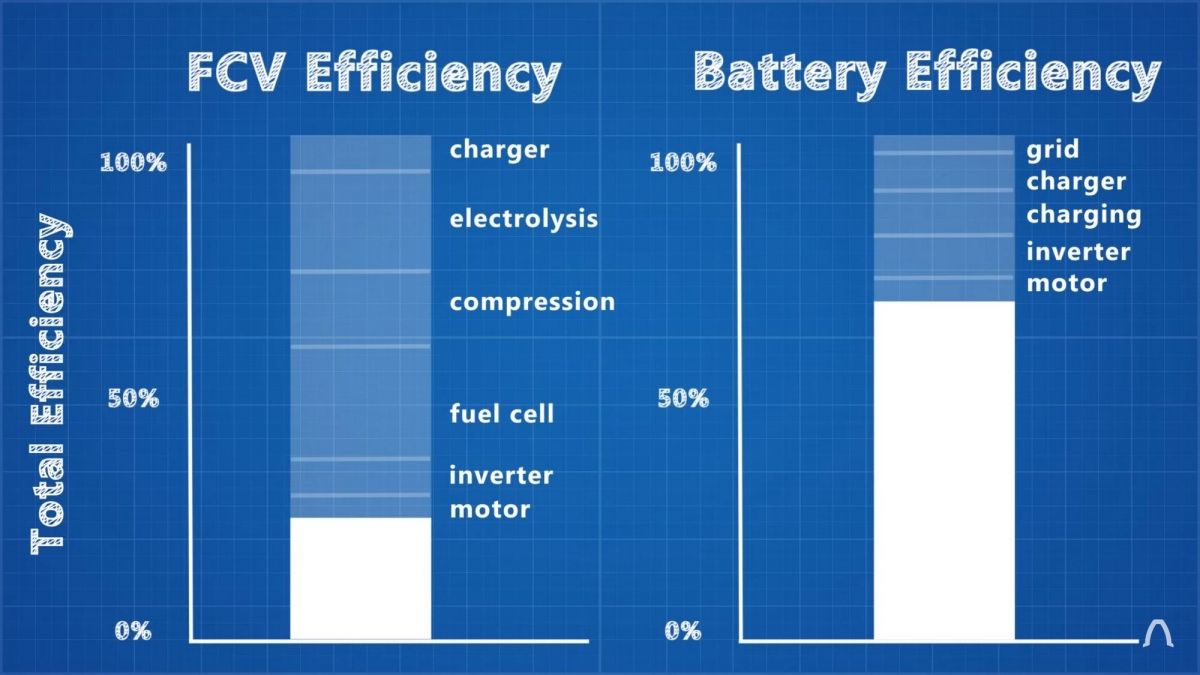
A fuel cell cad is likely to eventually cost the same as a Toyota Corolla while also allowing for gasoline-like refueling time and range.
Finally, there's no reason for a fuel cell to be similar as efficient as a battery powered car. As I said, it's technically a type of battery. If your going to talk about batteries of the future, you also have to talk about fuel cells of the future.
Look at this simple design, I'm sure they can't wait until they can finally mass produce it, so easy: https://global.toyota/pages/news/images/2020/12/09/1200/005....
And every car maker disagrees with you that it doesn't cost much.
Maybe in some future it can be built as cheap as you say, but not now. So you would really have to compare it to some future EV as well.
Fuel cell have been studied for 60 years, and their efficiency is still not good. Li-Ion has made far more progress in far less time and is still improving significantly year over year. Nobody has announced anything close to that in terms of improvement for fuel cells.
And even if there were such announcements, there is still a long way to go for fuel cells to catch up to current battery tech.
As if battery powered cars have no pumps, filters and tubes... And a tank is literally just a tank, with no complexity inside it. It allows you reduce the amount of batteries you need to carry by nearly 2 orders of magnitude. This is a significant reduction in cost and complexity.
> Look at this simple design, I'm sure they can't wait until they can finally mass produce it, so easy: https://global.toyota/pages/news/images/2020/12/09/1200/005....
You see a battery in the back, 3 hydrogen tanks, and the fuel cell stack in front. This is in fact quite simple.
> And every car maker disagrees with you that it doesn't cost much.
Most car makers have never even bothered to look seriously at fuel cell cars. The only companies that did think they can make one for the same cost as a Corolla. That should tell you something.
> Maybe in some future it can be built as cheap as you say, but not now. So you would really have to compare it to some future EV as well.
> Fuel cell have been studied for 60 years, and their efficiency is still not good. Li-Ion has made far more progress in far less time and is still improving significantly year over year. Nobody has announced anything close to that in terms of improvement for fuel cells.
> And even if there were such announcements, there is still a long way to go for fuel cells to catch up to current battery tech.
The problem is that you're just stuck in the past. Fuel cells have advanced to the point where they are a disruptive threat to battery electric cars. The notion that batteries have some massive lead is a claim completely at odds with reality. You're going to see cheap, long-ranged fuel cell cars in the coming few years. Due to advances in hydrogen related technology, batteries will lose every single advantage they enjoy, including the ability to refuel at home and cost per mile of driving. That is a big problem that battery powered cars will face.
You need the fuel cell itself, and that is not just some thin layer, but a whole complex subsystem that requires all kind of system around it. Then you need a very heavy high pressure tank and a high pressure fuel system. Looking at H2 cars and the amount of parts these system adds is illuminating.
Next up, you can make a battery completely structural, meaning the battery actually serves the function that the steel frame used to serve in a car. Integrated like that, the battery weight is almost negative.
Battery technology is improving fast, with both cost going down and energy and power density going up year over year. H2 cars can not compete in the current environment and there are no projection that they ever can.
Pretty much everybody has now given up on H2 cars ever being remotely viable. Some people are still holding on to the hope for H2 in trucking, but some large truck companies have already dropped it, and with Tesla Semi going into mass production, people will realize that H2 trucking has no future as they have realized it with cars.
You also seem to ignore all the negatives of H2. Fuel station that are about 100-1000x more expensive per station, and you need more of them. You can't charge over night at home with energy that is largely already available. Even if EU government funded H2 is successful, that would still not be enough for all of transportation, not even close.
The majority of hydrogen for the foreseeable future will by methane based and when the grid will already be almost totally carbon free, much of hydrogen on the planet will still not be carbon free.
And if you are talking 'in 10 years' you need to also look forward to what batteries will be like in 10 years. In 10 years its possible that we could have lithium sulphur batteries. Such batteries would be incredibly cheap and have crazy high energy density. Battery that cost a few 100$ and fits in a glove box could give multiple 100 miles to a small car. That is just one possible battery tech that might be viable in 10 years.
Last, let me address your point about mining. While of course the extra subsystems for H2 also need materials, a much bigger issue you have ignored. A FCEV is inherently significantly less efficient, this means that even if you are producing all the H2 with solar and win, the total amount of solar and wind required would mean you would need a significant amount more solar and wind. Guess what that requires, significantly more mining, more solar panels covering more nature, more wind turbines everywhere (that people already hate).
I really don't understand people love for these hydrogen fuel cell vehicles.