Edge Enhancement is pretty much what you are talking about with audio.
The way I applied it to audio, was to treat the spectral analyzer output as an image. Where the weird artifacts showed up most was when the overtones weren't precisely edited the same way. It was especially obvious in stereo, where weird glitches were really obvious hard-left or hard-right because of differences in the smoothing. Even if you couldn't identify what happened, it would catch your attention one side or the other. And it took away a lot of the "alive-ness" which I described as making guitar sound more synthy.
Here's the type of image I was working with: http://www.music-software-reviews.com/image-files/adobe_audi...
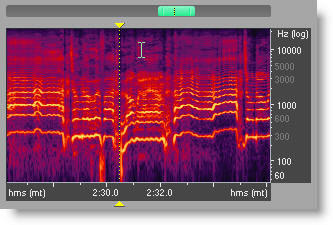
This was back in the latter 90's / early Y2K, so there might be significantly better methods available for keeping it consistent now.
Where I get this from, is many moons ago I experimented with turning audio into a very wide image. Visually it looks rather like a frequency analyzer. It was easy to shift pitches around, but the digitization left artifacts at the wrong (unexpected) pitches which changed the sound of vowels quite considerably.
Before I figured out why that is (and that alone was an amazingly interesting lightbulb over my head), I tried smoothing them out so those artifacts wouldn't be so odd. What I ended up with instead was something akin to talking through cotton, and guitar lines totally didn't sound like guitar anymore - more like a synth, which I thought sounded cool, but was effectively a failed experiment.
I don't want to discourage you from doing this using math, and I'd love to see your progress in it, but my prediction is that you'll find something similar occurs.
Having said that, I later discovered this device that I think contains the secret to making my experiments actually succeed: https://www.behringer.com/product.html?modelCode=P0CD0 because it literally compensates for the problems inherent to what my smoothing experiments were doing.
PS: I actually got the idea from an old television set I used to have that had a function that supposedly made it look higher definition. But even that showed some interesting artifacts (blur) if you looked at it up really close. But in motion, the videos indeed looked higher def, which is why I tried it on sound.