You find the right line and I'm right behind you, buddy.
I've been an addict and dude you sound like an addict
Smoked pot for a while in my twenties and it was crazy how I immediately became aware how much of my daily life was just stuff I was doing on autopilot.
When I haven't smoked pot in a while I sort of lose that awareness of it, and the autopilot just blends into the noise of everyday life.
It's a little scary when you think about how unaware we normally are of it.
Every single second is a struggle over the who gets control of the hardware, and most of the time the host wins.
What "I" want and what the primitive host brain/OS wants are 2 completely different things. Food, shelter, reproduction. That's all it needs. Needless to say, "I" want so much more.
Of course, what everyone else sees as "me" is the body/machine. We are one in the eyes of other people, but that couldn't be further from the truth.
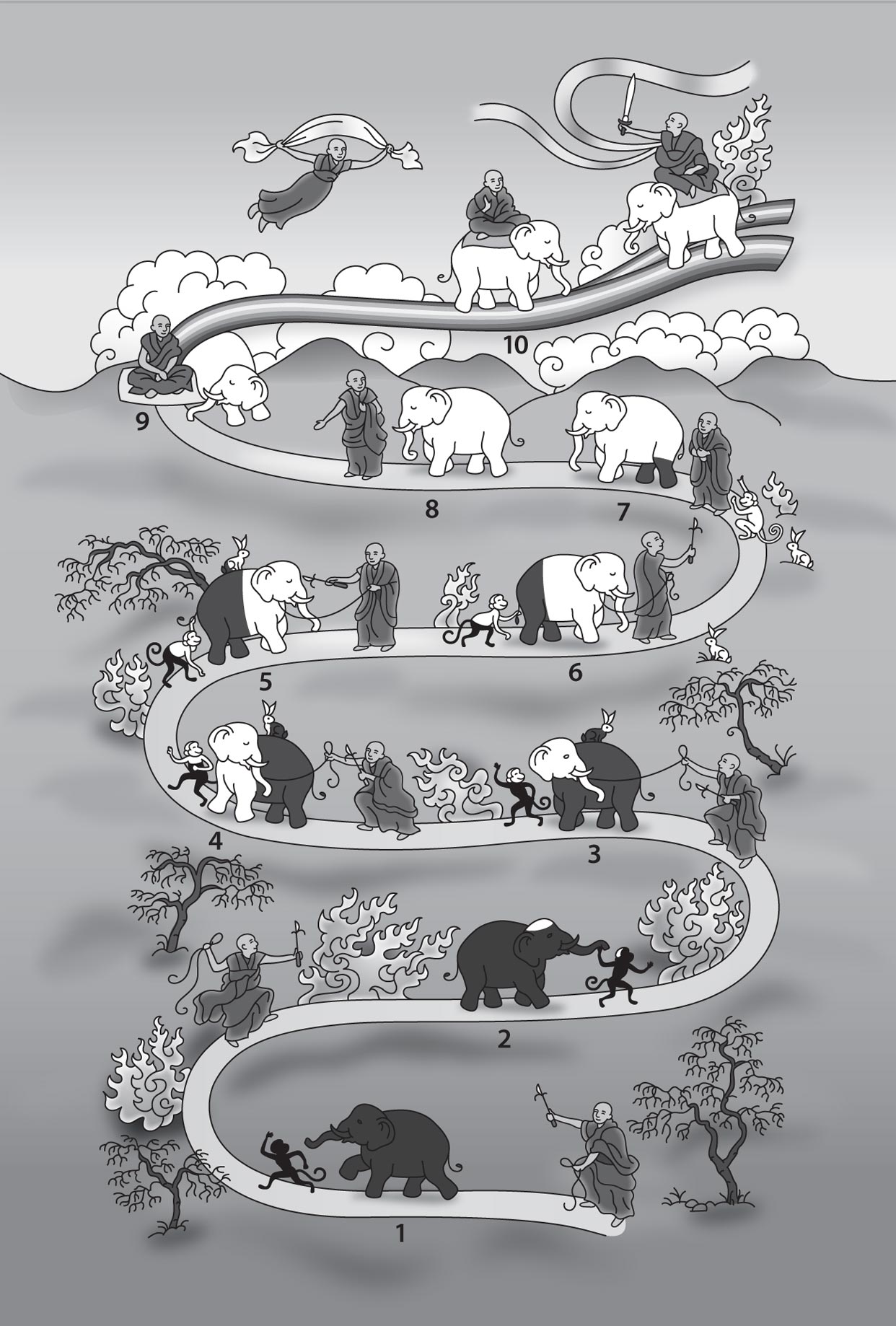
One commenter on HN once wrote, that meditation helps him more than the stimulants. The ten stages of meditation (https://www.consciouslifestylemag.com/wp-content/uploads/201...) depicts the mind as an elephant too. It gets distracted by the ape mind (look! shiny!) in the beginning. If you want to start meditation, get the book that has been recommended here before: Mind Illuminated by John Yates
Misquoted from the Hitchhiker's Guide to the Galaxy
If you're lucky that's a common state of mind. But for people like me who have severe cases of inattentive ADHD, it's a once-in-a-blue-moon state of flow. Off medication my life is a perpetual hot mess, in large part because my self-image of who I am is not reflected in how I act, moment to distracted moment.
Adderall (or Vyvanse in my case) gets me a 0.95 batting average. Every moment of every day I'm on-task, energized, and achieving what I want to achieve. It makes the person I am, moment to moment, reflect the person I want to be.
Most people get prescribed Adderall because of failings at work or school. People come to think of ADHD as an unable-to-work-hard personality failure. But really it's a my-life-is-a-hot-mess-and-I'm-struggling-to-stay-afloat condition that you just can't escape. Adderall is a magical drug that makes this failing go away, leaving us on top of things and feeling normal.
How do you recover when you get distracted in the middle of work and can't get right back to it?
How do you even do the planning itself when that task is just one of the ten or so that your brain thinks should be done right now?
Even after exercising, I feel good but I still can barely concentrate on anything, I have to always bring my attention back "manually", for lack of a better word.
I put the tasks into a text file.
I run a python script that keeps track of which task I should be working on, displays it to me, and shifts from one task to the next every two minutes with audio cues for 30-minute sprints.
So, I work on the email for 2 minutes, then I hear 'SWITCH TASKS' in my headphones and I read like two paragraphs of the paper and I hear 'SWITCH TASKS' and I spend two minutes on the code, then I hear 'SWITCH TASKS' and it's back to the email. It cycles through the task list in 2-minute bursts.
I know it sounds insane and incredibly inefficient, but it's the only way I can keep my brain on track. I have to keep it moving at a million miles per second. When my brain is racing as fast as it can to keep up it seems to be happy and my aggregate productivity goes up (even with the inefficiencies at a micro-scale).
Sometimes I'm lucky and I get through a few 30-minute sprints my brain will fixate on one of the tasks and I can do just that for the next two hours uninterrupted, but that's not something I expect every day. It's nice when it happens.
My brain wants to be doing ten things, so I just feed it ten things and keep cycling though them in 2-minute intervals so it doesn't have a chance to get bored with any one thing.
This is how I stay off of meds.
When I do manage, it’s a mix of things going on.
It helps to follow genetic advice like exercising, staying hydrated, sleeping enough, and not drinking too much. It’s generic advice because it’s pretty universally applicable.
Separating tasks into “must do” vs “want to do” helps keep things from falling through the cracks and makes it easier to prioritize.
I try to be mindful of when I am giving myself leisure time vs demanding performance, and reminding myself (preferably aloud) which mode I am in if I find myself distracted. Speaking of speaking aloud, vocalizing my internal monologue (aka “talking to myself”) helps me debug it, sort of like rubber ducking. I like to declare my goals for the day out loud to myself in my room, and it’s easier to get through hard times and make tough decisions when I talk to myself. I also feel like it improves my memory, though I haven’t measured to confirm.
It helps to work on my relationships with success and failure, and with meaningness. Some days will be failures. Most successes will be modest. Evaluating your self-worth on a day-to-day basis is like day-trading on the stock market, very risky and not the best growth strategy for most people. Warren Buffet’s investing advice is remarkably applicable to life in general.
Being in nature is incredibly healing. I love camping with friends/family, but any outdoor activity is good.
I’m incredibly optimistic about the potential of therapy involving psychedelics and I am a monthly donor to MAPS. Some people may benefit from pursuing similar treatment modalities on their own, though there are inherent risks and of course there is no silver bullet for mental health treatment.
I was diagnosed with inattentive-type ADHD, and while I definitely felt the “high” from Adderall (and was convinced I was more productive) it was hard to say I actually was. I did find it easier to stay up later than I should; but that loan always comes with interest, the drugs just give you a bigger line of credit. Ditto other stimulants.
The only stimulant I still use is caffeine, and I would like to use that one less. For non-chemical coping, I find day-before and morning-of planning to help immensely with my ADHD symptoms. I do wish I had gotten non-medication help sooner in life, but even in my late twenties, still better late than never.