I think it is unfortunate that many people are vilifying natural gas. It's almost as if they aren't aware that the main benefit of natural gas plants is that you can turn them off when needed. Grids have to become more flexible if they want a high percentage of renewable energy. It's not like natural gas is cheaper than renewables. The plants will only burn gas when necessary.
What is happening right now is that "Base load" (aka coal plants) is clogging up the electric grid in Germany. On some days you have a really good amount of renewables but the coal keeps running because it can't adjust quickly enough.
When you consider that thanks to the EEG surcharge the operators of renewable power plants still get paid despite producing no power you can see how this lead to the unreasonably high electricity prices in Germany.
This is not a problem with renewables though. The EEG is one of the most poorly though out political instruments to encourage renewables. Basically almost every energy intensive business gets an exemption so all the costs are borne by consumers. A carbon tax would have none of these issues. The coal plants would be shut down because they are bad for business.
But even without that, nuclear, wind and solar combined with lots of batteries (stationary and in all the cars) seems like a totally achievable solution. Especially in Europe and America where you have lots of varied geography and can get hydro, solar, thermal and wind to supplement each other, see example the plans for Denmark (wind), Norway (hydro), UK (nuclear).
source: https://en.wikipedia.org/wiki/Electricity_sector_in_Denmark#...
Also, RE Bio & waste emit CO2 - they are not particularily clean.
source: https://onlinelibrary.wiley.com/doi/pdf/10.1111/j.1757-1707....
I'm not sure what you mean by 'base-load problem', but what I mean is that you need a fossil-fuel base-load.
Basically saying this is wrong.
Technically, base-load refers to the minimum amount of energy demand on a given day. All sources and studies I have are from Germany, but our parliament, their adjacent (technical) offices and the universities here have concluded that "base-load" as a concept is wrong with today's power generation and the way a power grid works. Today they usually talk about residual-load, turning the paradigm around. Regardless of how it works, there are also renewable energies which can fulfil this classical "base-load" idea: Namely organic gas or geothermal power plants.
Why is Germany investing billions in NEW pipeline projects to ship natural gas from Russia for the next few decades? Germany says a lot of nice sweet-nothings, but their actions don't match their words.
Your statement says nothing about the feasibility, just politics.
Of course this is so ambitious that it might never get built but I can definitively tell you that a crane system like this would be barely economical [1] because weights are really expensive but it's a good attempt and can be refined further.
And finally here is an example of a scam concept: [2]
Digging shafts is unaffordable unless you reuse old mine shafts which would reduce the number of shafts in the picture to just a single one. If you can only have one weight per generator that means the system doesn't scale. The power density of lifting a 1000 ton rock 100m high is pathetic. It's just 270kWh. The cost of the concrete is negligible in this scenario but you won't find a generator that is cheap enough to compete with a conventional battery.
However, to stay realistic. Gravity batteries are about as likely to happen as everyone suddenly switching to nuclear power. The odds aren't great.
[0] http://www.eduard-heindl.de/energy-storage/energy-storage-sy...
[1] https://insights.globalspec.com/images/assets/784/10784/Ener...
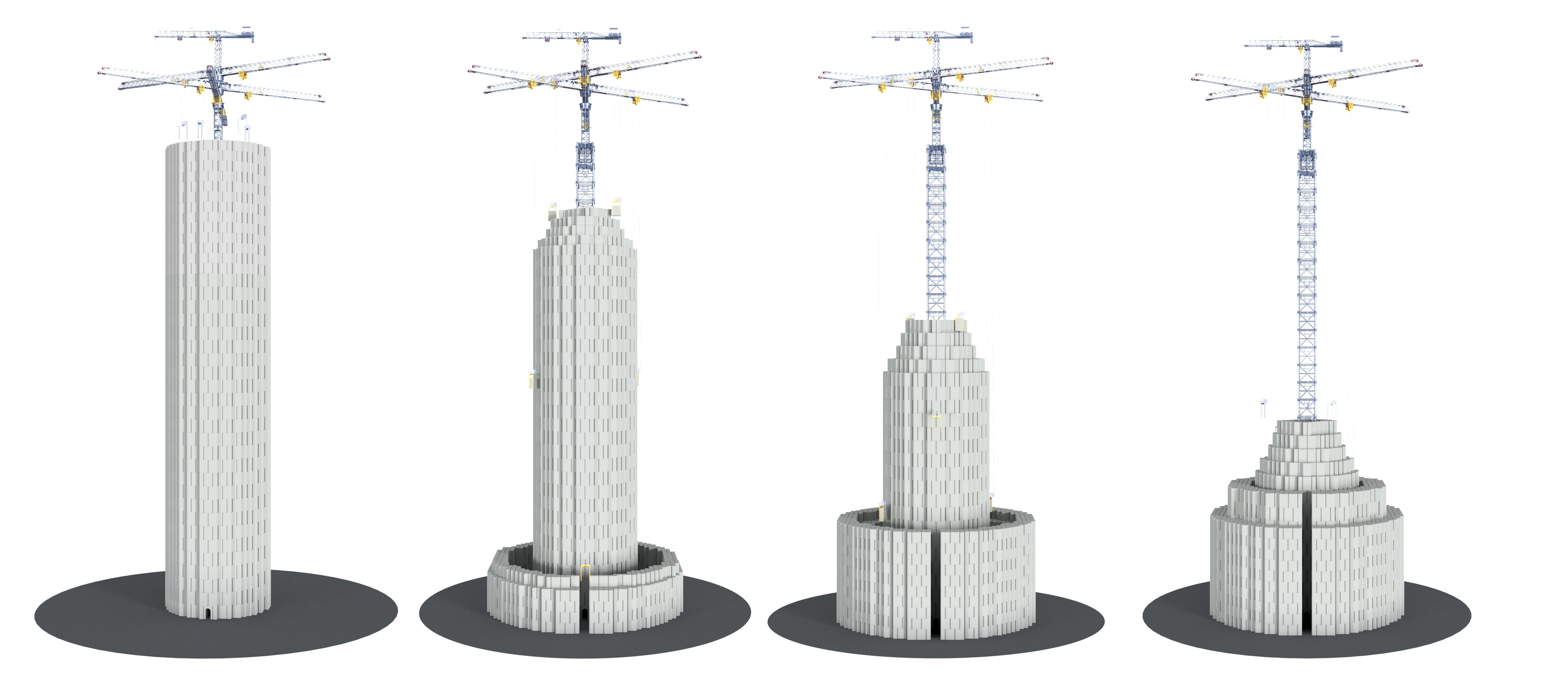
[2] https://offgridquest.com/images/banners/gravitybattery.png

Total US electricity generated by nuclear power plants was about 807 TWh (~92GW), but just in 2010 the world used 41 354 TWh generated by coal. That's a factor of 50. The US has about 95 commercial plants. So to replace just coal we'd need about 4750 new power stations.
Basically at this point everything that's not fossil based is great. Build all of them. More wind, solar, storage, nuclear, geo, etc.
https://www.iea.org/reports/world-energy-outlook-2019/electr...
Renewable generators only need to displace the electrical output of combustion based power plants, not the greater thermal energy contained in source fuels. A highly electrified, renewables-dominated world would consume less primary energy at the same level of energy service consumption. There's a lot less energy going toward production of useless waste heat when renewable electricity displaces fossil combustion electricity.
The average American coal plant turns only 37.4% of coal's thermal energy into electrical energy:
https://processbarron.com/u-s-coal-power-plant-efficiency-st...
In 2019 the United States lost 2/3 of all primary energy as waste heat:
https://flowcharts.llnl.gov/content/assets/images/charts/Ene...

(I used the number from this wiki page: https://en.wikipedia.org/wiki/World_energy_consumption#Fossi... )
What storage? The reality is that there is no storage solution that is capable of storing enough energy to power even a modestly sized city for days or even hours (or minutes for that matter). Certain approaches, like gravity-based storage, also require particular geography.
Did you notice that there is no region on earth that gets 100% of their power from solar/wind/storage? Why is that? Why is Germany signing multi-decade, mulit-billion-dollar deals to build pipelines to ship Russian gas for decades still? And any region that claims 100% fossil-fuel free power ALWAYS relies on hydro, nuclear or geothermal to achieve that level. Why is that?
That no location is currently 100% renewable is an obviously irrelevant point. I m talking about 100% CO2-free solutions. And new nuclear not sunk costed existing power plants.
> All the components of that exist and are proven.
All the components for solar roadways and hyperloop exist and are proven, doesn't mean either of those are viable.
For three straightforward reasons:
(1) Wind and (especially) solar have only recently become cheap enough for this case to be made. Utility scale solar fell in cost by a factor of 5 in just the last decade,
(2) The point I made was for an apples-to-apples comparison in which all the capital costs are considered. But in this transition time the renewables are competing against existing capacity, in which the capital costs are sunk,
(3) Fossil fuel sources are not being charged for their CO2 emissions. The point I made was for a CO2-free grid, which requires that fossil fuel sources not be allowed to emit CO2. Nowhere have CO2 taxes or regulations yet put us into this situation.
Today, there are very few, if any, places in the world where it would make economic sense to build a new nuclear power plant.
> All the components for solar roadways and hyperloop exist and are proven, doesn't mean either of those are viable.
Electrolyzers exist, and are being made and sold in rapidly increasing numbers. Hydrogen valves, compressors, turbines, pipelines, and underground storage caverns exist. This is integration of existing technologies, some with track records going back more than a century. The comparison you make there is silly in the extreme. It would be more appropriate if applied to the current hype about thorium and Hail Mary Reactors.
There's a fourth reason ... it isn't viable.
And for all the talk about how the technology is ready and proven, you can't even point me to a real-world deployment, existing or planned, that will provide storage at any sort of scale to replace natural gas as wind/solar backup.
Actions speak louder than words. Take Germany for example, why aren't they redirecting the billions they are spending on NEW natural gas pipelines to ship Russian gas for decades, on your 'proven' and 'ready' battery storage technology?
Your last question there has the answer "because the cost of CO2 in Europe is not high enough yet." Hydrogen doesn't make sense until natural gas is quite expensive, but even then a renewable system with hydrogen will be cheaper than a CO2-free system with fully costed nuclear.
Are you employed by the nuclear industry, by any chance? If so, if you aren't too old, run do not walk to another career.
To what?!? If your geography does not allow for large scale hydro or geothermal development, then your only alternative is Nuclear or Fossil Fuels. Solar and wind need base load provided by Fossil Fuels to be remotely viable and clearly are not capable of replacing fossil fuels.