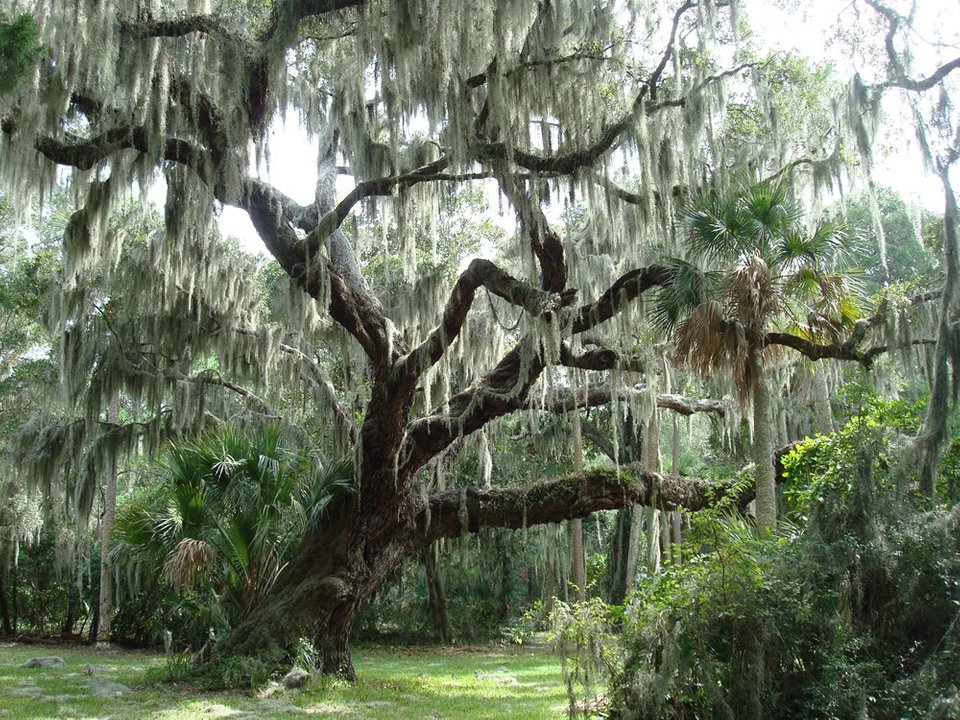
As for your pictures:
https://explorebeaufortsc.com/wp-content/uploads/2019/04/spa...
https://upload.wikimedia.org/wikipedia/commons/thumb/5/51/Ph...

https://www.gatlinburgtnguide.com/wp-content/uploads/2016/09...

https://natureconservancy-h.assetsadobe.com/is/image/content...

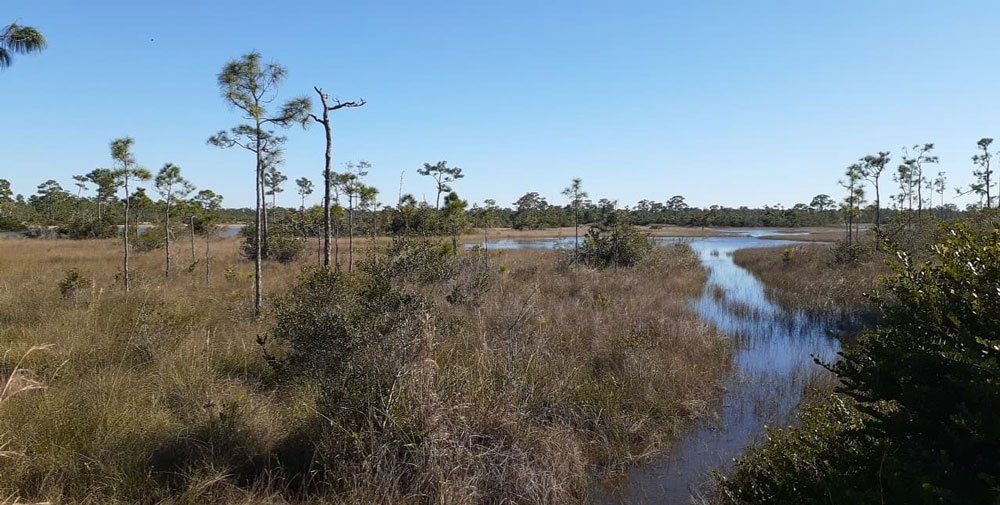
All in the Southeast.
https://imagineourflorida.org/wp-content/uploads/2020/03/Ima...
https://natureconservancy-h.assetsadobe.com/is/image/content...

https://www.nps.gov/common/uploads/grid_builder/cong/crop16_...

https://ashevilletrails.com/wp-content/uploads/2018/02/sams-...

With that said, as a Floridian I was happy to see palm trees again when I moved to the Bay Area. It's nice there.
It's my understanding that California has more spiky plants than broadleafs due to the dry-summer climate. Most of the Southeast is broadleaf because it's very wet year-round. Plants with small leaves reveal more about their structure from a distance while broadleaf forests form a green blanket. So the biodiversity in California might be a little more visible. Southwest Florida has a semi-xeric climate as well but with dry and warm winters, similar to southern Mexico, and various species of cacti can be found.
I often hear that the southeastern U.S. has some of the highest biodiversity of anywhere on earth, but as someone who grew up there, I'm not sure that it's really that apparent, at least visually. The vegetation all the way from Atlanta up to Maine tends to look like this (https://static.rootsrated.com/image/upload/s--nsRlDT5Y--/t_r...). If you dropped me in the woods in any state along the east coast, I wouldn't be able to identify which state I was in. Perhaps there is diversity in the number of species, but the trees and plants themselves don't look that different from each other. I moved to the west coast two years ago, and at least in appearances, it seems like there is more biodiversity (https://2.bp.blogspot.com/-Od2CTO9JsJw/Wq7QDGEtQ6I/AAAAAAAAD...). Does anyone know what might explain the discrepancy? Just north of SF, there are redwood trees and cypress trees, which look strikingly different from each other.
Also, for those of you that grew up on the west coast, I'm curious what was your subjective impression of the vegetation in the southeast the first time you visited?