News for hackers. Stuff that matters.
Re:FlexBuffers by rurban on Saturday June 20, 2020 @10:36PM (#23589282)
Kenton, so what are the main difference to your Cap'n Proto?

My guess are that Flatbuffers are more flexible and slower to read. And 5 years to late to the party.

Re:FlexBuffers by kentonv on Saturday June 20, 2020 @11:04PM (#23589402)
FlatBuffers has been around almost as long as Cap'n Proto. I wrote this comparison back in 2014, but it may be outdated now: https://capnproto.org/news/2014-06-17-capnproto-flatbuffers-...

This HN article, though, is about FlexBuffers. FlexBuffers appears to be based on FlatBuffers, but does not use schemas. Cap'n Proto, FlatBuffers, and Protobuf are all schema-driven (you must define your message types in a special language upfront). FlexBuffers is more like JSON in that all types are dynamic.

Personally I'm a strong believer that schemas are highly desirable, but some people argue that schema-less serializations let you get stuff done faster. I think it's very analogous to the argument between type-safe languages vs. dynamically-typed languages. Obviously there are a lot of smart people on both sides of these arguments.

Re:FlexBuffers by mzaks on Sunday June 21, 2020 @12:00AM (#23589638)
One use case where schema-less is the way to go, when you provide the infrastructure, but have no „ownership“ of data it will be used for. E.g. you build a logging or analytics tool where customers can send arbitrary data. Or a document database as a matter of fact. There schema-less / self described data is a must.
Re:FlexBuffers by kentonv on Sunday June 21, 2020 @12:26AM (#23589750)
Not necessarily. For logging/analytics, you could have customers upload their schema when configuring the service. I would think that doing so would allow for some powerful optimization opportunities, enabling your service to save quite a bit of CPU and maybe some bandwidth, too. It would probably also allow you to provide a better user experience, like making it easier to construct dashboards and such because you actually know how the data is structured.

For a document database, I don't agree at all. Some time back I spent more time than I'd like developing on Mongo, and boy did I wish I could actually tell it the schema of documents in each collection and have it enforce that (not to mention optimize based on it). A lot of developers actually use libraries on top of Mongo to define and enforce schemas.

Re:FlexBuffers by jd_mongodb on Sunday June 21, 2020 @08:39AM (#23591699)
You can apply a Schema to your collection and have MongoDB enforce it . This has been in MongoDB since version 3.6. We support the JSON schema standard. https://docs.mongodb.com/manual/core/schema-validation/
Re:FlexBuffers by kentonv on Sunday June 21, 2020 @10:12AM (#23592118)
Cool! My time using Mongo was pre-3.6 so I didn't know about this.
Re:FlexBuffers by mzaks on Sunday June 21, 2020 @02:48AM (#23590350)
True, I guess it all boils down to ease of use (convenience). You can build a system which accepts schema + data and build dash boards and data relevant relevant processing + optimisations, but that results in a much more complex system with higher entry burden. Sadly convenient systems always get broader adoption.
Re:FlexBuffers by kentonv on Sunday June 21, 2020 @10:14AM (#23592133)
Yeah, I see this as pretty similar to the debate over type-safe vs. dynamic languages. It used to be that people argued that dynamic languages were just way easier to use, and type-safe languages were just an optimization. But I think the real issue was that the tooling enabled by type-safe languages didn't exist yet. These days, TypeScript is no faster than JavaScript but is very popular, because of the tooling it enables, like editors with auto-complete and jump-to-definition.

I think protocols still don't have the level of tooling that makes it really obvious why schemas are better.

Re:FlexBuffers by lrem on Sunday June 21, 2020 @02:53AM (#23590366)
I own a service where users simply upload their schemas along their data. Doesn't seem to be a major issue.
Re:FlexBuffers by hackcasual on Sunday June 21, 2020 @12:08AM (#23589673)
Flatbuffers can support some writeable updates and it's language support is pretty comprehensive.

> Personally I'm a strong believer that schemas are highly desirable

I'm currently working on a project that's very executable size sensitive, and having a fixed schema is crucial to that, as can optimize a lot more aggressively. We can even use dead code feedback to identify schema parts that aren't consumed on the client
Re:FlexBuffers by senderista on Sunday June 21, 2020 @03:03PM (#23594434)
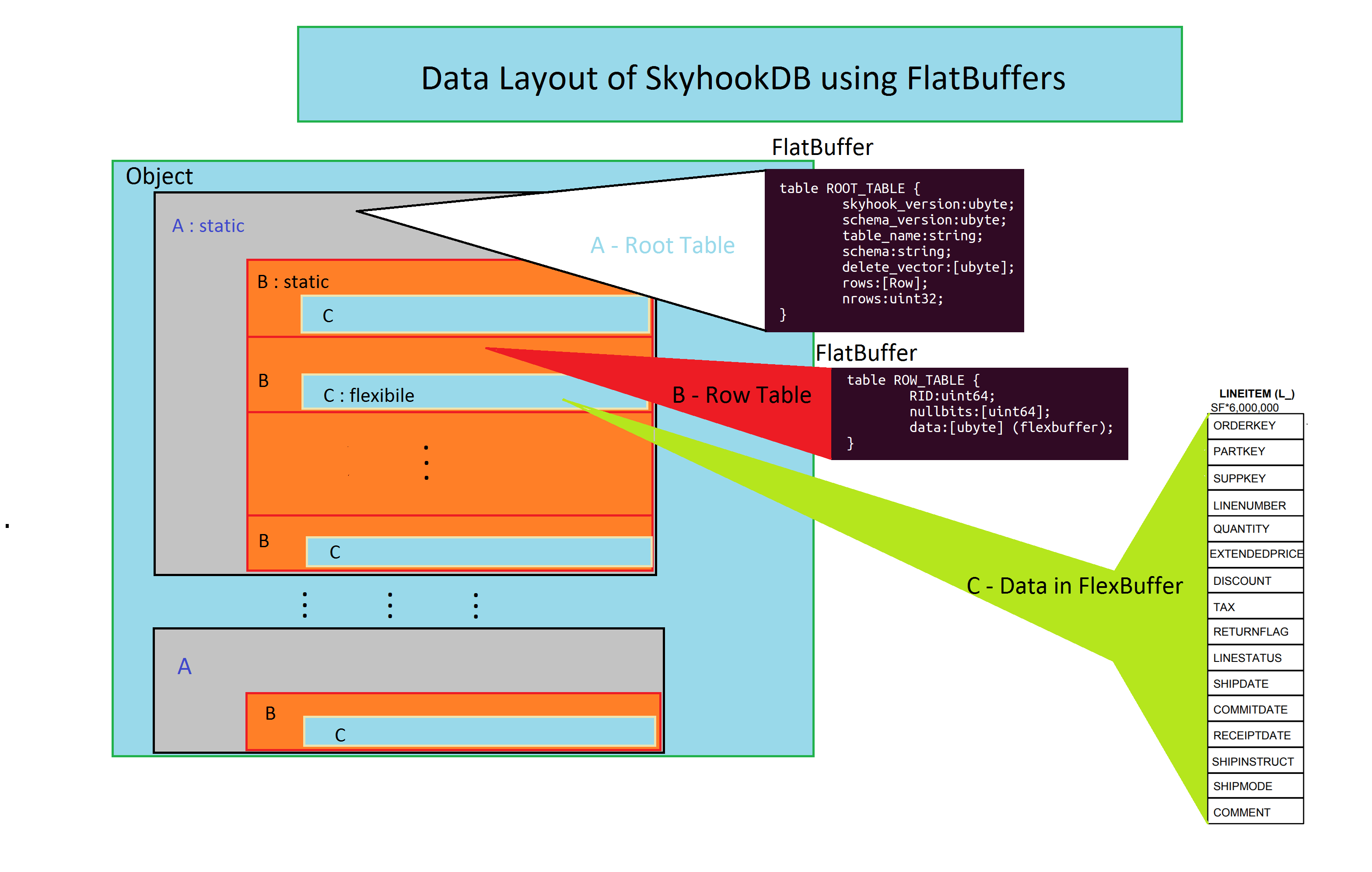
You can also combine flatbuffers and flexbuffers: https://users.soe.ucsc.edu/~jlefevre/skyhookdb/fb_structure_...
Re:FlexBuffers by alexeldeib on Saturday June 20, 2020 @11:56PM (#23589621)
Thanks for linking the article. Despite the original article being about FlexBuffers, I happen to have been looking at FlatBuffers vs Cap'n Proto today.

That article is a bit old; is there anything that stands out to you in the last ~5 years where things have diverged?

Re:FlexBuffers by kentonv on Sunday June 21, 2020 @12:31AM (#23589768)
I haven't kept track of FlatBuffers so I don't know what might have changed there, except that I imagine they support a lot more languages now (probably more than Cap'n Proto honestly). Cap'n Proto's serialization layer hasn't changed very much in those 5 years; development focus has been more on the RPC system.
Re:FlexBuffers by vlovich123 on Saturday June 20, 2020 @11:25PM (#23589496)
In theory, you could build something like flexbuffers for cap’n’proto if someone was really motivated, no?
Re:FlexBuffers by kentonv on Saturday June 20, 2020 @11:46PM (#23589584)
I suppose you could layer something on top. But I think it would be tricky to come up with something with satisfying performance properties. A naive encoding of JSON into Cap'n Proto would result in messages that are much larger than JSON messages, because of all the pointers and padding and text field names.

I haven't looked into exactly how FlexBuffers work but off the top of my head I suspect that leveraging FlatBuffer's "virtual table" technique probably helps here. In (normal, schema-ful) Cap'n Proto, fields within a struct have fixed offset, meaning that unused fields still take space. As I understand it, FlatBuffers tries to avoid this by adding an extra layer of indirection -- each struct has a sort of "virtual table" which stores the offsets of each field, where some fields might not be present at all. If multiple structs in a message happen to end up with the same virtual table, then the virtual table is only written once.

Totally speculating here since, again, I haven't actually looked at FlexBuffers, but if I were building something isomorphic to JSON on top of FlatBuffers, I'd probably look into extending the virtual tables to index fields by name rather than number. So if you have two structures with the same set of field names, they can share a virtual table, and those field names only have to appear once. That'd be a pretty great way to compress JSON.

Back in Cap'n Proto, we don't have these vtables. For data with fixed schemas, my opinion is that these vtables seem like they require more bookkeeping than they are worth. But for dynamic schemas they seem like a much bigger win. So if you wanted to encode dynamic schemas layered on top of Cap'n Proto, you'd probably have to come up with some similar vtable thing yourself.

Re:FlexBuffers by Aardappel on Saturday June 20, 2020 @11:56PM (#23589620)
FlexBuffers are actually not built on top of the FlatBuffers encoding, they have their own special purpose encoding, which tries to be as compact as possible while still allowing in-place access (details, search for FlexBuffers here: https://google.github.io/flatbuffers/flatbuffers_internals.h...).

Funny you should say vtables may not be worth it.. I was of a similar opinion (why would you have many fields that are not in use??) until people showed me some of the Protobuf schemas in use at Google, with hundreds of fields, most unused. This is what pushed me in the direction of the vtable design.

Data always starts out neatly.. but the longer things live, the more this kind of flexibility pays off.

Re:FlexBuffers by kentonv on Sunday June 21, 2020 @12:06AM (#23589667)
> some of the Protobuf schemas in use at Google, with hundreds of fields, most unused

Yeah, I was quite familiar with those back when I was at Google. But, IIRC, a lot of them were semantically unions, but weren't actually marked as such mostly because "oneof" was introduced relatively late in Protobuf's lifetime.

Re:FlexBuffers by Aardappel on Sunday June 21, 2020 @12:15AM (#23589700)
Agreed, most use cases are not this extreme. But I saw them as an "upper bound" on how people would stretch a serialization system. I didn't want to be the guy saying "640k should be enough for everyone".

No joke, I originally was arguing for 8-bit vtable entries because surely no-one ever needs more than 256 bytes worth of fields. Good thing my co-workers were smarter than me.

And yes, FlatBuffers has built-in unions from day 1, which was probably helpful.