Re:The case for national paid maternity leave
by throwaway894345 on Monday May 18, 2020 @01:37PM
(#23225619)
I think about this a lot too because my family could live off of my income alone. We might move to this at some point, but for now my wife prefers to work. That said, I'm genuinely curious if "single income households" were ever a norm, or if it was only a norm for the upper class (or perhaps for the middle class for a very short time, such as for a few decades in the 20th century).
[ Parent
| on HN ]
Re:The case for national paid maternity leave
by rubidium on Monday May 18, 2020 @02:16PM
(#23226263)
For married couples, the US has seen an increase in women working for pay from 30% participation to 60% participation from 1955 to present.
https://ourworldindata.org/uploads/2017/08/Labor-Force-Parti...
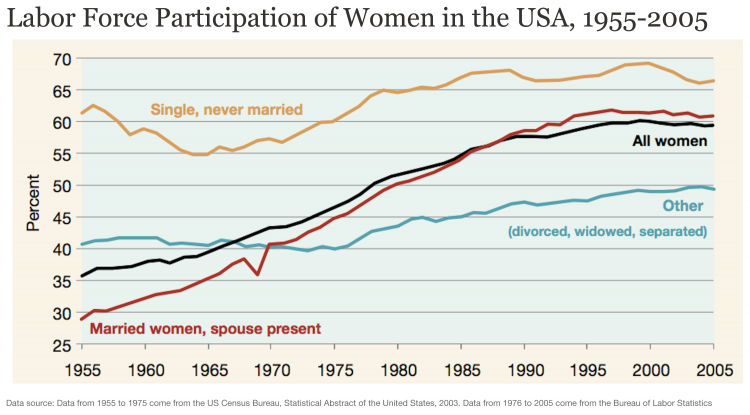
So there was a while when most married women with kids stayed home.
Re:The case for national paid maternity leave
by throwaway894345 on Monday May 18, 2020 @02:36PM
(#23226576)
No doubt, but I suspect that the mid 20th century is a historical anomaly. I'm also surprised that only 60% of women work for pay at present.
I think "everyone in the family works" used to be the norm.
Re:The case for national paid maternity leave
by sixstringtheory on Monday May 18, 2020 @02:09PM
(#23226147)
It’s always been true, but the answer to the question “for whom?” has changed a few times, like in the agricultural and industrial revolutions.
Re:The case for national paid maternity leave
by barry-cotter on Monday May 18, 2020 @02:08PM
(#23226142)
Single income households were only ever a norm for the upper classes, whether aristocracy or haute bourgeoisie. Almost as soon as that changed society did. Mass leisure society with many single income households were a post WWII US thing. The richest country in the history of the world sustained that from maybe 1945 to 1970, by which time feminism was in full swing. Capable women got bored and wanted meaningful non family work.