> This is the first known antibody that blocks the infections
> The antibodies have to be tested in humans, which can take months
> The research still has to be peer reviewed
> It stops the virus from further internal infections, allowing the patient to recover
> They are trying to get a pharmaceutical company to mass-produce it
> A vaccine would be a real solution, others are working on it. Vaccine development can take 2 years
The part that is most relevant for the development of a new drug/treatment is the safety and efficiency testing in the clinical studies - and that alone will take many months. It can be shortened if it is a drug that has been used before for something else (e.g. that chloroquine for malaria) and is only repurposed because there we know the drug is safe already. For a completely new drug it could take a year or more just to do the testing and get the approvals.
So I wouldn't have high hopes to see this being deployed widely any time soon.
> So I wouldn't have high hopes to see this being deployed widely any time soon.
I don't know, I mean, this is one of those things where compassionate use seems likely? Won't we end up trying that and doing studies on them after?
If the drug or vaccine you are developing ends up killing more people than saving it is not much of a cure, is it?
The same if the drug isn't effective - in that case it would be wasting critical resources and probably causing the sick to not get a really effective treatment.
That said, this process will be certainly sped up to maximum amount possible, given the situation, but it will still take a long time.
Biologics like this are new enough that we don’t really know the time courses but in a normal situation it’s still multiple years.
However, if I have it, my wife probably has it too. Her only symptoms are a mild sore throat and an ache in her back. It's much less severe than mine.
I had the bad luck of getting swine flu in 2009 and this is just as bad.
>Similar to patients with SARS-CoV and MERS-CoV, some patients with 2019-nCoV develop acute respiratory distress syndrome (ARDS) with characteristic pulmonary ground glass changes on imaging. In most moribund patients, 2019-nCoV infection is also associated with a cytokine storm, ... in those who survive intensive care, these aberrant and excessive immune responses lead to long-term lung damage and fibrosis, causing functional disability and reduced quality of life.
https://www.thelancet.com/journals/lancet/article/PIIS0140-6...
With all of the information available demonstrating that it clearly is pretty serious, I've come to identify people downplaying it as essentially the exercising of wishful thinking: If I tell everyone it's nothing, maybe it will be.
I hope it's nothing. At the same time I understand the responses that have occurred.
For middle age people, if you are unlucky and get other virus at the same time(because you met with lots of people in a place), like the flu, it can be extremely dangerous.
Last year I catched two virus at the same time and it was so painful. My body reacted too strong with an autoimmune reaction, attacking my own body, my joints, my muscles.
It took me two months to properly recover, and I live a very healthy lifestyle. I sleep and eat well and exercise. The doctor told me that someone in the same situation that smokes for example could develop lots of complications.
> Common signs of infection include respiratory symptoms, fever, cough, shortness of breath and breathing difficulties. In more severe cases, infection can cause pneumonia, severe acute respiratory syndrome, kidney failure and even death.
The problem is that some people forget that between "common signs" and "severe cases" there's a vast area of very uncomfortable symptoms until you get to the severe cases, and we're currently still learning about this very gray area.
Just yesterday the following link was posted on Hacker News: "Coronavirus: Some recovered patients may have reduced lung function", https://news.ycombinator.com/item?id=22568100
Good shot of ending up in the ICU.
1.22434.701, P = 0.028) were risk factor for disease progression [Table 4].”
[1] https://journals.lww.com/cmj/Abstract/publishahead/Analysis_...
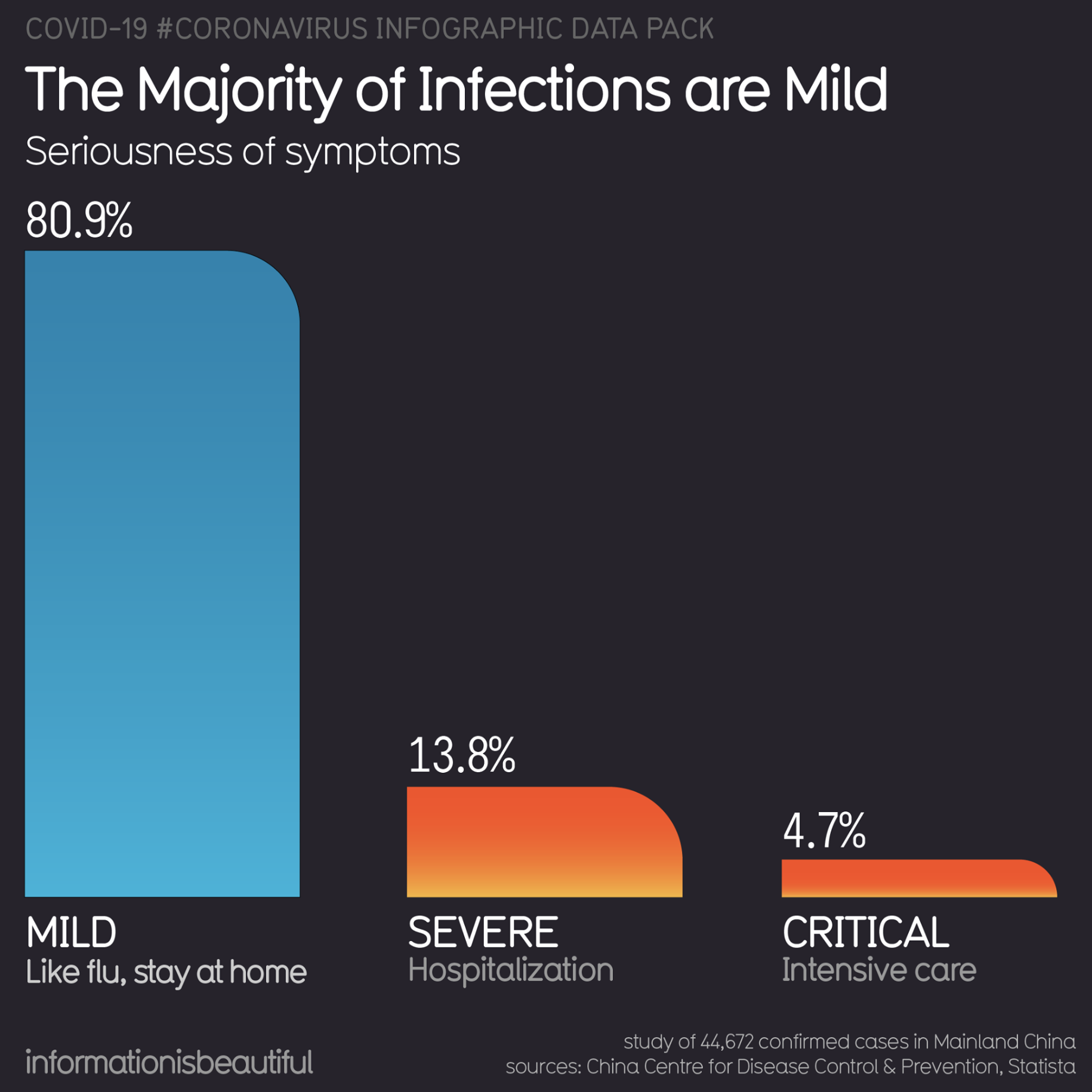
Here's a chart made from a study in China. It's actually a bit unclear, but I'm assuming it's 18.5% of confirmed cases that require hospitalization. Now, the question is how many of those that got sick at all got confirmed in China, and how many people presented symptoms (those are unknown).
So it seems like it's less than 18.5%. On top of this, Chinese men are heavy smokers and the air quality in China is pretty terrible, so that may play a part as well.
If it passesthe review stage it will probably be published in the scientific Journal Nature.
Note: this is not a vaccine. Its a treatment option for people who are already sick.