Evidence that humans, while excellent problem solvers suffer terribly at the creative aspect. In far too many disciplines only by already 'knowing' something can we solve for it. The real miracle is that we're here at this level at all.
Compared to what baseline animal?
Its arguments are “it was not proven then” and „Galileo wasn‘t skilful enough not to insult the pope.”
It also intentionally misleadingly avoids to show to the readers the actual papers and sentence made by inquisition which are preserved and completely disprove the quasi-arguments.
Over the course of 1500 years after Ptolemy's publication there were more accurate measurements, so Copernicus threw in more epicycles to have the model better match observations, but that's just another layer of indirection. But how are C's epicycles any less 'ad hoc' than P's?
They hardly look any different, at least to a layman:
* http://astro-andy.eu//img/the_solar_system_of_mlp_ptolemaic....
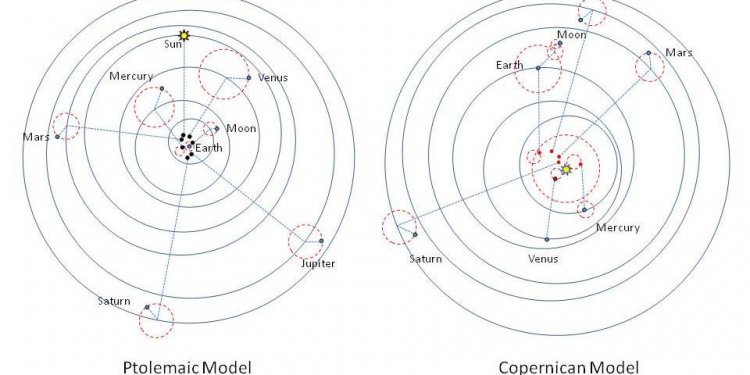
* https://casswww.ucsd.edu/archive/public/tutorial/images/hist...

First off, you have to understand the intellectual background. Aristotelian physics dominated Europe at the time. Aristotle held the Earth to be separate from the heavens, with the heavens being the realm of perfect forms. All imperfect objects seek to move to the center of the Universe, which is the center of the Earth, while perfect objects move in circles in the heavens. This was the intellectual foundation of geocentrism.
Galileo was the first human in history to point a telescope at the sky, and what he saw fundamentally undermined Aristotelian physics. The Moon is not a perfect form: it has mountains, just like the Earth. Not everything revolves around the Earth: Jupiter has its own moons that orbit it. The Sun is also not perfect: it has spots. Galileo also did mechanical experiments that demonstrated the principle of inertia (Newton's first law), which further undermined Aristotelian physics. With Aristotelian physics out the window, the strong intellectual bias towards geocentrism was also gone. Until Galileo's telescopic observations, he himself had been a geocentrist, like most people.
If you then look at geocentrism and heliocentrism with fresh eyes, there are a lot of appealing aspects of heliocentrism.
* Geocentrism needs epicycles to explain even the most basic elements of planetary motion (retrograde motion). Heliocentrism already explains retrograde motion without any epicycles. Not only that, but heliocentrism correctly predicts exactly where (in relation to the Sun) retrograde motion occurs. In the geocentric model, retrograde motion could occur anywhere, but in the heliocentric model, it has to occur when planets are opposite the Sun, and lo and behold, that's exactly where it occurs.
* The Jovian system and the Earth-Moon system also suggest that small objects orbit larger objects, according to some as-of-yet (at Galileo's time) undiscovered principle. Why would the Sun (which was then known to be much larger than the Earth) orbit the Earth?
* The phases of Venus decisively rule out Ptolemy's model. In order to save geocentrism, you have to invent some weird geo-heliocentric hybrid model (Tycho's model). To many people, a pure heliocentric model was much more appealing, and the hybrid model appeared to be an awkward attempt to save some of geocentrism.
Kepler published his defense of the Copernican system in 1596. He then published his first two laws in 1609 using Brahe's (pre-telescopic?) observations; the first patent for the telescope was in 1608. So even by then things were moving toward what 'reality' actually is.
More generally, I think that the 'Galileo affair' is portrayed as being a bigger deal than it actually was. I also think that people underestimate how much "politics" was a blood sport at that time.
That is argument for what exactly? That only "proves" that the layman can't understand something that is "hard". "Math is hard, lets go shopping" argument.
Galileo didn't have to simply "believe" Copernicus, he was physically the first man ever to see the moons of Jupiter with this own eyes, using the telescope he made with this own hands.
The mere existence of these moons was completely against the church doctrine, explicitly stated by the Inquisition in the official sentence with which he was sentenced:
"the above-mentioned Galileo, because of the things deduced in the trial and confessed by you as above, have rendered yourself according to this Holy Office vehemently suspected of heresy, namely of having held and believed a doctrine which is false and contrary to the divine and Holy Scripture: that the sun is the center of the world and does not move from east to west, and the earth moves and is not the center of the world, and that one may hold and defend as probable an opinion after it has been declared and defined contrary to Holy Scripture."
The author claims:
"the reaction at the time was "WTF? Which heresy are you talking about here?"
But the exact heresy was explicitly and very clearly stated both in the sentence by the Inquisition:
https://hti.osu.edu/sites/hti.osu.edu/files/documents_in_the...
"the above-mentioned Galileo, because of the things deduced in the trial and confessed by you as above, have rendered yourself according to this Holy Office vehemently suspected of heresy, namely of having held and believed a doctrine which is false and contrary to the divine and Holy Scripture: that the sun is the center of the world and does not move from east to west, and the earth moves and is not the center of the world, and that one may hold and defend as probable an opinion after it has been declared and defined contrary to Holy Scripture."
And in Galileo's Abjuration:
http://www.creatinghistory.com/galileo-galileis-abjuration-2...
"after having been judicially instructed with injunction by the Holy Office to abandon completely the false opinion that the sun is the center of the world and does not move and the earth is not the center of the world and moves, and not to hold defend, or teach this false doctrine in any way whatever, orally or in writing; and after having been notified that this doctrine is contrary to Holy Scripture; I wrote and published a book in which I treat of this already condemned doctrine and adduce very effective reasons in its favor, without refuting them in any way."
The premise of the whole "4 hour" series by that author is also wrong, approximately, that because the parallax of the stars wasn't observed until around 1750 Galileo "couldn't prove" in 1633 that the Earth is not standing still, therefore the Church was "right" and it wasn't a matter of faith but "a personal thing." It's obviously a completely invalid argument. Because the reason why Galileo was convinced about the wrongness of the heliocentric theory was the simple fact that he was really the first human in the world who saw the moons around other planet, not accidentally called "Galilean moons":
https://en.wikipedia.org/wiki/Galilean_moons
He didn't have to "prove." He was really sentenced only for "having held and believed a doctrine which is false and contrary to the divine and Holy Scripture." It's explicitly stated in the official document.
That something like that is a reason enough for a condemnation by the religious authorities, even in much more recent times, can be obvious to anybody who tried to read the source text of the condemnation to murder of the author "along with all the editors and publishers aware of its content" of the book "The Satanic Verses" in 1989. I won't link to that, intentionally, but there's enough details to... check the original sources!
Additionally, not only Galileo's but the Copernicus' book too remained banned by the Church for the next 200 years after Galileo was sentenced, in spite of all the scientific discoveries in these 200 years that made these texts less unique. And the discoveries... there were many of them. Starting with the publication of Newton's "Principia" in 1687, only 50 years after the sentence. Newton was, of course, out of the reach of the Catholic Church, thanks to the lucky coincidence of him being born in "a political system found on the family values of Henry VIII."
It's always more worth checking the original sources instead of believing in 4 hours of text of somebody who intentionally avoids quoting and discussing these very sources. A lot of false claims can be constructed by omitting the evidence, the original sources and inventing the interpretations of the actual events. It's a very dishonest approach and should not be supported.
* https://tofspot.blogspot.com/2013/10/the-great-ptolemaic-sma...
The fact that the Earth moves was not 'proven' (or more technically, had strong empirical evidence for that hypothesis) until 1806 when Giuseppi Calandrelli reported parallax in α-Lyrae. That's ~250 years after Copernicus, and ~150 after Galileo.
Note that by 1700 or so, everyone had switched to Kepler's model: not necessarily because they thought it was "right" (there was no empirical way to tell), but primarily because the math was much easier and it got correct results. There were actually seven models floating around during the 1600s:
* Heraclidean. Geo-heliocentric. Mercury and Venus circle the Sun; everything else circles the Earth.
* Ptolemaic. Geocentric, stationary Earth.
* Copernican. Heliocentric, pure circles with lots of epicycles.
* Gilbertian. Geocentric, rotating Earth. (proposed by William Gilbert in De magnete)
* Tychonic. Geo-heliocentric. Sun and Moon circle the Earth; everything else circles the Sun.
* Ursine. Tychonic, with rotating Earth.
* Keplerian. Heliocentric, with elliptical orbits.