News for hackers. Stuff that matters.
Re:Wi-Fi Alliance Brings Wi-Fi 6 into 6 GHz by fareesh on Monday January 06, 2020 @02:05AM (#21967169)
Is it a universal rule that higher frequency = lower range?

The range of 5Ghz is already pretty low and has trouble going through solid materials like concrete. Would 6 be significantly worse?

Re:Wi-Fi Alliance Brings Wi-Fi 6 into 6 GHz by swebs on Monday January 06, 2020 @04:30AM (#21967820)
In general, higher frequency means greater attenuation, which means greater power loss when passing through objects. It's a lot more complicated than that depending on the frequency and medium, so don't take that as an absolute rule.
Re:Wi-Fi Alliance Brings Wi-Fi 6 into 6 GHz by Reventlov on Monday January 06, 2020 @02:06AM (#21967175)
No it is not universal at all. For example, some materials are transparent, kind of like glass for light, another well known EM wave.

You have to look up materials frequency response: on earth, for example, athmosphere does not have a monotonous response (look at http://www.gb.nrao.edu/GBTopsdocs/primer/spect002.gif for example). Same with water: https://en.wikipedia.org/wiki/Electromagnetic_absorption_by_...
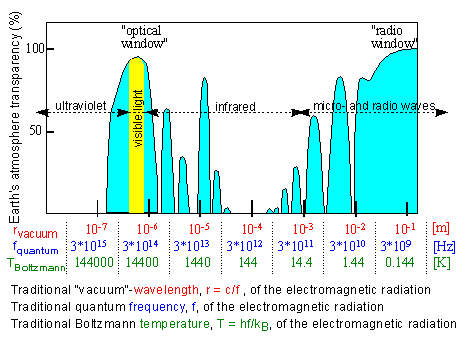
Really, WiFi 5GHz is just well absorbed by walls and buildings, that's all.

Re:Wi-Fi Alliance Brings Wi-Fi 6 into 6 GHz by stoops on Monday January 06, 2020 @05:08AM (#21967999)
Will 6GHz perform in buildings than 5GHz?
Re:Wi-Fi Alliance Brings Wi-Fi 6 into 6 GHz by enjenye on Monday January 06, 2020 @02:41AM (#21967317)
Indeed : radio transmissions follow Friis equation [1] -- power decreases by the square of the frequency (same goes for distance). So, going from 2.4 to 5 GHz cuts the received power at a certain distance by a factor of 2 (more or less). Assuming free space, of course : obstacles will make matters worse, depending on frequency, thickness and materials.

Meaning that going from 5 GHz to 6 GHz will decrease the range by a factor of around 1.2

[1] https://en.wikipedia.org/wiki/Friis_transmission_equation

Re:Wi-Fi Alliance Brings Wi-Fi 6 into 6 GHz by henrikeh on Monday January 06, 2020 @03:39AM (#21967599)
Take note that Friis transmission equation is extremely misleading, since it makes certain assumptions about the choice of antenna, which are not necessarily true for all systems.

Too ask the pointed question: Why would propagation in free space be affected by the frequency of the field?

A good explanation is here: https://www.dsprelated.com/showarticle/62.php

Re:Wi-Fi Alliance Brings Wi-Fi 6 into 6 GHz by Reventlov on Monday January 06, 2020 @03:13AM (#21967468)
As you note, it's only true when you assume free space. In practice, you have air, you have obstacles, you have earth curvature, you have […], which makes it wrong, because athmosphere has an opacity that varies with the frequency (or wavelength): https://en.wikipedia.org/wiki/File:Atmospheric_electromagnet...

So, no, it's not an universal rule.

Please also note that shorter range is not necessarily bad: it means less interference from neighboring devices that use the same frequency band ( https://www.embedded.com/why-60ghz-mmwave-is-moving-into-the... ).