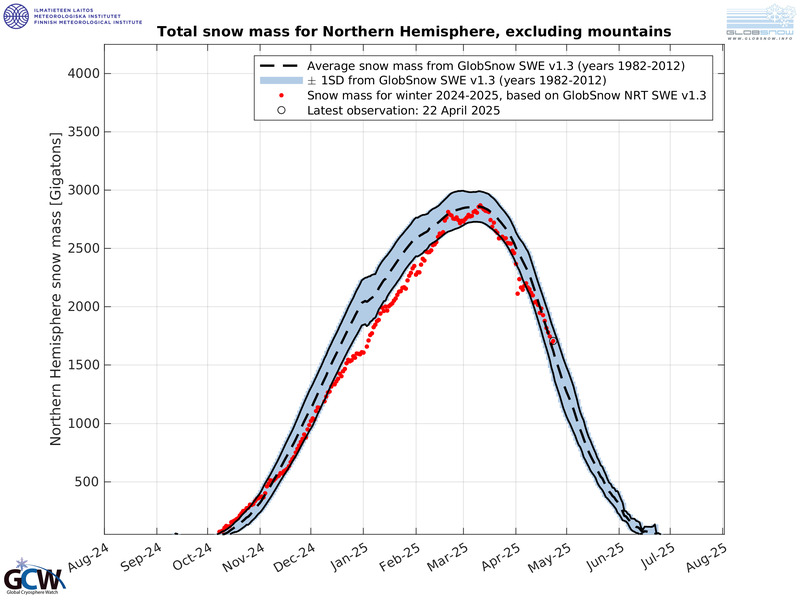
We are also having near record levels of snow across the Northern Hemisphere, which according to your world view, shouldn't be happening: https://globalcryospherewatch.org/state_of_cryo/snow/fmi_swe...
So, I’d strongly suggest you should just read the NCA, because this argument is both ridiculous and false according to known science.
Incidentally, it’s worth mentioning that, while I’m not an expert, I have several recent publications in hydrology, and I talk regularly with climate scientists and hydrologists about drought, including coauthors of the report I linked. The lines of argument you stated above are nonsense, I’m afraid. If you care about this subject, please do yourself the favor of reading some high-quality research summaries. It’s actually quite striking how much we do know about the Earth system.
CO2 does not act literally like a blanket over the earth, that's not how radiation works. If CO2 cannot retain the heat then it will be lost to space at night.
The closest thing to a true blanket effect would be clouds, although they have complex shapes and depending on where they are located in the atmosphere can have either a cooling or warming effect. They are made up of mostly liquid water and do vary according to solar activity through cosmic ray flux as shown in Svensmark's work. Link above.
The quote I gave tells a couple of specific links. The report itself offers plentiful analysis to back the conclusions up.
You can't just dismiss this evidence by asserting "zero causal linkage" and then referring to a single paper that is not about climate at all.
*
I was trying to raise another general point. It's actually not surprising, due to the centrality of water in the Earth system, that global increases in CO2 (and hence, radiative forcing) would influence the distribution of water.
That's partly why the section on water and climate is chapter 3 of the report I linked instead of chapter 12.