1. We know is that there's a range of temperatures where humans have thrived for hundreds of thousands of years, and life has thrived for millions of years.
2. We also know that there's a range of temperatures where it will be too hot for humans to survive.
3. We also know that global temperature is changing from the former to the latter.
Given these three facts I don't think we need to know what the ideal temperature of the earth is to be concerned.
The issue is the effects of moderate temperature increases, rising sea levels, changing farming, etc. so it’s a mass disruption to our civilization (migration, resource wars, etc.) Not that we’ll literally be too hot and can’t somehow survive that as a species.
Humans live in Australian Outback and Alaska. We are adaptable, but the growing pains are not pleasant, hence the problem to civilization.
Really, when? How much hotter was it in the past?
I’m not saying we shouldn’t fix the issue. I’m saying the argument that the average temperature will be unlivable is bad. It’s like saying bullets kill people because of the lead content, not the process of getting injected. The process of climate change will impact us most, not the impact of the temperature on our biology.
We do have to be careful playing with the chemistry of the atmosphere of the only habitable planet we have.
https://upload.wikimedia.org/wikipedia/commons/thumb/f/f3/Sa...
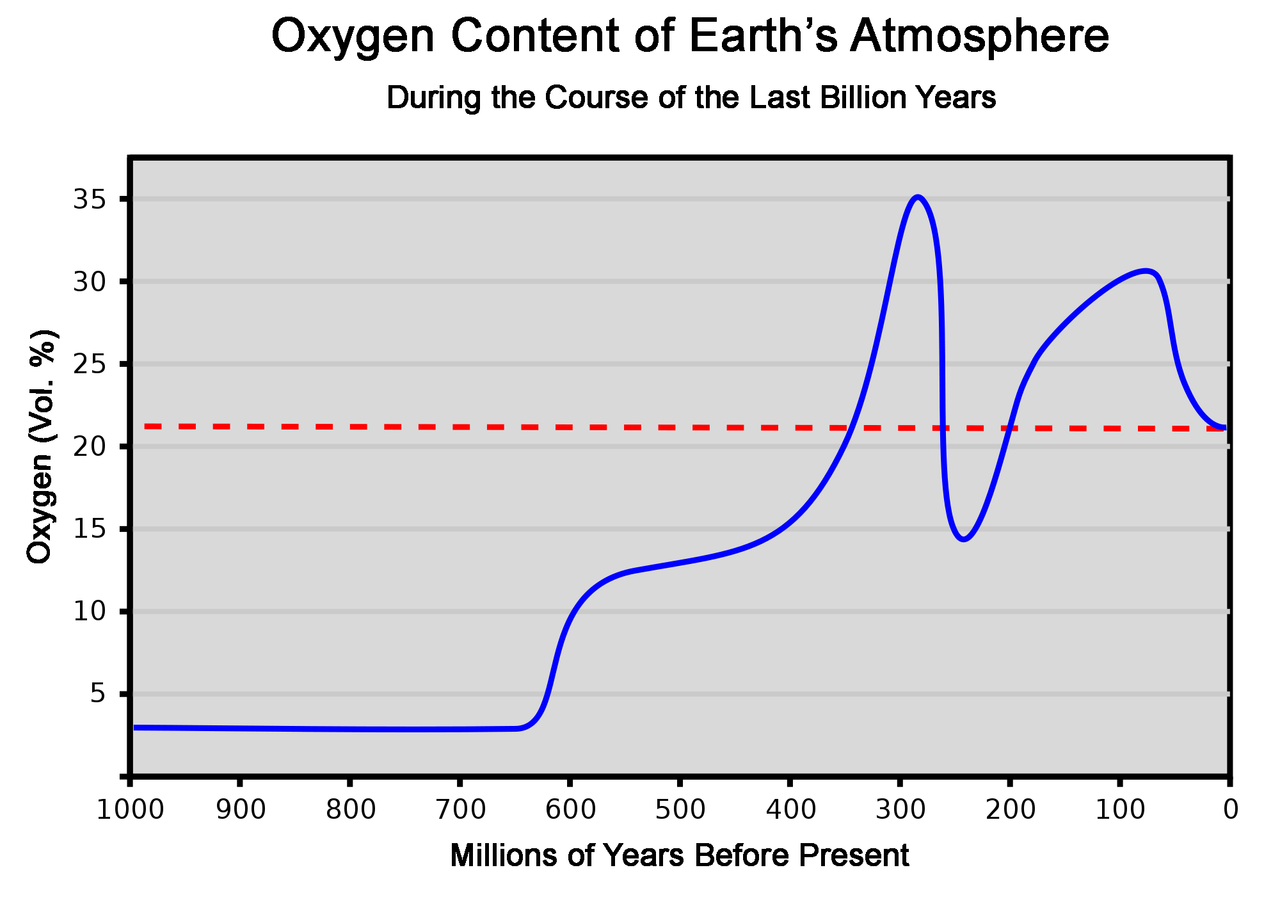
The argument that extra CO2 or a few degrees C will be unlivable for humans is laughable. The changes to our civilization from this is not (farming, weather patterns, mass migrations).
Just saying, it's not like there's a law of nature that keeps Earth habitable for humans. We should be aware of that. I think you're shifting the goalposts -- earlier you seemed quite confident that there wasn't a period within hundreds of millions of years that wouldn't have been habitable by humans. Have I changed your mind about that?
I don't think anyone who worries about climate change as an existential threat is thinking of sea level rise, a few degrees C and a few hundred ppm of carbon doing us in. Those could make life quote difficult at most. But it's the feedbacks that might run away from there, which are very hard to bound. How quickly might a few hundred ppm become a few thousand, if methane hydrates start to off-gas? Etc.
How confident can you be that it won't happen, when the Earth has carried itself away before?
Earlier posters made it seem like the problem with climate change was that earth was moving out of a narrow temperature band that supported human life. We live in the arctic, jungles, deserts, ice ages, mountaintops. We will be fine. The problem is the transition’s impact on our existing civilization (sea level change, new weather patterns), not the final temperature.
Let me put it this way: if we discovered earth 100 years in the future, even with our current climate change rate, we would rejoice about how easily it could be colonized (vs Mars, the moon, etc).
The climate will get hotter, and it’ll still be quite livable in places. This is the equivalent of people who think earth is in the “just right” orbit, if it were 10 feet off in either direction the planet would freeze or burn. And yet the elliptical orbit of the earth around the sun varies by millions of miles, and we don’t light on fire when climbing a ladder. We don’t die because someone left the AC 5 degrees too hot or cold.
http://burro.case.edu/Academics/USNA229/impactfromthedeep.pd...
If you can, please let me know what you think of the image on page 6. Mind you this is an unproven theory about the end permian mass extinction. But it's an interesting perspective on what could cause the whole planet to become uninhabitable, rather than just shifting the comfortable zone farther to the poles. I'm curious about your thoughts on, if it did happen that way, how long humans would last in such conditions.
Humans are hardy and adaptable, but so are insects, birds, rats, and many other species. Somehow the end permian extinction killed up to 96% of all species, including even insects and the formerly ubiquitous trilobite, and apparently nowhere on Earth was spared. Land vertebrates were almost wiped out.
I also appreciate the optimism about mars colonies, but we actually haven't demonstrated the technology or robustness to even sustain a colony on Antarctica without outside support. If we did set up a mars colony, I'm skeptical that it could last even a hundred years on its own. Technology is a powerful tool but supporting cement factories, steel mills, silicon fabs, power plants, farms, and everything else, in a self-sustaining way, really requires a habitable planet. I don't think it would be possible to sustain in an underground bunker for very long.
I hardly know enough to comment on whether that is likely. But I think it's a much better argument about why the Earth will be uninhabitable for us specifically.
(That said, it doesn't really matter if the earth eventually becomes uninhabitable or not, we want to avoid the cost of having to move everyone for even minor sea level rises.)
You're asking leading questions which contain a lot of presuppositions, and you're ignoring my post in which I specifically reject those presuppositions, which makes it hard for me to believe that you're just trying to learn.
Before a region get's there consistently, it'll be that way intermittently and many people who can leave probably will because even in the high 20's and low 30's it'll significantly impact humans ability to do things.
Let’s assume that’s the number.
What I, as an individual, can do to help?
This serves for all the other commenters complaining about my responses.
If you can’t provide something that I can do as an individual I can’t help you.
It doesn’t matter how much we complain about how governments are not doing what they are supposed to if we can’t start with the smallest organizational unit of our planet which is the individual.
2. Consume less.
3. When you must consume, buy used (much of the carbon footprint of many products comes from producing the item).
4. Buy more local goods (much of the carbon footprint of many products comes from transporting them long distances).
5. Travel less, and more carbon-efficiently. Live closer to where you work. Walk > bike > public transit > cars.
6. Stop arguing that climate change doesn't exist.
7. Spend a few minutes researching the answers to your own questions before going on the internet and arguing that environmentalists don't have any answers. There's a wealth of information out there, and lots of people who are trying very hard to educate people, who would be happy to educate you if you asked questions in good faith, or typed your questions into a search engine.
In reality it's of course a bit more complicated since earth is complicated. Another good proxy for "fixed" would be "glaciers and permafrost exist and are not decreasing" while broken would be "large areas in the third world have become uninhabitable to humans"
Haven't gone out and done my own validation, or checked other sources, but it'll give you somewhere to start
I'm not arguing that there's some "ideal Earth temperature": that's your straw man argument that you're making and has nothing to do with anything I've said. I don't need to provide data to prove a claim I never made. I've made three points, numbered in my previous post. Two have data behind them, and the other is fairly self-evident. If you'd like to share which of the claims I've actually made that you disagree with, I'd be happy to engage you in a discussion where we present evidence for our respective positions, but I'm not going to answer you if you continue asking me questions of the form, "Why can't you provide evidence for this claim you never made?"
Clearly you haven't even had the time to read any of the references that you were specifically given that answer many (if not all) of your questions - yet here you are, continuing the climate-denial fight.
Do the honorable thing and stop phrasing your statements as questions - it is a waste of peoples time answering them.
Just to make it explicit for the audience: before he was claiming just to be an honest truth seeker looking for references to learn about the topic, and now he acknowledged he's just a troll. Which was obvious from the start, but worth pointing out.
You do realize the plastic waste issue is separate from climate change?
I'm afraid that, since you seem to be reasonably intelligent and informed, I have to assume your replies are not made in good faith.
That's because you aren't asking questions, you're making vague points with question marks at the end.
> If these people were actually worried about climate and all related subjects they would be working on providing actual things reasonable people could do to help as oppose to calling other names and demanding they stop using plastic straws by showing pictures of turtles.
One thing actual reasonable people can do is stop pretending climate change doesn't exist and isn't a problem.
[1] https://slatestarcodex.com/2017/04/07/yes-we-have-noticed-th...
I'm not here to argue with you. I am just pointing out that people are linking you to references, and you clearly aren't even reading them before you post your follow-up "questions".
If you want to argue, argue with evidence - don't dress it up as a question.
The point is that current levels of climate emissions are much costlier and deadlier than a world where (good) policies have been enacted to decrease the flow of carbon into the atmosphere.
Just to throw it out there, though, I'd suggest a guaranteed change of 2F/century would be greeted with an instant acceptance and sigh of relief by everyone.
Ideal for what goal?