Re:LastPass Extension slows Chrome's responsiveness by up to...
by pastelsky on Sunday October 06, 2019 @02:36PM
(#21173918)
It isn't perfect, and it does penalize LastPass's behaviour more due to its poor startup performance.
But I don't think it is entirely unrepresentative of real world performance.
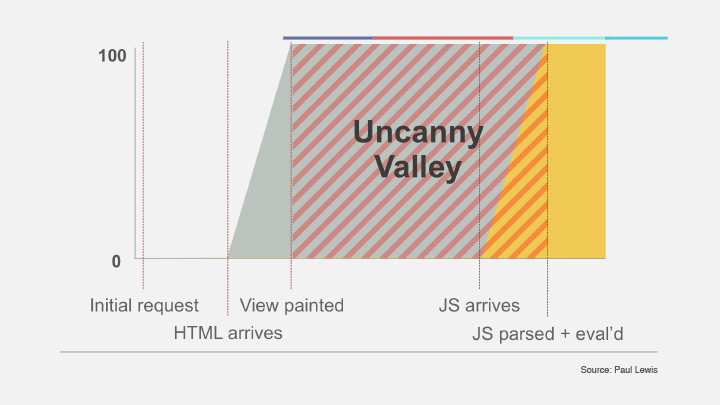
If your hypothesis is correct — if you have LastPass installed, your pages are probably going to load slower and you'll experience a longer "uncanny valley". The tax paid is worse for pages that are otherwise lightweight.
Re:LastPass Extension slows Chrome's responsiveness by up to...
by y4mi on Sunday October 06, 2019 @04:31PM
(#21174905)
> uncanny valley
You might want to look up that term sometimes. It means something different than you seem to think.
Re:LastPass Extension slows Chrome's responsiveness by up to...
by pastelsky on Sunday October 06, 2019 @09:28PM
(#21176519)
I was referring to the time between the browser paints your site and when JS execution kicks in.
See https://www.fastly.com/cimages/6pk8mg3yh2ee/3Toq5jWy0EuqG8KU...
Re:LastPass Extension slows Chrome's responsiveness by up to...
by y4mi on Monday October 07, 2019 @05:39AM
(#21178982)
I can't find any other source for that definition besides that picture.
Where does it originate if I may ask?
Re:LastPass Extension slows Chrome's responsiveness by up to...
by pastelsky on Monday October 07, 2019 @07:33AM
(#21179590)
The term isn't very ubiquitous, but the problem it describes is. Some references —
https://addyosmani.com/blog/rehydration/
https://developers.google.com/web/updates/2019/02/rendering-...
My conclusion then was that the speedometer 2.0 benchmark is dominated by page load, because it does that a zillion times as it goes through all the different todomvc implementations.
The lastpass performance tax shows up mostly during page load.
The question is, how representative is the speedometer benchark of normal use?