In school did you learn writing with pressure-and-release strokes? I'm referring to how hard you press on the nib to control the ink flow, using a dip pen. If so, more power to you :-) (The other day, a colleague from the UK also mentioned that they learnt "calligraphy" in school, not sure what kind it was, though.)
On this being a "basic handwriting", while I'm still a novice in Copperplate, if you squint hard in my example, all the upstrokes are (supposed to be) thin, and the down strokes, thick—they are not uniform, and most calligraphic scripts involve these pressure-and-release strokes. As you would know, it requires a precise control. I'm far from it; it takes a months of dedicated practice to get that smooth flow of ink.
Also, note that with Copperplate, it looks like you wrote a word, or even a letter, in one go, but it's not the case—almost all letters require you to lift your pen several times over the course of a word, let alone a sentence. (E.g. writing the Copperplate lowercase 'k' requires you to lift your pen three times.)
Maybe basic Copperplate practice letter strokes (for lowercase) in the right-most column here gives a better picture of it: https://kashyapc.fedorapeople.org/Copperplate-lowercase-prac...
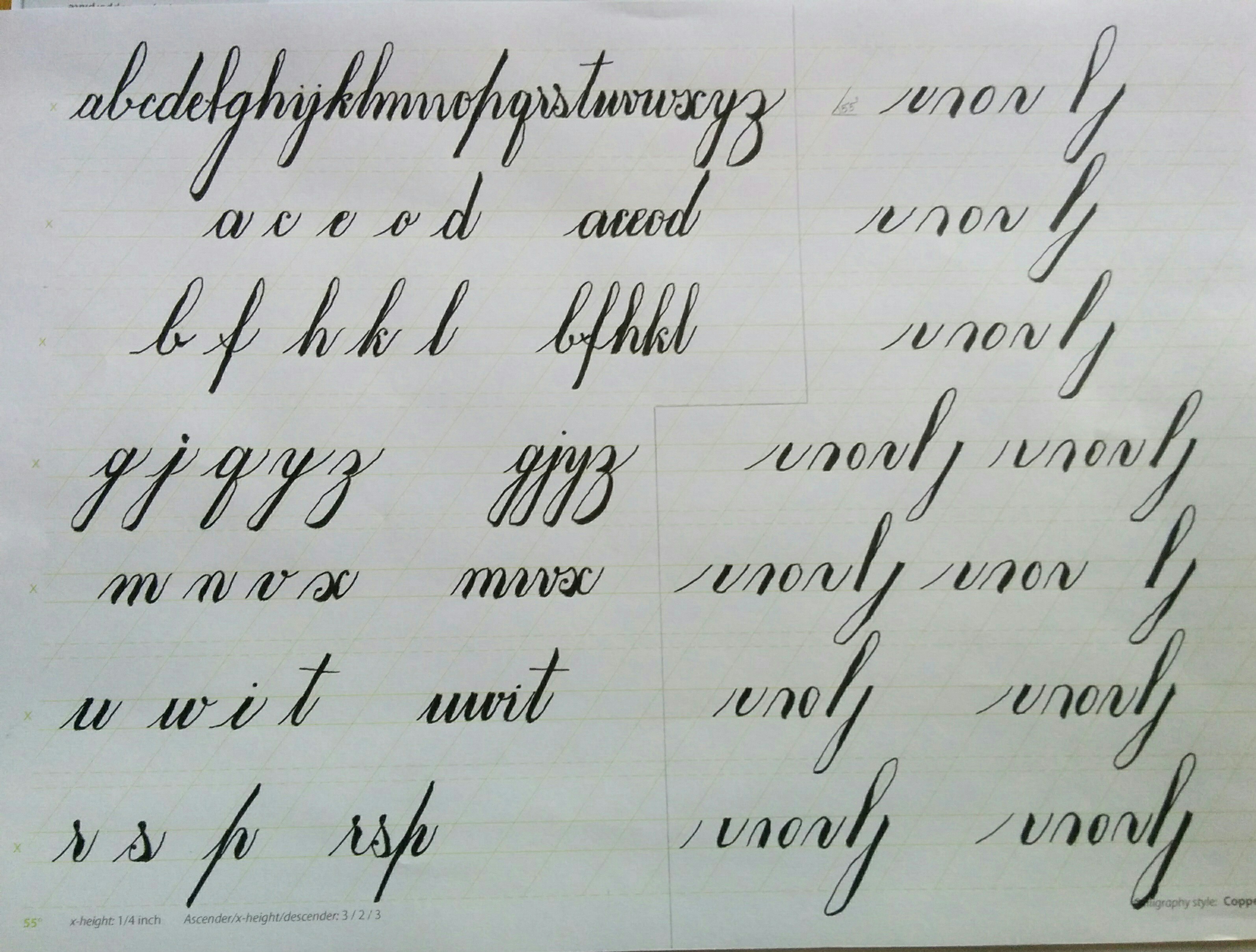
Yes. That was actually the part on which you got your grades for. Tough days.
> E.g. writing the Copperplate lowercase 'k' requires you to lift your pen three times.
Some letters have variants. There are variants of 'k' I know of with only two or one lifts and at least one that doesn't need a lift at all, albeit not looking as good but still considered Copperplate.
Here are a couple of samples from my practice (of 3 weeks) :-)
https://kashyapc.fedorapeople.org/Copperplate_practice_1.jpg
https://kashyapc.fedorapeople.org/Copperplate_practice_2.jpg
What inspired me was this book called Meetings with Remarkable Manuscripts[1], which has samples of great calligraphy from centuries old manuscripts, among many other interesting things. (Previously mentioned it on HN here[2].)
And I am learning Copperplate script itself from a wonderful book, Mastering Copperplate Calligraphy, by Eleanor Winters.
I'm thoroughly enjoying the entire process. Including the experience of using a proper nib, calligraphic ink and the oblique nib holder. The oblique pen holder (can be seen in the first image linked above) is really helpful, as Copperplate script requires letters be at a 55 degree angle; also lets you avoid having your wrist twisted in an awkward way.
[1] https://www.penguin.co.uk/books/213/213069/meetings-with-rem...
[2] https://news.ycombinator.com/item?id=20332914