    It’s as daft someone complaining that they have a family
    and can’t go to the after work drinks, but the people who
    do go are perceived to be the important, hard workers,
    taking decisions with limited input and documentation.
    And then you say “I chose not to have a family so it’s
    all your fault”
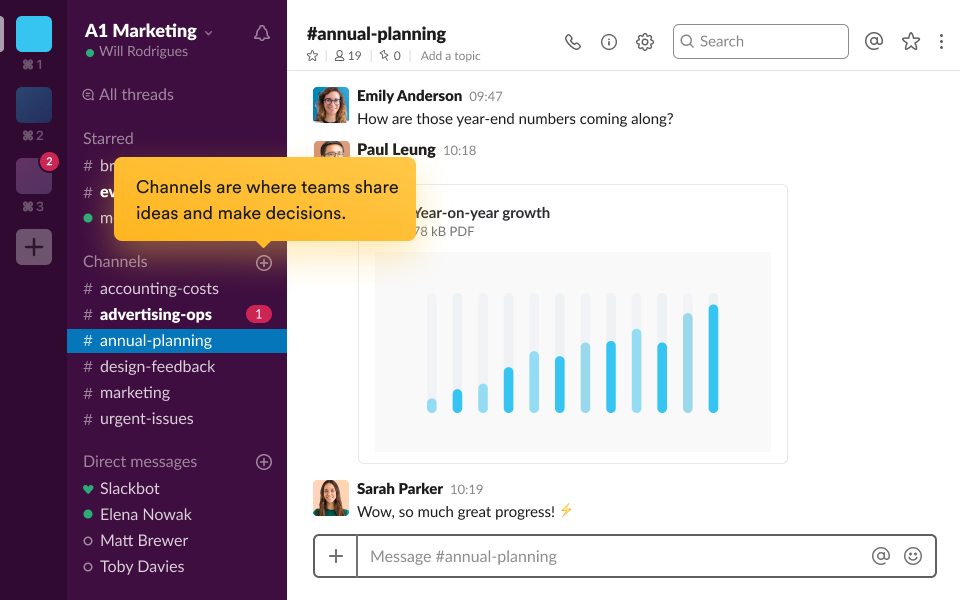
If that's the tool everyone else uses, then blaming one person for not resisting is inaccurate and unfair. Blaming the team for only using that is fair game, but blaming the tool for being designed that way is also fair game. Slack promotes itself as a panacea, the top of the homepage says "Whatever work you do, you can do it in Slack" and the first image you see[1] is a channel called #annual-planning where Emily asks "How are those year-end numbers coming along" and Paul replies in 20 minutes with a PDF with a graph embedded in the chat, and 1 minute later, Sarah (someone else) says "wow".
In that image[1], which of these people are you supposed to imagine that you are? Emily, able to drop in on anyone and check up on them instantly, or Paul, interrupted and rushed for something someone else wants at the drop of a hat, knowing that at least two people with power enough to ask this of you, have been alerted to the request by the channel, and are now thinking about this topic? Or are you intended to think, as the parent commenter here suggests, that you are Paul and you could ignore the request entirely if you wanted because it's up to you not to be weak?
Either Paul had to drop what he was doing and turn the numbers into a graph, turn the graph into a PDF, and share the PDF - or Emily and Sarah have just bothered Paul to link them to a PDF they could have found by themselves. Or Paul was already working on it and they have absolutely no tools for tracking progress where Emily could have seen the current status without the interruption.
Is the design of the product, and the way it's demonstrated, selling you on the idea that /you/ are the powerful person in the screenshot and /you/ can get instant answers from anyone, anywhere, anytime, without having to wait too long?
The second image[2] in their carousel is no better in this context, Sarah is asking Paul for a link to a document. Which is perfectly fine and pleasant, but .. can't she use a computer? Why can't she get to the document directly? It's on a Google Drive, is there no clear folder structure in their company, no "search" in either Slack or Google? Oh wait the point of this image is that you can bring files into one place and the next image is that "files are easily searchable". Apparently not easy enough for Sarah to use to avoid using Paul as human search. Maybe that's his job? Who knows.
[1] https://a.slack-edge.com/11cf9/marketing/img/homepage/uis/or...
[2] https://a.slack-edge.com/11cf9/marketing/img/homepage/uis/sh...

Communication tools aren’t used in isolation, they’re a connection between people, it’s not just how you use them, it’s how the people on the other ends of the comma use them as well.
No of course it’s not the slack app opening every 30 minutes and not being closeable, it’s the Slack affordances putting your name in the middle of a big team wide discussion which you are conspicuously absent from, it’s the Slack channel where you’re visibly (and logged forever) asked to help with something and didn’t respond, it’s the Slack usurping of where decisions were made from an official place for decisions (committee meeting, Github issues) to a place where people are chatting at the time the decision comes up (coffee shop, pub, chat log).
It’s as daft someone complaining that they have a family and can’t go to the after work drinks, but the people who do go are perceived to be the important, hard workers, taking decisions with limited input and documentation. And then you say “I chose not to have a family so it’s all your fault”
No they wouldn’t be tempted to drill every wall, as if.