Really the fact intelligence and law enforcement agencies are lobbying is actually utterly fucked up. Their purpose is to serve us not the other way around.
If people with actual sense were in charge the fuckers pushing for it would be fired and out the door so fast it breaks the sound barrier - actively undermining that which the nation benefits from the most economically and making them weaker to attackers - all while not making adversaries weaker? That is inexcusable incompetence.
However "we" want them to be able to "stop the bad guys" and "monitor bad communication". "We" also have nothing to hide.
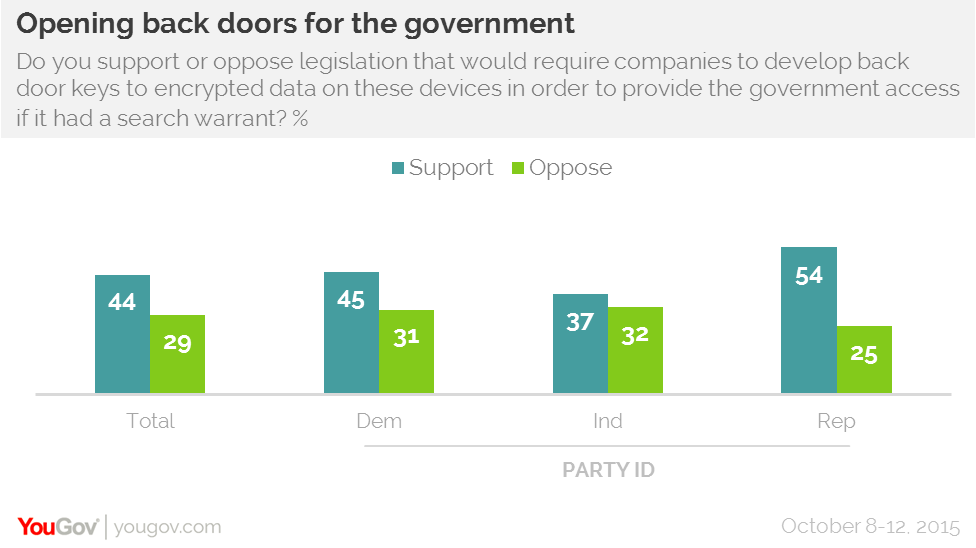
This yougov poll shows more Americans support backdoors in encryption than oppose it
https://today.yougov.com/topics/technology/articles-reports/...
https://d25d2506sfb94s.cloudfront.net/cumulus_uploads/inline...
The last question does show more "favor" than "oppose" for installing back doors in encrypted systems, but the first question shows much more "oppose" than "favor" for reducing encryption to help government agencies. The second question shows that more people want tech companies to protect customer privacy than to cooperate with government agencies to fight terrorism and crime.
So people want encryption back doors that don't reduce encryption and don't require tech companies to cooperate with government agencies. Of course "we can have all the good stuff and none of the bad stuff" is a common delusion among government agencies proposing encryption back doors too.
c.f. also the recent Australian prime minister who claimed that legislation can override mathematics.
I believe the phrase is PI IS EXACTLY 3
And that's where democracy falls down
This is appropriate, under the assuption of accountability; right now, three letter agencies aren't subject to it.
> "We" also have nothing to hide.
This is disingenous or naive (and it's a worringly widespread idea). Literally (as in literal-literal) anybody can be accused and charged, it's just a matter of legal power¹. Giving up privacy makes it dangerously easier.
¹=There's even a book on this subject (although the angle is not precisely this): https://www.amazon.com/Three-Felonies-Day-Target-Innocent/dp...
In reality these are massive organisations of people who want to do good and protect people from actual dangers and repeats of actual harmful incidents. So I think framing the motives as malevolent isn’t helpful because the motives aren’t malevolent.
I think it’s much more reasonable to ask why these things arise. Eg maybe the government says “how will you stop something like x happening again” and they say “well it would have been really hard to detect but we were slightly suspicious of them. If only we could get a warrant to find out what they were talking about...”. And this probably seems reasonable to the minister who still thinks these intelligence agencies are steaming open letters or tapping into phone lines.
It doesn’t even need to be the case that people know these laws would work/be useful, all they need is to feel that they would. And this can quite easily happen without any malicious intentions.
Other things one could imagine happening are finding warrants annoying because they feel like a formality and feeling that the pause in the process potentially causes harm. Or seeing the whole “I ask my ally to spy on my citizens” process as a silly way to get round an annoying loophole. I can imagine something like this happening in a multinational company and if you see intelligence allies as actually working together in a team it doesn’t seem so crazy to see it as a silly legal formality to allow the actual teamwork. So (to say the same thing again) I don’t think these things arise from bad intentions.
A final thing is that many people in these intelligence organisations seem to care about how this surveillance is done in an ethical way (although some people don’t). Eg note here that they want to get this ability with a warrant (perhaps they really want it warrantless and plan to get it or perhaps they feel like they were burned by the various revelations and don’t think they could get it anyway).
Compare this to the way much of the modern mass surveillance we are exposed to every day is planned where there is virtually no ethical oversight at all.
You'd have to be super naive or ignorant of history to think any different. Even if you trust our current regime, you never know what could happen in the future. It's just too much potential harm in exchange for the convenience of simply not having to do targeted spying instead of mass surveillance.
Nobody likes terrorists but mass surveillance is just way too open to abuse.
I'm going to defend what is probably the minority opinion on this site and say yes, I'd rather live in a society where communication is open to surveillance.
The reason being that the situation appears to me very binary (and I think most people would agree on this), either there's strong encryption in which case almost all communication is not subject to surveillance, or the state has the capacity to eaves-drop.
The first scenario scares me because it essentially eliminates the ability to engage in surveillance when it is needed. Be it financial fraud on a wide scale, terrorism, crime, radicalisation or whatever else, and society has a vested interested in having the capacity to prevent this.
I don't think the two most cmmon criticisms hold up. The first one is that surveillance affects many people adversely. I don't think that's true. Nobody has an interest in eaves-dropping on average citizens, it's simply a waste of resources. The second one is the slippery slope line of argument you brought up. I don't think there is a lot of evidence that, in states of law, surveillance has been abused or employed illegaly.
What about in the current case of the Nicaraguan government? https://www.hrw.org/world-report/2019/country-chapters/nicar...
I think it's valid to say that governments like these do abuse surveillance, but my problem with this as an argument in these discussions is that it also equally applies to anything else. They abuse the power of police, of the military, of state owned enterprises and anything else, but yet in other nations we still rely on all of these facilities to a large degree.
So I think there should be a distinction between problems intrinstic to surveillance, and bad actors using surveillance as a tool for abuse.
[1] https://www.privateinternetaccess.com/blog/2016/09/police-ro...
I was thinking more along the lines of targetting of political dissidents, building unlawful programs, arresting people on the basis of information not lawfully collected, and so on.
The Snowden revelations brought this topic up when it comes to US intelligence abroad, but I don't think such violations ever occured inside the US. (or respective western countries, say).
Or let's go old school. Remember good ole' J. Edgar Hoover? Even before the digital age, the man created enough waves through amplified access via HUMINT that cast a pallor of doubt over decades of politics.
There is absolutely no rational reasoning to endorse further centralization to enable systemic abuse. No privileged system will remain free of abuse in the face of those seeking ultimate power. The only way to prevent those seeking it from finding it is to identify the power grab when it happens, and shut it down.
I absolutely do not condone the Four Horsemen of the Infocalypse, but let me be clear; a world with pervasive and perfect surveillance is a world where the machinery, if left alone to it's own devices inevitably tends toward the destruction of our humanity.
I know the religious language may not carry As much weight for some, but I think in this rare case it's the most concise way I can make my point. As sinners, we are born, through forgiveness, repentance, and redemption we grow and cultivate that which as a species is said to entail all that which is generally regarded as being beautiful, and virtuous about us. Part of that, as a societal unit, comes in the form of fighting the most vile amongst us without abandoning the moral high ground.
We don't have police procedures and the rules around dispensing justice because we want above all else to punish criminals; if we were really out to do that, just point the mob of the majority at everyone they disagree with or deem a criminal and 'let God sort it out' as the most ruthlessly pragmatic would say.
On the contrary, though; we make it so hard to police, we constrain acceptable methods of investigation, because at some level we all understand the violence inherent to the system, and the inevitability of the occasional employment of it. We rein it that we may in some manner drive it, and live not in constant fear of those that drive it; as they too are (supposed to be) bound by it's laws.
It should strike a tone of alarm in anyone when those acting as the executors of the system's mandates begin fighting to loosen the rein. In no case does that bode well for anyone involved left unchecked.
[1] https://www.nbcnews.com/politics/immigration/u-s-officials-m...
Intelligence agents willingly sacrifice much of their personal privacy as a condition of their security clearance, so by selection bias would be more willing to subject others to loss of privacy.
> its been proven over and over that if there is a way it will be abused.
Is there actually any good, cite-able instance of government backdoors being abused? I believe it is possible, but i don't know of any instance of it happening.
They seem to unlock most of this info though by attacking the endpoint itself anyway.
Even if it it was possible I think the bigger question is do we want to live in a society where any and all conversations can be ease-dropped on? I get the point that they want it for investigations, but its been proven over and over that if there is a way it will be abused.
Would intelligence and LE also be ok with that same rules applying to them?