If there was a requirement for manufacturers-at-scale to display visual overviews of potential defects over time due to normal use - and with the same prominence as the marketing material:
* a laptop with stressed / broken cables
* a defective keyboard
* inputs in iPhones that appear to fail due to microscopic dust / debris accumulation
then you'd have a forcing function which addresses the information asymmetry in consumer transactions and perhaps you'd quickly see a lot more attention directed at these kind of product defects.
Of course this kind of thought-bubble regulation might be totally unworkable: how do you determine thresholds of wear and tear considering 'correct use' as considered by manufacturer vs 'real-world' use by user base. But then again doesn't good design consider the practical over the theoretical reality wrt product usage?

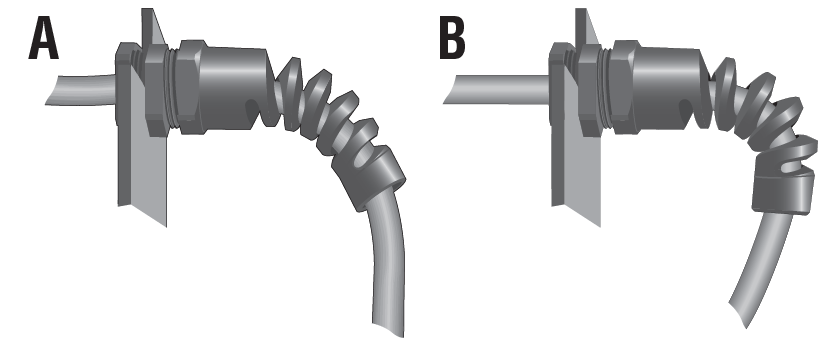
The part circled in red is the strain relief, separate from the cable itself, and from the connector.
Image taken from http://www.blogquail.com/strain-relief/
Others have already helpfully provided pictures of the common stuff.
It's used where you have a flexible material in contact with a rigid material. Most commonly on electronics it's on cables - between connectors and either connectors (when removable) or into the case/device (when fixed).
The strain relief prevents all the stress (from bending, induced by movement or just gravity) being placed on one location and spreads it out.
Once you know what strain relief is, and you look around at all the cables/hoses/etc in your life - you start seeing them everywhere.
Headphones, Keyboards, Network cables, power cables, USB cables. Just sitting at my desk I can see a dozen or more of them.


1. https://store.storeimages.cdn-apple.com/4974/as-images.apple...
That's the redesigned magsafe2 cable with longer and slightly more flexible strain relief.
The original magsafe power adapters had almost nothing, and it was a much harder plastic.
While material choice and thinness may be an issue, it's exacerbated by the strain relief being insufficient.
As they make a fuck-ton on resale of these accessories. (planned obsolescence)
Strain relief is, or can be, somewhat ugly. More angles, thicker cables, varying widths - it all adds up to muddying the lines of their product.
Compared to how much they make on device sales - selling a few more adapters is peanuts. How many people do you know that have downright dangerous cables which they persist in using? I'm sure I know dozens.
But despite the obvious advantages, the next generation went back to the old design, but a little bit smaller, and back to all the old issues. I probably spent a few hundred dollars on replacement 3rd gen chargers alone, while the 2nd gen charger which came with my laptop is still in perfect working order in a box in my closet.
The cynical of me honestly wonders if they didn't see a decrease in peripheral revenue after the first iteration, and reverted to the old design only because of that.
Apple's cables have for generations now been fraying and cracking all because someone decided that strain relief was an unsightly and unnecessary thing.
It could be forgiven if it was on one era of products, and learned their lesson when people started getting electrical shocks, devices started dying, and things being set on fire - but no, they persist.
Even today they've only made the most minor of attempts at introducing strain relief.