As the water level rises we're gonna need to lose some of the cynicism around geo-engineering.
Unless you're convinced that society will somehow value the stability of our climate over economics? I feel like there's more evidence (given our snail-like progress over the past few decades) to demonstrate that's a not gonna work out compared to attempting _some_ form of geo-engineering.
My fear is that once people figure out how to Geo-engineer things with fine tuned results that it will eventually be used as a weapon.
Imagine if you could turn up the temperature of an area to create a drought?
Or flood/freeze out an area?
This could be done covertly as it would be hard to identify the exact cause if done under the 'radar'.
No bomb shells or traces left behind to place blame.
I'll pass on homo-sapiens ego presuming they are smarter than the planet and can fix any problem using technology and our brains.
Maybe for the first time in History we may be smart enough to mitigate the potential ill effects of the climate cycle, however this planet was here long before humans and will probably be here long after.
There was a joke once, about human's being the planets Herpes, which seems to be a good metaphor for our existence on this rock.
https://en.wikipedia.org/wiki/Environmental_Modification_Con...
To restate I am all for being able to help the planet, mitigate our impact using new greener technologies and changing our habits, however this needed to be done a long time ago and trying to fix our current problems with the band-aide of Geo-engineering I personally believe is a futile effort.
Nothing. It already happens in nature, but at a far smaller scale. It is not a self-renewing or runaway process. The point is to distribute the correct amount of olivine to stabilize CO2 at ~200 PPM which is close to its pre-industrial level.
4000 ppm CO2 was found in nature far before pre-industry came along. Does the fact that anything "happened in nature" make it "ideal?" What is the globally "ideal" level of CO2 anyway? Certainly 200ppm is an order of magnitude low when considering the ideal for plants.
200ppm is around the level humanity, and much of the flora we share the planet with, evolved. It's the level we started to develop from, to farm.
Nature and the planet has no ideal, it copes with whatever there is. Humanity on the other hand would appear best served by the level we evolved with - 200ppm or thereabouts. 400ppm causes problems for us, 4,000ppm would almost certainly be the end of us or as near as makes no odds.
If by "end of us" you mean human extinction, I'm curious why you think that. Reducing the co2 in a building to whatever level one wants is cheap enough (by bubbling air through water mixed with soda lime or lime) that it seems to me feasible for a few million humans to survive indefinitely even without major advances in technology. (I am assuming that the cost of a co2 measuring device, currently over $1000, could be driven way down before they would be needed in large numbers as part of the machinery to reduce co2 levels inside buildings.)
Wouldn't most food crops would grow much better at 4000 ppm than they do now?
People would be able to go out into the 4000-ppm-co2 outdoors for hours at a time with no obvious serious problems. (I exposed myself to higher levels than that for years by sleeping in a very small room with very low "draftiness". Not recommended of course.)
Co2 at 4000 ppm would kill billions of us and make the survivors miserable and is certainly something I wish for humankind to avoid, but that is different from human extinction.
End of our civilisation. End of us as an industrial society. Perhaps as relevant and historic as the Romans or Ancient Egyptians. I'd prefer to stop long, long before that.
Who knows all the knock on effects of 4,000ppm, I certainly don't except to say it's way beyond the worse case models I've seen. End of much productive work outside. Reduced performance for all. Probably much of the equatorial and tropical simply uninhabitable. We'd be looking at what, 7, 10, 12 degrees? I have no idea. Heaven knows how many reinforcing tipping points will kick in. I don't think we can confidently say it won't result in actual extinction. Even if it probably won't.
We'd lose both ice caps, so something like 60 odd metres of sea level. How many major cities and entire countries does that lose? I've seen maps that at just 4C much of the USA's farm land would be near desert, and the Sahara greening. Unprecedented temperature, habitat and rainfall changes with no idea which species will make it, and which not, maybe many we depend on to eat. How much forced and unwelcome migration? Which prediction is the accurate one? With that energy in the system are we looking at cat 10 super-hurricanes?
Does it matter if it's 0%, 1 or 2%, or even 10% are grubbing out a post-apocalypse zero growth life or whether it's Mad Max, 18th C or bronze age? Unrecognisable. Unpredictable. Survivors would tell fables that their ancestors did it. Knowingly. Maybe some other species gets its chance and does a less idiotic job.
I don't think the difference matters. At all.
As to humans, 400ppm causes zero problems, matter of fact, OSHA says 1000ppm for continuous exposure. NIOSH says 10,000 ppm for a 10 hour work shift.
For instance: https://inspectapedia.com/hazmat/Carbon%20_Dioxide_Exposure_...
You mean it causes zero known problems.
Medicine and biology are not yet advanced enough to say in most case whether putting the human body in a condition humans haven't experienced in 800,000 years is harmful. It took decades to learn that asbestos is harmful. If the harm caused by asbestos were cognitive decline rather than shortened lifespan, it probably would've taken longer, and cognitive decline is the effect that appears at the lowest concentration of all of the known adverse effects of co2. (One study found cognitive decline after 2.5 hours of exposure to 1000 ppm.)
Plants use co2 to make their bodies just as we use proteins, fats and carbohydrates to make our bodies, so I am not particularly reassured by knowing the plants thrive at very high co2 levels.
Graph of co2 levels over the last 800,000 years: http://kaltesonne.de/wp-content/uploads/2017/03/co2-1024x576...
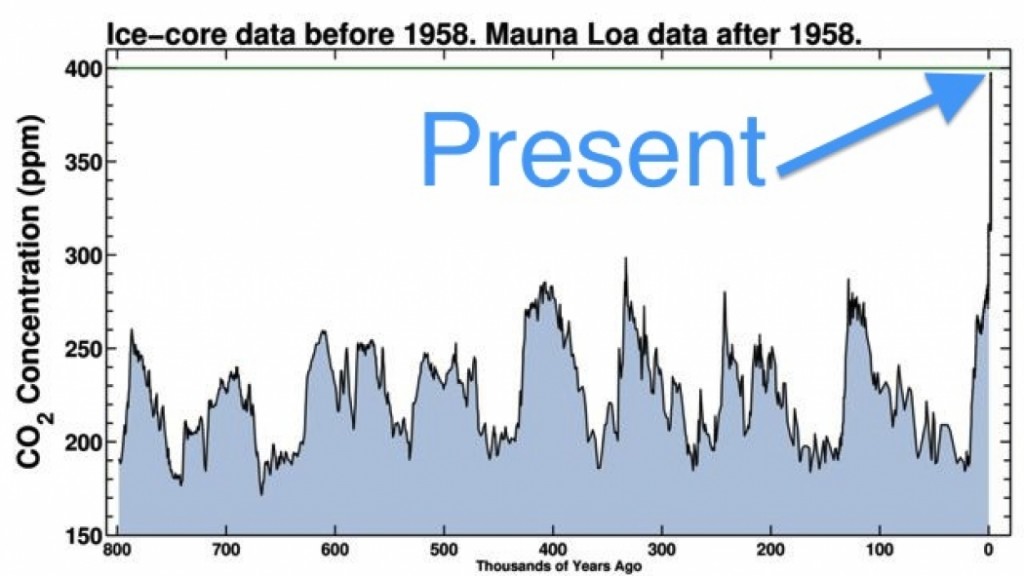
I'd say that's far from zero problems.
What could possibly go wrong?
Edit: not sure why the downvotes. Perhaps I should have explained my skepticism more clearly? Any geo-engineering initiative almost always fails to predict the unintended consequences for the environment - e.g. perhaps one day we'll discover that too much olivine rock on beaches destroys ecosystems, or something else.