There are a range of renewable generation and storage options only seriously industrially developed for just a couple of decades yet already wind and solar products are the cheapest form of new generation (without subsidies).
So in depth comparative analysis is moot now, current renewable options are cheaper even including current storage options to make them dispatch-able, and they will continue to get cheaper. Nuclear will not catch up without some game changing invention which would practically amount to a new technology that we cant debate yet.
Only lingering passionate argument from the years when there was some uncertainty about renewables potential maintains any vision of nuclear competing with them to provide carbon neutral and environmentally friendly power, at the present and into the foreseeable future.
https://www.lazard.com/perspective/levelized-cost-of-energy-...
Most people agree with the consensus that nuclear and some renewables (wind/solar/hydro) are low carbon. Other renewables (biomass) are not low carbon.
Then we quickly descend into a debate that effectively comes down to energy storage for the intermittent renewables vs. the cost of nuclear. Wind is at full power ~35% of the time in the US, solar is at full power ~25% of the time in the US. Recent nuclear builds in the US and Europe have been absolute boondoggles, though S. Korea remembers what the learned from Combustion Engineering and can build standard reactors very well now.
Energy storage discussions span daily fluctuations (e.g. the duck curve) and batteries to seasonal fluctuations (much more challenging for know storage tech).
Nuclear discussions also inevitability dip into nuclear waste (which has a scientific consensus solution in the deep geologic repository) to safety (where more people die every day from coal as-normal emissions than have been killed by nuclear accidents ever). Renewable discussions dip into land use, San Bernardino Co's recent ban on new large solar in the desert, migratory Hoary bats getting their lungs ripped out by wind turbines, and so on.
I consider nuclear a total underdog right now because Wind and Solar are kicking butt while nuclear plants are getting shut down early. Because of this dynamic, I advocate for nuclear as part of the low carbon future. I wrote a thing about these topics in more detail here [1].
Bill Gates recently said that the people who say solving climate change will be easy are now more of a problem than people who outright deny climate change [2]. I agree with him. Lots of headlines you see on /r/Futurology and /r/energy make it seem that decarbonized world is right ahead of us. It's not, and cheap fracked natural gas is enemy number one. Sure, it's half the CO2 of coal, but that's still an order of magnitude too high!
Many pro-nuclear people like myself are also very pro low-carbon renewables. The one vs. the other mentality is strong in both camps, but there's a growing number of "centrists".
[1] https://whatisnuclear.com/blog/2017-12-17-primer-on-energy-g...
The lesson from recent nuclear power plants in Europe is that we can't build them on budget and on time anymore. Maybe nuclear is affordable if it's on budget, but is it still when there's massive budget overruns?
How does the cost trend look? It doesn't seem likely that we'll be able to relax regulations on nuclear.. so is it likely to get significantly cheaper? If you look at cost projections 20 years into the future, will it still beat solar- and wind with storage?
And are there developments in load following nuclear power plants? Solar and wind needs to be paired with load following plants, not base load.
It seems to me like we need to put massive investments in R&D to develop a small plant (so it's easier to iterate) that can be a perfect match with solar/wind, yields less dangerous waste and has low proliferation risk..
I've seen some interesting startups in this area. Everyone working on it should be given more money and regulatory support. I feel like there's a significant risk that those developments could be made irrelevant if there's further breakthroughs in renewables and storage, but we need to hedge our bets.
Nuclear in the West is in rough shape, but again the Chinese, Russians, Koreans, and even the Japanese are pretty good at popping them out on time/budget. They all have established supply chains and trained craftsmen. Korea, in particular, is amazing. They chose one design and standardized it and built a bunch of them. This is the model of success in nuclear.
For this reason, it worries me a bit that lots of small startup in the US are trying to build different reactors in relative isolation. This is not the kind of industry where that is likely to go well. It takes billions of dollars to get to first product.
I think the open source model is much more likely to succeed in nuclear. Most of the tech is commodity anyway, so finding a business plan around this shouldn't be overly challenging.
The guy who built Korea's nuclear industry just did a great interview where he basically said that the US taught him how to build nukes, they perfected it, and now he wants to partner with the US again to decarbonize effectively with standardized nukes. [1]
https://www.technologyreview.com/s/613325/how-greed-and-corr...
I often wonder about non-compact kinetic energy storage, like huge fly-wheels or railcars, since kinetic energy is quadratic with velocity. When using a large radius circular railway, the limiting factor is no longer tensile strength as in usual fly-wheels. I wonder how low frictional terms can be brought for evacuated tunnels. the rail could be the stator and the circular train the rotor, or the other way around: a constant cross section "train" of mass with a rail as the rotor, and the fixed train wheels as the stator underneath... if it is underground or in a pit accidental energy release could be less catastrophic.
https://www.osti.gov/biblio/6836648
https://www.researchgate.net/publication/224376883_Magnetica...
Graph: https://partofthething.com/thoughts/wp-content/uploads/ipcc-...
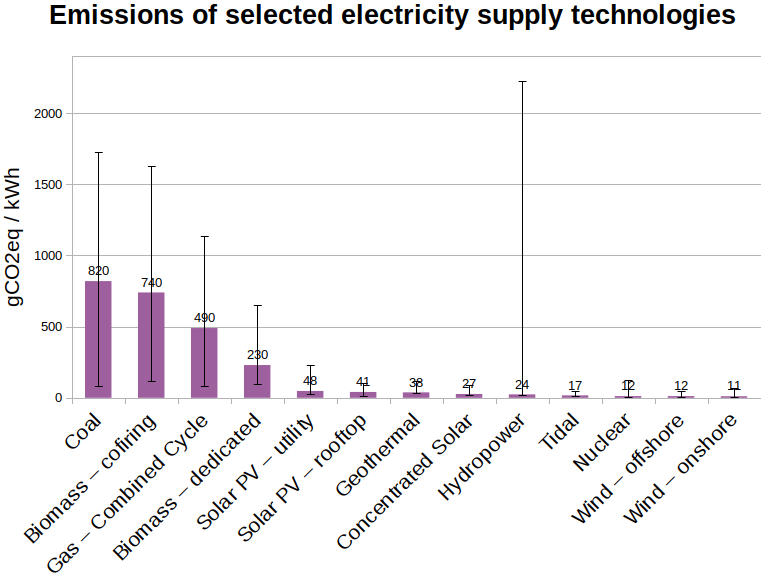
Citation: Schlomer S., et.al., 2014: Annex III: Technology-specific cost and performance parameters. In: Climate Change 2014: Mitigation of Climate Change. Contribution of Working Group III to the 5th Assessment Report of the IPCC)
Link to source: https://www.ipcc.ch/site/assets/uploads/2018/02/ipcc_wg3_ar5...
Then ponder the financing problems of decades long megaprojects counting on a certain minimum electricity price after completion.
I'd be super interested to read it.