The real way to make an impact on the world isn't by shouting as loudly as you can about whatever the issue of the week is. People tune out, and soon you're just shouting into an echo chamber.
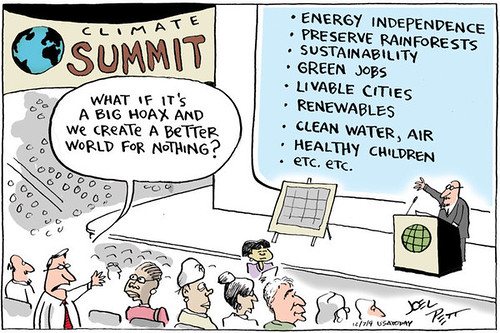
We know there's a crisis with plastic in our water and entering our food supplies, even killing our fish and birds. We know CO2 levels are rising. But there's one place where we don't have any data about these two problems: North Korea. Saying we should wait until we get data from North Korea to judge whether or not it's a global problem isn't restraint. It's being intentionally obtuse.
That's probably why no-one is saying that. Try to resist the temptation to set up exaggerated caricatures of your opponents' arguments as straw men: this does not lead to anything positive.
The areas not surveyed are places where it’s quite difficult to carry out such a long term study, like Africa and the Middle East. Waiting for a 40 year study to be completed in central Africa, one of the locations mentioned in the article, is quite the delay, and it may not even be possible to do at the moment. Delaying actions in Germany and Indonesia to wait for this is, very simply, asinine.
A society designed for longevity does not behave this way. Instead it follows an approach of punctuated equilibrium where it accumulates technology and robustly tests it in small pilot projects that are highly monitored and contained. Then after maybe a 1000 or 10,000 years when technology has matured it introduced a set of well tested technology into the system whose effects are very well understood. In this way a society designed for longevity goes through epochs and evolution... rather than extinction in short order.
It's also much easier living in such a society because change is very gradual so having to retrain or learn new things in a lifetime is not necessary.
I have no interest in an appointed elite debating for 40 years whether the smartphone will be a problem before deigning to allow it's adoption.
The point is also not to argue the adoption of a single piece of technology... but to allow the adoption of an epoch of technology all at once whose interaction you can predict... because proper science and due diligence has been done on it. And also to create a real culture that you are born into and will die with... rather than the disposable culture of everything... i.e. the tech that you are born with is the tech you will die with.
The fact you're expressing it here is a more an attempt to step-around the reality that the US refuses to confront it's fear of having a strong government. The original Deus Ex game actually had a very good line regarding this - "the West, so afraid of strong government, now has no government - only financial power."
In a bid to avoid having to deal with the problems of corporations and wealth, people like you would try and reach into research laboratories and tell people to stop working on things which would genuinely improve the planet. Your problem is not the adoption of technology, it's a cultural refusal to limit the power of money in the belief that soon you'll have some and don't want to be limited.
This presumes that strong governments don't deserve a critical eye. It's not hard to find contemporary examples worldwide and historical examples in any country.
But the US government is violent today. Yet incredibly weak at protecting it's citizens welfare or rejecting external manipulation against them.
And the US government is formed by its citizens. It's presumptuous, and I'd argue dangerous, that a government should be in a paternal position. In particular, if a democracy is in charge of purifying the media its citizens consume, who holds the the government censors and gatekeepers accountable if (when) they become corrupt?
It's not a coincidence that Venezuelan leadership cracked down on courts and independent media as it slid into the current mess.
Further, "protecting its citizens" is often narrowed to "protecting the true citizens", enforcing bigotry with a patina of honorable intentions. See the Jim Crow American South, the Spanish Inquisition, and the murder of Christians in 17th century Japan.
UNITED NATIONS (AP) A senior U.N. environmental official says entire nations could be wiped off the face of the Earth by rising sea levels if the global warming trend is not reversed by the year 2030. Coastal flooding and crop failures would create an exodus of ″eco- refugees,′ ′ threatening political chaos, said Noel Brown, director of the New York office of the U.N. Environment Program, or UNEP.
He said governments have a 10-year window of opportunity to solve the greenhouse effect before it goes beyond human control.
The article is identical as quoted above, except for the date. It's actually talking about 2000 - 19 years ago. The article was written in 1989. With climate change we made rather catastrophic predictions long before we were reasonably certain of them. And I think this was generally well intentioned. It's the same logic as above. The worst case outcome of doing something is far less bad than the worst case outcome of doing nothing, and so focusing on the extreme seems justified.
Yet I think this exact behavior is a big part of the problem. Each highly publicized prediction that fails to come to be results in an ever larger blow to credibility. Have this happen often enough and ever more people simply stop caring altogether, as in the fable of the boy who cried wolf. And so should insects become the next hot button issue, I think we should very much make every effort to ensure that our predictions are in no way whatsoever aiming to invoke emotion or utilize sensationalism. And so in this way, I think articles such as this which overview with data with a tempered and level head and likely to be a million times more effective in effecting actual change than the extremely sensationalized and hyperbolic articles from other media outlets.
----
Look at it this way. Imagine you could go back in time and change history to try to optimize the chances of society doing anything about climate change. What would you change about the past 30 years? In my opinion had we avoided the doom and gloom predictions and simply focused on testable demonstrable effects, we'd be much further along today simply because the credibility of predictions going forward would have a much higher degree of credibility and proven reliability behind them. And so I think going forward on this issue, the #1 thing we should focus on is credibility and reliability of prediction.
The article summarizes as: there are a number of studies from specific geographies (Germany, the Netherlands, Puerto Rico, etc) that show very dramatic declines (> 50%) of insect populations over the last few decades. Since there is no data for most other countries, we should not react for now until more studies are done.
In the general case, when there is insufficient data, such an attitude can be seen as rational. But not when the data are so severe, and time is clearly running out. It is time for action, not for more business as usual.
Ugh. I hope future generations will be around to forgive us for screwing up the planet.