So perhaps Boeing felt that this didn't really change anything in that regard. They seem to have been proven wrong.
* Control airplane pitch attitude manually with control column and main electric trim as needed
* If the runaway stops, stop.
Well, electric trim input on the yoke will stop MCAS temporarily. Of course if these guys had any experience on an NG they're already used to the computers trimming the plane in a counterintuitive manner via the speed trim system (STS). So not only is MCAS not a runaway trim situation, but pilots flying the NG will get used to the computer trimming the stabilizer "at random".
1: http://www.737ng.co.uk/737-800%20Quick%20Reference%20Handboo...
  4 If the runaway continues:

      STAB TRIM CUTOUT switches (both)   . . CUTOUT

      If the runaway continues:

        Stabilizer trim wheel    . . . . .   Grasp and hold

  - - - - - - - - - - - - - - - - - - - - - - - - - - - - -

  5  Stabilizer    . . . . . . . . . . . .   Trim manually
This is what the Lion Air crew of the flight before the one that crashed did, in response to the same sort of MCAS failure, and completed the flight without further trouble. While Boeing made a serious error in hiding the differences between this variant and its predecessors, it seems that the prior trim runaway procedure does work for this sort of MCAS failure (unless evidence to the contrary comes out of the Ethiopian Airways investigation.)
I think the problem is that the symptoms are different from other 737s, and if you don't KNOW about the MCAS stuff, that's very surprising. So as humans, even though logically the same procedure applies, instinctively you don't think to do it. And given the very short time frames involved, and the margin of error, it's not too surprising that these events have occurred.
Perhaps the need-to-retrain criteria needs to include the following amendment:
If the craft exhibits new symptoms, even if the response to those symptoms are covered correctly be the old operations manual, pilots will need to be retrained to account for the new symptoms.
No, it doesn't and that's the problem. A runaway won't stop when you hit the trim buttons.
Depends on what causes the runaway. If the autopilot goes berserk, the trim buttons will override it (if I recall correctly, it's been a long time).
So while yes, runaway trim is a thing, the circumstances under which an error could happen are substantially different.
For instance, a pilot could check the maintenance log book and see some work or inspection was done on the auto-trim subsystem. This would prime the pilot to be more on the alert for the possibility of trim misbehavior during the flight. Crisis averted, right?
But no pilot would look at an entry for an AoA sensor being off or worked on, and would think, "Boy, better look out for that safety system I never knew existed that could cause a trim runaway because my previously airworthyness agnostic AoA sensor is unreliable."
Flying and complex system diagnosis in time sensitive conditions requires extensive ahead of time mental model creation ahead of time.
If anything, the process of engineering is most difficult in that answering most questions tends to be straightforward (not easy, but straightforward once you know the right methods to apply), while figuring out if you've asked all the right questions is the thing that keeps me awake at night. If you don't ask and dig in until you've answered it fully, it's easy to get blind sided.
I have difficulty believing it could have gone so horribly wrong now, but I can't deny that just from the information available, even if MCAS isn't the root cause of the Ethiopian Air crash, there is some egregious failures in sound practice going on with Boeing to have slipped up this badly.
That's the thing with sound Engineering, when you do it, it just verks. When you don't...
That's a tall order when the manufacturer doesn't inform their customers out of commercial expediency.
You could choose to select the input that results in the least-worst bad outcome. But that may not bring the total risk below the increased risk of utilizing both sensors. The sensors are doing something purposeful, after all.
So it may be logical what they're doing. OTOH, the logic may make sense only in a path dependent sort of way, after a series of bad decisions that put them in a corner with poor options. There probably really should be 3 or more sensors.
Without any ability to differentiate bad from good input, you may be better off simply relying on a single sensor at any one time and completely ignoring the other, at least as far as controlling MCAS is concerned. Tossing up a warning that says the sensors disagree is another matter.
I agree that one can argue that this doubles the chance of system shutdown compared to properly detecting that one sensor fails. That's obviously only ok if the system is expendable to a certain degree.
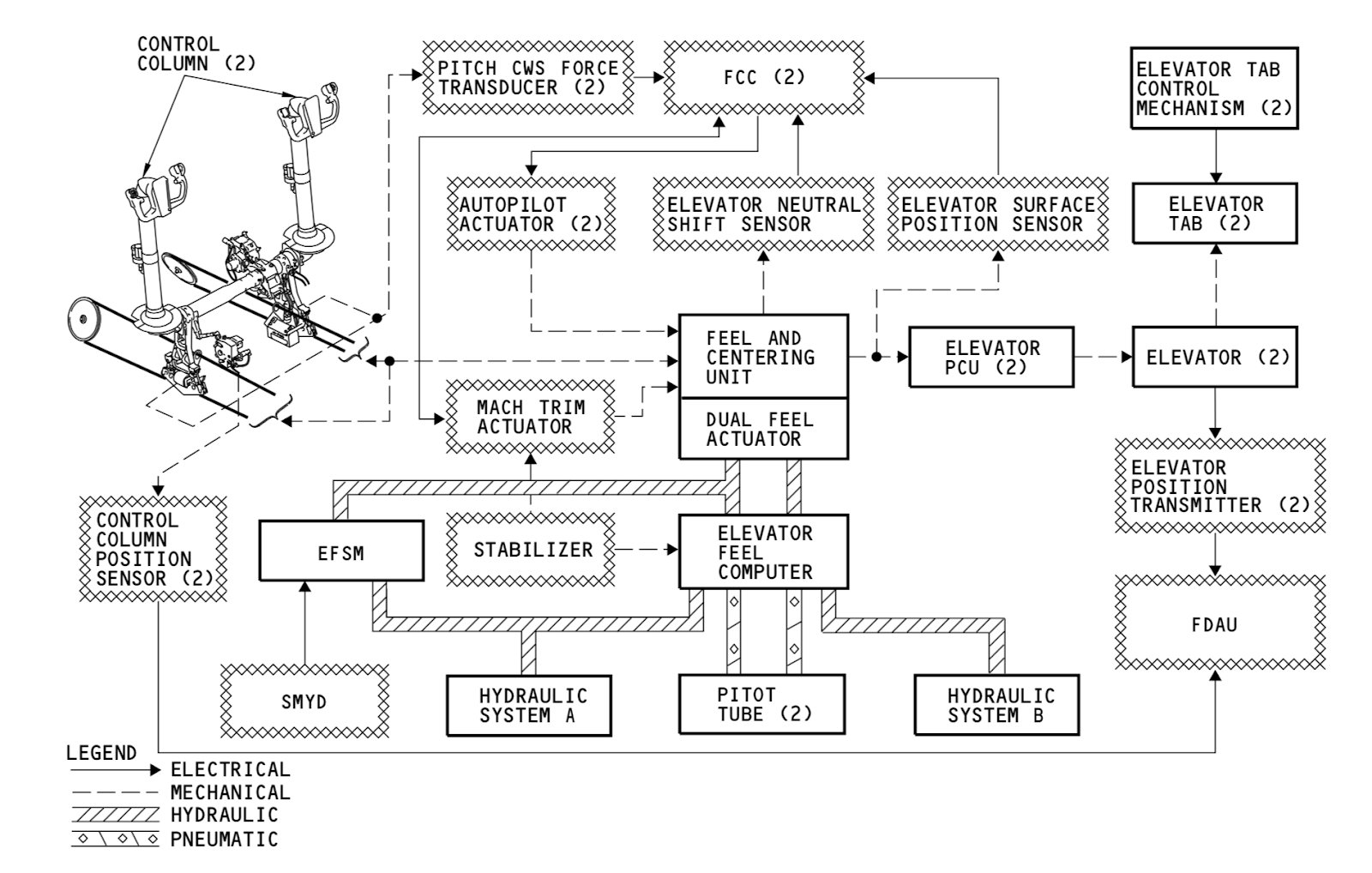
The elevator feel system (EFS) uses multiple sensors, in fact it has its own pitot probes[1] (two of them) on the elevator. It's not clear if it uses both, but I suspect it also uses both alpha vanes up front like MCAS should be doing. Input from the alpha vane (AoA sensor) is new on the MAX, IIRC. His tweets were a bit ambiguous, but the elevator feel system does not change the trim at all (also EFS was non-op on the Lion Air bird).
It's almost certainly NOT a sensor problem. Look at the graphs from the black box on the Lion Air flight. The angle-of-attack was almost exactly offset by twenty degrees left to right[2]. That sensor was working just fine, but something else on the path was fucked up (bad wiring? bad ADIRU? both have happened before). The fact that the alpha vane was replaced and that didn't fix the angle-of-attack readings supports this. Also, the 737 NG and 737 MAX use identical alpha vanes. While the angle-of-attack data is less important on an NG, we haven't seen people come out of the woodwork talking about how common alpha vane failures are on an NG. I'm inclined to believe that they're not all that common.
The Lion Air flight crew did write up the sensor problems[3].
I saw another one of these "I'm a software engineer so I've got great insight" posts[4] and chuckled. It's a bit of swing and a miss as well. MCAS is hardly silent or subtle. The same trim wheels his Cessna have are present on the 737 and they're noisy[5]. MCAS doesn't quite override the pilot either, and you can see that on the black box graphs from the Lion Air flight[2]. Twenty times the pilot flying entered opposite trim to counteract MCAS and twenty times MCAS paused for five seconds. On the twenty-first time something changed and the plane crashed. It's not quite that simple and that's why there are active investigations.
1: https://4.bp.blogspot.com/-ZsL1asAUBRU/W-pSdWs2dYI/AAAAAAAAF...
2: https://reports.aviation-safety.net/2018/20181029-0_B38M_PK-...
3: https://theaircurrent.com/wp-content/uploads/2018/10/jt43-jt...

4: https://medium.com/@jpaulreed/the-737max-and-why-software-en...
You say that the MCAS is neither silent or subtle, but there is no light or master caution or anything, just the trim wheel turning and clicking. I’m not sure you’d notice it if you were wearing a headset and were being distracted by the stick shaker.
The reason they died on activation #21 and not #1 is that the effects are cumulative. Every time it activates it dials in another 2.5 degrees of nose down trim. Eventually you can’t pull on the yoke hard enough to hold altitude.
I agree that the jury is still out as to whether it’s a sensor issue per se or some sort of ADC or data transmission issue.
The stabilizer position was graphed on that preliminary report (see: pitch trim position). There was a slight trend towards nose down pitch, but no, at the time they lost control there's a sharp decrease in pitch that doesn't correlate with MCAS. If you look at the "trim manual" line you'll see that the pilot flying was continuing to input nose up pitch on the switches to no effect. Something changed and it wasn't simply that the pilot was overridden by MCAS. After 21 even MCAS continued to counter the pitch up inputs as the stabilizer continued to contribute additional nose down pitch.
I agree that the jury is still out as to whether it’s a sensor issue per se or some sort of ADC or data transmission issue.
To be clear I highly doubt the alpha vane was defective. It's a possibility, but look at that graph. The left "angle of attack indicated" mirrors the right one almost exactly except that there's a near constant twenty degree offset. If that's a sensor problem in two separate sensors I'll pull a Werner Herzog and eat my freaking shoe.
BTW the trim wheel has little stripes on it, moves quickly when being operated automatically, and is fairly noisy. It will get your attention. However, my suspicion is that pilots experienced on the NG will mistake the trim wheel doing counterintuitive things for normal STS operation (especially after takeoff). I don't know if the Cessna trim wheel(s) are any quieter or more subtle, but the Cessna certainly doesn't have all the band-aids that a 737 NG or MAX would.
To this point here's a post from a 737 NG pilot[1]:
As a long-time 737 driver I'll just chime-in a few points
[...]
(1) Just after takeoff there is a lot going on with trim, power, configuration changes, and as noted above, the darn speed trim is always moving that trim wheel in seemingly random directions to the point that experienced NG pilots would treat its movement as background noise and normal ops. Movement of the trim wheel in awkward amounts and directions would not immediately trigger a memory item response of disconnecting the servos. No way.
(2) The pilots could very reasonably not have noticed the stab trim movement. Movement of the stab trim on the 737 is indicated by very loud clacking as the wheel rotates. On the -200 it was almost shockingly loud. On the NG, much less so. HOWEVER, the 737 cockpit is NOISY. It's one reason I am happy to not be flying it any more. The ergonomics are ridiculous. Especially at high speeds at low altitudes. With the wind noise, they may not have heard the trim wheel moving. The only other way to know it was moving would be yoke feel and to actually look at the trim setting on the center pedestal, which requires looking down and away from the windows and the instruments in a 'leans'-inducing head move. On the 717, for example, Ms. Douglas chimes in with an audible "Stablizer Motion" warning. There is no such indication on the 737.
[...]
Finally, runaway stab trim is a very, very rare occurence up until now. We trained it about once every other year in the sim because it is so rare. And when we did it was obvious. The nose was getting steadily heavier or steadily lighter with continuous movement of the trim wheel. That is a VERY different scenario than what these pilots faced.
We also trained for jammed stabilizer, the remedy for which is overcoming it with force. The information they were faced with could very reasonably have been interpreted that way, too.
1: https://www.pprune.org/rumours-news/619272-ethiopian-airline...