Google would be fairly easy to break up among Alphabet subsidiaries, and Amazon could be split among Amazon.com, AWS, and Whole Foods.
She actually gets fairly specific about what she her plan is if you actually read the medium article linked in the first paragraph of the OP.
While i agree with you wholeheartedly i don't know anyone who has ever got elected by attacking the media and big business.
But there are issues:
+ Amazon uses profits from AWS to dump in other sectors, selling goods and services below market value. The weird situation could mean Amazon pumps many billion dollars a year into pushing major grocers (who operate on thin margins) out of business. This is not good for anyone - but it's not a case of 'monopoly' so much.
+ Google is dumping in adjacent areas of tech - giving away Android for free, for example.
There should be some regulatory tweaks here, but it's going to be tricky.
As you point out - a much easier win would be to break up value chain consolidation over all.
Carriers, tech providers, content creators, content distributors - might benefit from being separate entities.
I don't think there are any net benefits to society from these entities being consolidated. There are no economies of scale, no proper synergies. There are however, huge incentives for investors to have AT&T own content creation and distribution obviously, so they can subsidize their own assets and not others. There's no long win for consumers so it makes sense to keep them separate.
Finally - there might be an opportunity on platforms. I think that the Apple store may be an anti-competitive issue - the notion that you don't control/own the $1K device you just bought is getting ridiculous. I would require platform makers to at allow open access to the platform. Same would apply to mobile phones being 'locked' onto a network - that should just not happen.
There is big competition in cloud computing so AWS is priced according to market rates. I seriously doubt AWS profit is significant enough to influence the rest of Amazon in way that would be considered monopoly abuse. Amazon's purchase of Whole Foods did not result in WF reducing prices (as was expected) to uncut other grocers in that market.
> Google is dumping in adjacent areas of tech - giving away Android for free, for example.
That ship has sailed; Google effectively eliminated the market for mobile operating systems and Microsoft could basically no longer sell Windows Mobile. But the open-sourcing of Android has led to direct competition as well -- Amazon runs a completely Google-free version of Android on their products.
AWS profits were worth a few hundred billion over the past seven years. As Amazon only as $40 billion in cash on hand, it's hard to argue they haven't put that money to good use.
[0]: https://ir.aboutamazon.com/news-releases/news-release-detail...
It's impossible to prove in most cases because it may have nothing to do with intent.
Amazon's advantage in 'groceries' is inherently structural.
They can sell bananas for 10 cents less than Safeway because their opex may be subsidized, or they can transport cheaper, not 'because they are acting predatorily'.
The nature of this value chain overlap is inherently problematic.
The thought of 'putting grocery chains out of business using surpluses from AWS' never has to even cross Bezo's mind, or the minds of anyone in the entirety of Amazon. It can happen due simply to structural issues.
For much the same way, it's impossible to have a free trade deal with China, so long as they have political controlled financial system and currency. 'Dumping' will be an artifact of the system as a whole. Nobody even needs to think it for it to happen.
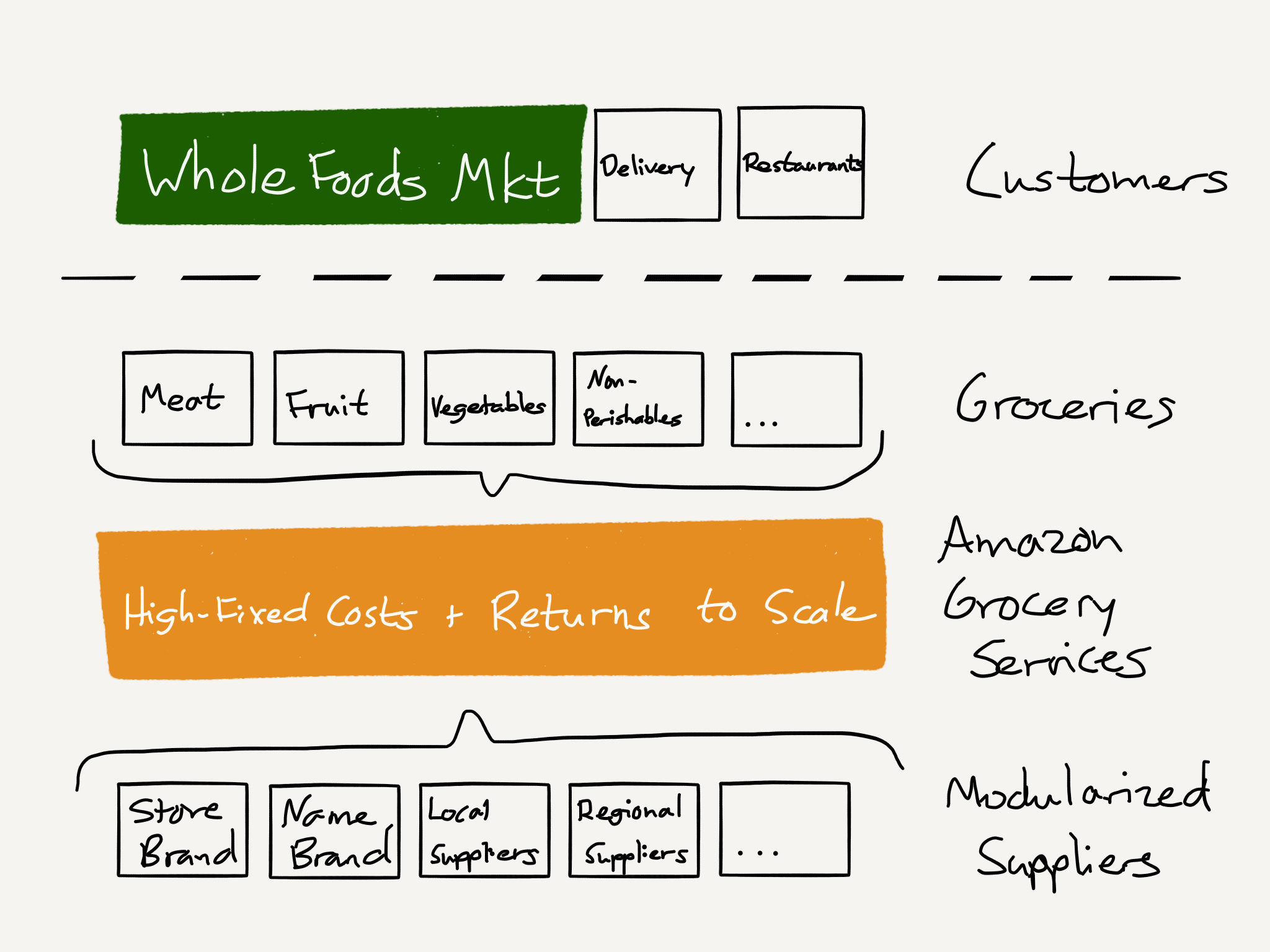
In this model, Amazon WANTS grocery stores to stick around, and buy groceries from Amazon wholesale grocery. The same way that amazon wants AWS to be everyones platform, and for their business to flourish.
But Amazon is going to open a regular grocery store chain soon, so it won't be just Whole Foods.
What Amazon 'wants' is to make money. If they can control all of the food distribution in the US, they will make not only all the profits from that market - they'll make a 'monopolizers surplus' from having the power to charge higher prices in the long run.
That cash-cow is much bigger than the partial cash-cow of owning only an intermediary layer.
I can't think of a single market segment where Google and Amazon lack effective competition. Facebook is already bleeding users, and how would you break up a social media company in an impactful way anyhow? Facebook's ventures outside of social media aren't even close to being monopolies.