Re:Cache Eviction: When Are Randomized Algorithms Better Tha...
by NovaX on Monday February 18, 2019 @11:47AM
(#19191971)
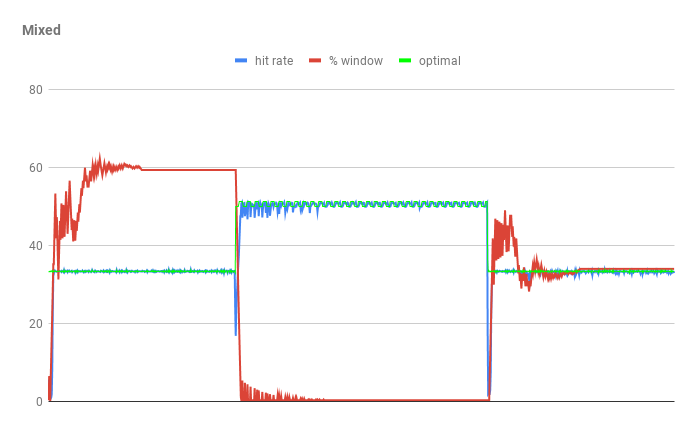
Naming aside, the structure is <LRU | LFU filter | LRU>. The latest version of that is adaptive, where the front LRU may grow or shrink based on the workload. This allows the cache to mimic LRU for recency-skewed workloads (e.g. job queues) and LFU for frequency-skewed ones (e.g. loops). In a stress test, ARC and LIRS had 20% hit rate, Caffeine has 39.6%, and Optimal is 40.3%.
https://user-images.githubusercontent.com/378614/52891655-29...
If the overhead of the cache itself is significant, as in kernel virtual memory management. A clock based algorithm is usually preferable which uses an array to approximate node based structures. ARC and LIRS have CAR and CLOCK-Pro respectively to simulate them. CAR is vulnerable to re-use distances near the boundary of the cache size. [1] CLOCK-Pro is widely used, notably in Linux VM. [1] https://www.slideshare.net/huliang64/clockpro