But as you say, not a high-end keyboard experience.
The optical hand tracking I mentioned was cameras on sticks perched on an existing laptop. So the multitouch was in addition to, not a replacement for, a niceish-for-a-laptop thinkpad keyboard. Well, except for modifier keys without the pinky exercise of actually pressing them (which may or may not be actually viable). If you ever say tactilely run your hands over your keyboard, and say drum your fingers, but all without sufficient pressure to press any key, it was that experience, added to the usual keyboard experience. With 3Dish hand pose and motion available, the two modalities might demultiplex fairly cleanly.
Even for programming in VR, I'd like to avoid UX regressions, and so start with a nice keyboard. Though I was happily surprised by being able to hold a chopstick without it much degrading typing. Providing a nice in-hand high-precision 6DOF controller. And potential 6DOF (pressure) stylus - ball on the end let it sort-of glide over keys... but jitter and pragmatics would need improvement to be viable.
Optical position tracking of fingers was actually ok (but not on a bus, and not so much for stylus), and with a look-along-the-keyboard-surface mirror, even optical height and touch was ok. But the touch wasn't great, and occlusion was a "keep it always in mind" problem. So I would have been delighted to find say a low-precision multitouch textile, to hopefully drape over the keys without too-much impairing typing. To decouple a fast low-precision-XY high-precision-Z touch, from simple and adequate camera XY. But crafting a capacitive grid... seemed a yak too far. All this was yak shaving - I actually wanted to be exploring VR IDEs catalyzing improved programming languages. :/
[1] https://upload.wikimedia.org/wikipedia/commons/c/ca/ThinkPad...
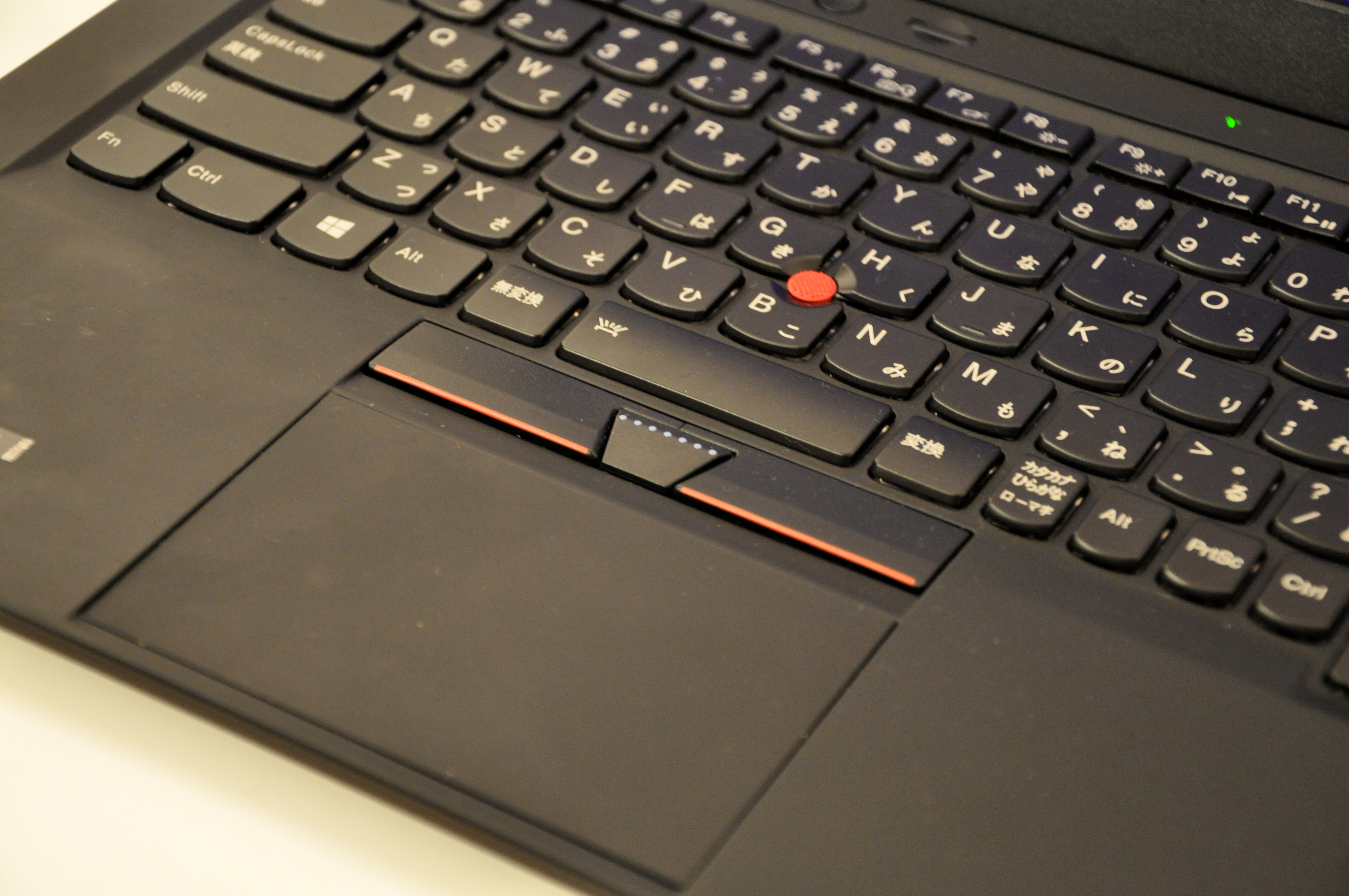
Anyway, Apple has patents covering this idea. I believe 9,041,652 is the one I'm thinking of.
Commercial HID innovation seems to be bimodal, DIY and bigco, with a patent-induced desert in between. Take multitouch. Years of crippled small companies, selling kits to dodge patents, to small DIY communities (DIY historically being much less of a thing than now). Speech-to-text and Nuance. Hand pose from webcam and colored glove research, becomes of-course-unsuccessful startup, bought by bigco, and thereby unavailable to support further innovation. Leap Motion's DIY Project North Star is an ongoing example - there's software, and you can buy parts, but not devices. So while there's an active small-company ecosystem around say keyboards, that falls off really fast. Small-scale markets of oem support for exploration and innovation... aren't an interesting niche for bigcos. So they produce patents and not products, and even proven too-small-just-a-distraction-for-us markets are abandoned.
As education innovation starts overlapping ML and tech, it looks to be picking up similar dysfunction. Ah well.
Myself, I really want more touch feedback from my keys, not less, but to each her own!