What if America's education problem is that the children don't have parents who can nurture them?
Because we have stagnant or decreasing real wages? Because the cost of daycare, housing, health, and advanced education have all gone up? Because we're making it harder to declare bankruptcy? Because we're criminalizing activities, and ripping families apart?
Maybe it shouldn't be a surprise that our education is ranked poorly.
And pointing to education, as though it's a system we can study in isolation, and claim that it's a failure, therefore other state-run systems must also be failures, isn't really being honest?
And maybe it's worthwhile to look at other countries with the economic conditions we're proposing. Like single payer healthcare. Because we can look at them.
You're absolutely right that "just because something is run or controlled by the state does not mean it will magically be either efficient or high quality."
But people like you seem to delight in using that as an argument against government programs that have been shown to be effective, again and again, in country after country.
So then I can say, "just because something is run or controlled by the state does not mean it will be either inefficient or low quality."
And we've both said something completely meaningless, and now can we please get back to looking at examples from other countries, and try to learn from them?
https://nces.ed.gov/surveys/pisa/pisa2015/pisa2015highlights...
Singapore almost always takes 1st in international test scores and their long time leader didn't pull punches
and it's not an income thing, the poorest whites and asians score as high as black students from families making 200k+ a year
https://i.imgur.com/PD9hz9b.jpg
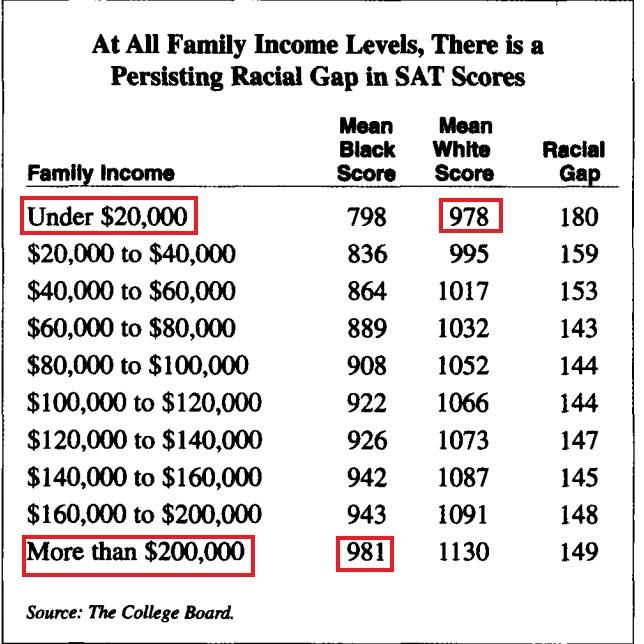
So in a way you're right, US government does run their education system very well, it just seems to be a racial thing which can never be spoken about politically so it's just ignored as the elephant in the room
It takes a long time to undo damage like that.
If you want studies, here's discussion of one I just saw the other day:
https://www.bloomberg.com/opinion/articles/2018-12-04/verdic...
And who am I going to trust to decide that? Not a politician. Not someone who strongly favors one side or the other, either. And not just somebody at a bar, nor even a media personality. I want someone who actually knows some economics, and actually is attempting to be impartial. In fact, I want several independent ones of that.
American healthcare being more expensive than anywhere else fits the pattern. It also apparently costs more to build a rail line or any other work of infrastructure here than anywhere else in the world.
I'm not sure why this is, but health care is not exceptional.
Theorists set the groundwork. They come up with a lot of vague notions and then move to work with experimentalists to figure out how they can test these notions. How to "prove" it.
But saying they are "worthless"? That's just hogwash. Even if wrong, they aren't worthless. (Hint: most of the time they are wrong) And yes, economics isn't as rigid as something like physics. But it is pretty complicated stuff and they don't have as much of a history and basic principles. They may not be a hard science (or some might say not even a science), but calling an analysis worthless is just bad. And saying that in "normal science" (it's just science) things need to be testable to be useful is also just wrong. I'd call string theorists mathematicians, but what they do isn't worthless.
If this is really the way people think science is done, we've got a big problem.
Just as a counterpoint, the US public primary school education is state run and funded, and has both poor outcomes and is the most expensive in the world [1]. Just because something is run or controlled by the state does not mean it will magically be either efficient or high quality.
[1] https://www.theguardian.com/us-news/2018/sep/07/us-education...