In Perl 6 object hashes allow you to do the same (https://docs.perl6.org/language/hashmap#index-entry-object_h...). If you're only interested in checking for existence, you can use a Set (https://docs.perl6.org/type/Set). If you want to just count the number of occurrences, you can use a Bag (https://docs.perl6.org/type/Bag).
> Perl's optional variable declarations catch a lot of minor bugs.
In Perl 6, variable declarations are obligatory by default.
> Python's iterators/generators take a lot of work to replicate in Perl.
In Perl 6 there is an easy to use interface for creating iterators (https://docs.perl6.org/type/Iterator)
All of these features are built-in, so no module loading is necessary.
Furthermore the last I heard, Perl 6 performance was a disaster story. And libraries + real world adoption is kinda thin on the ground. Therefore other scripting languages (particularly JavaScript and Python) are more compelling targets to migrate to.
Has this picture brightened in the last year or so?
These beliefs are shared by most users of both languages, which makes bringing up Perl 6's capabilities in a Perl vs Python discussion confusing.
Making things faster in Perl 6 has been the main focus of development in the past 3 years.
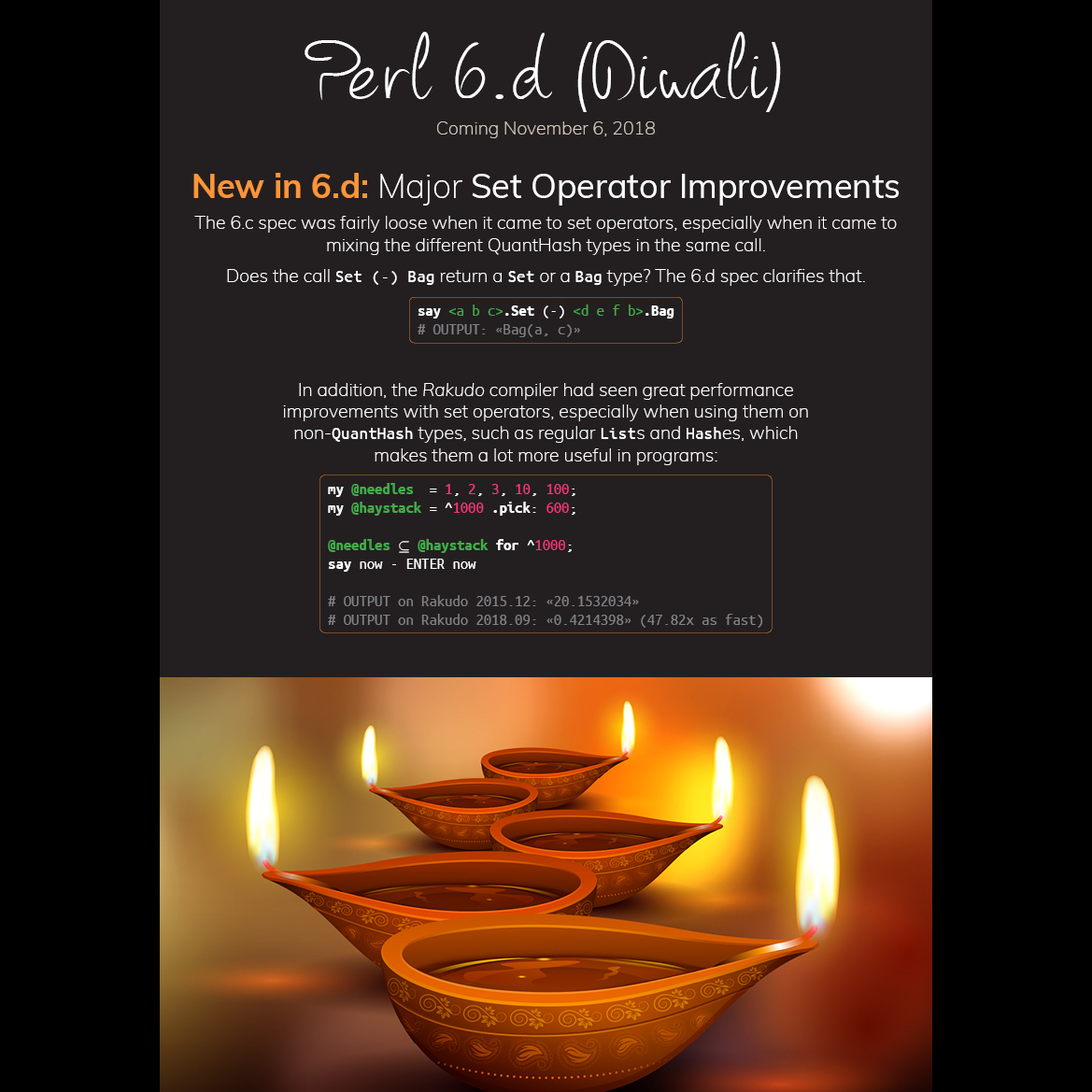
See also our most recent teaser for the 6.d release: https://i.redd.it/et514ut106u11.jpg which shows that the use of set operators has become almost 50x faster in that period.
You can do this in perl too with a core (since perl 5.004) module. https://metacpan.org/pod/Tie::RefHash.
What is weird about Perl is that it is intentionally designed to use the part of our brain that parses syntax to encode a bunch of information. So $ means "the", @ means "these", and so on. The linguistic analogies are carried surprisingly far, and There Is More Than One Way To Do It is considered a feature.
By contrast Python tries to have a very simple and regular syntax. It has well-organized libraries. And aims to have one simple and right way to do it. (Though why their one way to handle opening external processes should be so Byzantine..well I digress.)
But both of them live in the space of dynamic interpreted libraries with similar kinds of introspection, similar native data structures and so on. Both take heavy advantage of the fact that between decent scalars, arrays, and hashes you can write algorithms for almost any problem which will perform within a constant factor of a theoretically ideal data structure. Therefore given the same problem it is natural to write the same solution in about the same way with very similar characteristics.
If you know one, learning to write the other isn't hard and the mental translation remains easy.
Oh, there are differences. Some things are easier to express directly in Perl. Like backticks. Python can let objects be used as keys in dictionaries. Perl's optional variable declarations catch a lot of minor bugs. Python's iterators/generators take a lot of work to replicate in Perl. (Yes, there are CPAN modules that make it doable. Have we agreed on which one is right?)
But on the whole for most code, you tackle it in the same way, with equivalent data structures and naturally organize it similarly using the same strategies.
Compare and contrast with, say, Java.
The fact that they are so close puts them in a natural competition. And there, well, Perl is not popular for new projects while Python is one of the most popular languages out there. All the cool new integrations are made available in Python first and Perl is an afterthought. If they are too similar to co-exist without competition, it is clear which one is going to win. And it isn't Perl.