https://www.microchip.com/wwwproducts/en/ATtiny4
For scale, this alone is about the size of a large SMD capacitor and would basically be lost in most designs today.
https://www.digikey.com/en/product-highlight/t/taiyo-yuden/e...
https://en.wikipedia.org/wiki/Magic_number_%28programming%29
For example, looking for ELF or Portable Executable headers, as a crude estimate to determine attack opportunities. In this case, the magic numbers would probably be more selective and sophisticated, but still have an aspect of hard-coded values, since we're talking custom silicon.
They probably found it out when they were repeatedly tried to reflash the BMC flash, and saw that checksums did not match.
And prior to that, there were already persistent rumors in the Chinese interney of certain Chinese mobos sending "weird garbage on ICMP," and "BMCs that somehow boot and work with their flash memory soldered off"
Remembering that, I might even suggest that this is not a modchip that does something with signal on the go, but just a very tiny flash chip that has the modded firmware.
Going further from that, to pack, say, 16 mB on a sandgrain sized chip, the densities need to be like that of best flash chips out there, which also means that they have access to last gen flash fab.
https://download.csdn.net/download/duanzhang512/10385038
The recovery overrides the primary if detected by default.
The place they put their "filter cap" is right on top the empty TSOP8 pad for the recovery flash. And they probably ordered the factory to sneak the traces just a little bit more, or put hidden vias under it, or simply had somebody very dexterous to solder it to pads with hair thin wires.
That makes the whole thing gloriously simple. A part "stuck on" afterwards is obvious. A part fitted into a no-fit footprint after optical inspection is not, it looks exactly as if it was meant to be there.
It also means that the extend of intervention into board design was minimal, and that a trivial automatic xray would not have picked it up. And as implied in the article, later they buried the bug to beat the AOI, if it was done higher upstream.
So, they would've been screwed even if they were doing board testing outside of China.
That's a clever trick.
But the sole fact that the chip has "to phone home" makes detection trivial, and puts the usefulness of the method to nil - anybody sees the router blink when it shouldn't and your bug's cover is blown.
https://www.itcreations.com/dist/landing/i/MBI-6128R-T2/MBI-...
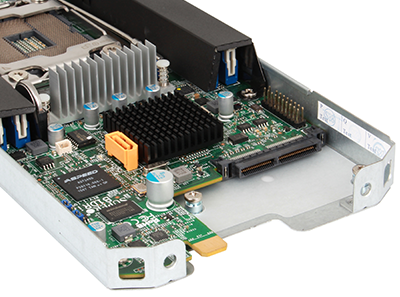
Left of the sata connector. An empty space with 8 pads for an smt eeprom or flash. It is occupied by the thingy on bugged boards.
Right below is the Aspeed chip - the BMC
The payload could be pretty small, since the server boards are likely using OS packages that match the chipset. This limits the software to a small set of well known targets, Linux, Windows, Apple. Target their kernels, and you only have to snip out a small chunk of bytes, and splice your own pre-defined package in. Splice in a miniature runtime, that operates a turing complete set of operations, and open up a listener that waits for network access, and now, your payload can enable arbitrary code execution, irrespective of permissions.
Now, to exploit, the payload needs to time the opportunity to splice itself onto the disk correctly. If certain well-known chunks of code will always exist in each given operating system, then with every disk access event one just needs to wait for the inevitable moment those magic system-specific bytes travel over the bus, in order to replace the known bytes with the poisoned modification. Events might target when the bytes are originally installed with the OS, or every time the OS reads those known bytes back into live memory, from any source.
The total payload package could probably fit inside a couple of megabytes, pack on a few more for the "listen & splice" part of the attack to round out the entire mass, and all we know how much data an SD card can fit into say... five grains of rice?