Lagos and all of Nigeria suffers from the same plague that is consuming the West: extreme inequality. There's economic growth but when the rich capture the overwhelming majority of the new wealth then, combined with population growth, you can get a population where many people are actually worse off as time goes on. This is why even as the economy grows the number of people living in poverty is actually increasing [1][2].
It's highly unlikely the government will/can/wants to address the inequality [3]. At some point the only "fix" to this problem will be, as it has been in the past, war. The growing regional and ethnic divisions just need another decade or so (by that time we'll probably see as many as 120m living in poverty) and then, suddenly, the water reaches a boil.
Ironically, if you speak to many Nigerians they'll tell you that inequality isn't a problem at all. If you work hard and smart enough you can make it. Sound familiar?
[1] https://www.stearsng.com/article/inequality-in-nigeria-is-wo...
[2] https://qz.com/963465/some-of-the-worlds-biggest-countries-h...
[3] https://www.oxfam.org/en/even-it-nigeria/nigeria-extreme-ine...
But there seems to be an assumption baked into your point that inequality is the problem to optimize for, rather than actual poverty alleviation. And of course wealth inequality doesn't correlate very well with absolute outcomes in economic wellbeing. Cambodia has very low income equality (Gini index of 30.8%) and very high percentage of people living in extreme poverty (6.15%). Brazil, on the other hand has very high Gini index (51.3%) and very low percentage of people living in extreme poverty (0.5%). Those numbers are just from Wikipedia but there are plenty of studies done on how useless 'inequality' is as a measure of real world outcomes.
[1]https://ourworldindata.org/wp-content/uploads/2013/05/World-...
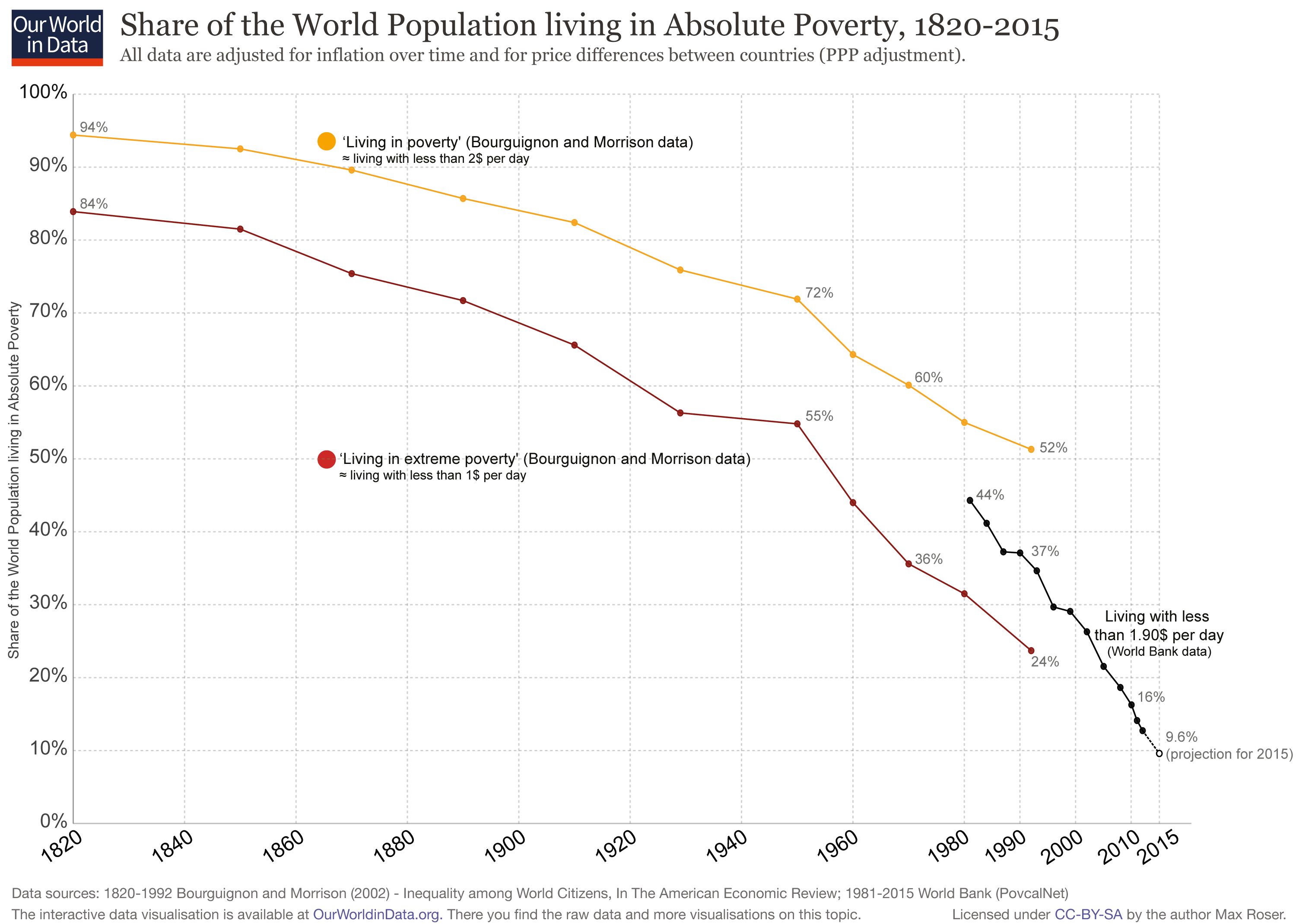
Nigeria's GINI is hardly exceptional. Adjusting the shape of the income distribution can achieve limited improvement to the quality of human existance compared to raising the distribution's mean.
If the “troubles” of a society are really the disparity between the richest and poorest, then a country like Somalia would be a glorious example of liberty and prosperity. Yet everyone there is poor and with extremely limited options in anything you might want to measure.
Clearly this isn’t it. Maybe in order to get a healthy thing going you must have some extreme outliers as a result of the freedom/ability to let people do their thing.
Proposing violence to fix an issue with which appears your friend is not well versed on seems just like the mass mob lynching of a “suspected” person doing X. The mob feels righteous at the time, only to learn the person killed didn’t do anything at all.
Stating that as the basis for a debate is not the same as endorsing violence as the fix. It seems to be a tragic fact that different societies have not found a political way of solving this issue and that alone is worth discussing.
I think that's wrong, though. Poor people do not have the resources to wage war. Wars are led by people with resources against other people with resources, with poor people only serving as cannon fodder. That also holds for revolutionary wars, e.g. pretty much any Communist revolution was led by middle-class intellectuals. So I think that inequality might increase criminality and strengthen violent gangs, but it's unlikely to lead to actual war.
It's unclear why or how could a disequilibrium form and stand in a free to travel country: as long as the metropolis offers even a modicum of economic opportunity, such as being a water seller at the intersection, that is already much better then being a subsistence farmer in an overcrowded country that experienced famine as recently as last year.
There is no catastrophe looming, just the slow grip of poverty following people around and slowly suffocating their lives, absent coordinated social organization and coherent politics to end it.