This is in context of dividing two fractions where kids are taught an arbitrary rule too early in their studies and it turns them off to math overall because it's become a class of memorizing arbitrary procedures instead of learning concepts.
(That's all my summary of that segment with a little reading between the lines, not my personal view of it. Or it might be later, but have to consider it more.)
Tend to think about constructive mathematics for this particular insight.
But I mostly think that "fractions as ratios" can be left until the child is older and has more chops for derivations.
The Greeks thought about these as different ways to measure intervals, and they worked out the idea of "common measure" as a good solution to dealing with these problems.
Summation of fractions is much easier to visualise, even if it is harder to calculate.
The amount of crap I got for using the "wrong way" to calculate something in math class, was probably one of the major reason I never really got into it.
I remember math classes in the beginning actually being fun, I loved figuring out more convenient/to me more logical ways to calculate something, only to be constantly shut down by the teachers for using them, as he/she demanded I use the solution given by the book.
I do understand the value of getting to the same solution in different ways, I even did back then, but teachers didn't frame it like that; their insistence on the book solution just felt like an accusation against me of not understanding, telling me my way of calculating is wrong (even tho they usually proof calculated right) when to me it looked like it was them not understanding, by insisting on that one formalized, and often awkward, solution, and only that.
So as a somewhat rebellious character, it didn't take long for me to start actually despising math classes.
If I could go back I'd probably try to do it differently, I'm in my mid-30's now and consider myself "math illiterate". Sure I can do most basic stuff and even the occasional Pythagorean theorem (which fascinates me to this day, take two knowns to figure out the third unknown!), but I still feel like I missed out on something I could probably really have enjoyed.
This image[0] from wikipedia shows it all: the area of square a plus the area of square b equals the area of square c. It's just really convenient that we can use that to calculate triangle sides without resorting to trigonometry.
[0] https://upload.wikimedia.org/wikipedia/commons/thumb/d/d2/Py...

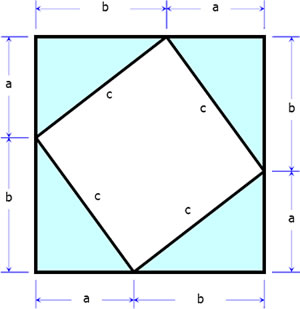
It could be improved by putting -(ab/2) inside the triangles, but I'm on mobile, so making something is out of the question.