Third wire does not collect interference in a balanced line. Instead, voltage signalling balanced line uses one ground and two signal lines of opposite polarity and input is difference between these two signal lines. Induced interference is more or less the same on both signal lines, therefore cancels out. At a quick glance this article [1] seems to explain this without delving into electronics. Some differential lines (e.g. RS-485, popular in industrial automation) use current signalling thus requiring two wires per signal.
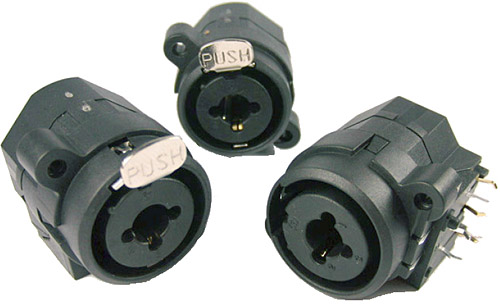
[0]: http://www.cliffuk.co.uk/products/combijacks/combijacks.jpg [1]: http://www.aviom.com/blog/balanced-vs-unbalanced/
Virtually all high-speed digital communication uses differential signalling.
E.g. PCIe transmitters are HSCL, which is a form of current steering that gives the receiver exactly the voltages it needs to see at nominal currents and termination values.
In fact, he's got a nice little simulation of generating a "gold code", adding noise and multipath distortion to it, feeding it through an I/F mixer, quantising it, and recovering the original code. http://www.aholme.co.uk/GPS/SRC/2011/C++/Simulation.cpp
The receiver inverts -sig and adds it to +sig.
Any noise appears in both lines and is subtracted to zero, leaving 2 * sig.
Problem is the circuit needs very accurate resistors and needs to be carefully balanced, just like an instrumentation amp.
The opposite also exists - a “digital stage box” to convert analog signals from mics and instruments to digital as soon as possible.