And how exactly did you arrive at this judgement? Restitution is solely to make whole on the financial damage.
His jail term is completely appropriate for counterfeiting and piracy with intent to distribute and profit under federal jurisdiction.
WOW you have a completely screwed set of ethics and morality if you believe putting a person in a cage for 15 mos for duplicating restore disc is "completely appropriate"
Would his sentence have been more lenient had the value of discs estimated to be $100,000 instead of $700,000? Nope.
Would his sentence have been more lenient had he not spent effort to infringe on copyright and attempt to make fakes that are harder to discern? Maybe.
Would his sentence have been more lenient had he not actively tried to deceive and defraud those buying the discs from him believing them to be genuinely produced by Microsoft/Dell? Surely.
Would he be scot free in this situation had he just shipped a free OS? Definitely, but recycling or reducing waste wasn't his intent as you can see for yourself from his email and bank records.
He didn't even spend the minimal effort to inquire with Microsoft if they would help him in pushing more recycled computers with Windows but instead decided all by himself to fly to china to create 20,000+ copies of genuinely sold recovery disks and to sell them as genuine when he clearly knew they weren't while coaching his codefendants to play dumb, suggesting them on evading scrutiny from customs and pressing them to sell more product so he can realize returns on his investment. If that doesn't show criminal intent, I don't know what does.
The fact that you seem to get your ethics and morality from the law says a lot. I don't, I personally find large segments of the law to be highly immoral and unethical.
>Would his sentence have been more lenient had the value of discs estimated to be $100,000 instead of $700,000? Nope. Would his sentence have been more lenient had he not spent effort to infringe on copyright and attempt to make fakes that are harder to discern? Maybe.
Ok that may be a factual statement, that has nothing to do with the fact it should not have been a criminal matter in the first place, but a civil matter where only monetary damages would be punishment
I believe prison should be reserved for people that are a physical danger to other, not as punishment for harming a corporations profits
>He didn't even spend the minimal effort to inquire with Microsoft if they would help him in pushing more recycled computers with Windows
They would for $25 per computer, That is MS double dipping method for recyclers to force them to purchase a new license for a computer that was already licensed by the OEM at the time of manufacturer
>If that doesn't show criminal intent, I don't know what does.
Again you are talking about the law, I am talking about ethics, surely you to not believe all thing that are illegal are unethical and that all thing that are legal are ethical? If you do believe that I return to my original statement in that you have a completely screwed set of ethics and morality
> The fact that you seem to get your ethics and morality from the law says a lot. I don't, I personally find large segments of the law to be highly immoral and unethical.
As much as you'd like, the judicial system doesn't work on ethics as judged by you. I hope you understand the functionality of the judicial system before making such broad statements about it.
> The fact that you seem to get your ethics and morality from the law says a lot.
I don't, but I also don't let my own feelings affect my interpretation of law.
> Ok that may be a factual statement, that has nothing to do with the fact it should not have been a criminal matter in the first place, but a civil matter where only monetary damages would be punishment
Do you know what the difference is between civil and criminal law? It doesn't appear so.
> I believe prison should be reserved for people that are a physical danger to other, not as punishment for harming a corporations profits
So do I to a certain degree, but you must first understand that the corporations comprise of people like you and me and not some evil mind CEO who eats all the profits.
> They would for $25 per computer, That is MS double dipping method for recyclers to force them to purchase a new license for a computer that was already licensed by the OEM at the time of manufacturer
You're making presumptuous statements here (and I know because A - your statement is false, $25 is only necessary if the device does not have a recovery disk already; B - your statement is in no way related to my quoted response of approaching Microsoft if they'd be interested in partnering in a recycling program). I'm not going to engage with your prejudice against a corporation of your dislike.
> Again you are talking about the law, I am talking about ethics, surely you to not believe all thing that are illegal are unethical and that all thing that are legal are ethical? If you do believe that I return to my original statement in that you have a completely screwed set of ethics and morality
When all else fails, paint the other person in black?
You believe software should be free to distribute and copy because it is a never ending source and can be created out of thin air once someone has developed it?
How about you try counterfeiting US Dollars which are also created out of thin air?
Software is the currency of the tech companies that develop it and they like to protect is just like our Govt. likes to protect their own economic interest. If you don't like a company you have the choice of not using their products but don't go around saying they're a bunch of evil morons for protecting their interest.
While it is true the corporations are "made up of people" the very nature of a corporation separates liability from those people, thus when you remove said liability people generally tend to behave worse than they would when they are personally liable.
Then there are the group dynamics where many many people working together can justify, rationalize, and excuse all manner of actions that when done as a individual, they would individually find abhorrent but when done as a group they do not.
This is why at best a corporation can only be described as amoral (at best)
The fact that corporations are "made of people" has no relevance to my comments
>As much as you'd like, the judicial system doesn't work on ethics as judged by you. I hope you understand the functionality of the judicial system before making such broad statements about it.
The legal system of a society should be judged by the ethics of the members making up that society, people like you that believe the law is the law and we just have to accept that are part of the problem in society today
I see this law as being unethical as such I am advocating against this law.
You believe the law is the law and should remain unchanged as if it was the word of a god.
>You're making presumptuous statements here (and I know because A - your statement is false, $25 is only necessary if the device does not have a recovery disk already; B - your statement is in no way related to my quoted response of approaching Microsoft if they'd be interested in partnering in a recycling program).
Yes it is as that is their "partnership program" for Recyclers,
I do not believe MS should be allowed to charge $25 simply because the owner of the device did not keep or make a recovery disc upon purchase. I believe (and the law supports) that the physical disk is irreverent, it is the LICENSE that they sell not the Physical media.
Of course MS, and most other tech companies, want to have it both ways, picking a choosing which sections of law they want to apply based on the circumstances. Sometimes treating it has a Sold Good where the physical product matters, but then other times saying it is a licensed product and the physical media has no value
>How about you try counterfeiting US Dollars which are also created out of thin air?
I dont think you want to know my thoughts on Fiat Currency. (hint I am not a fan)
>Software is the currency of the tech companies that develop it and they like to protect is just like our Govt
I have already stated I find our government (aka the law) to be largely unethical and immoral. So you defense is to point out how the Tech Companies are acting like our government... i.e Unethically and Immorally
>If you don't like a company you have the choice of not using their products but don't go around saying they're a bunch of evil morons for protecting their interest.
I do not define virtue as " protecting their interest." it is possible to be a Evil Moron and be " protecting their interest." at the same time.
I'm not sure what the appropriate sentence should have been, but I strongly disagree that it's this. Those discs were not worth $700,000. Were they worth $200,000? 6 month term. $20,000? Fine and probation. They were worth something, all right, but not $700,000. That's just not accurate.
Is your sentence estimation accurate?
> The sentence is based on the value of the infringed goods, right?
For financial restitution part of the judgement, yes. But for any deterrence in terms of jail time or restrictions on further operations it isn't as nuanced as you put it out to be, it does not matter whether you intended to counterfeit and distribute $100,000 worth of goods or $1,000,000 worth of goods.
> Were they worth ... $20,000?
His own bank/paypal transaction records and emails show they were worth much more than that.
For example, software company distributes free CDs that contain copy of software, however software cannot be run without a non-transferable activation code. Unauthorised copying of printed label or contents of CD could be copyright infringement. Assuming it is, what are the damages? What is value of CD without activation code? (e.g. cost of the optical media) What is value of CD with activation code? (e.g. cost of the software license) Which measure is appropriate?
Microsoft argued that the value was that of fully licensed software, ultimately $25 per disc, which is what refurbishers pay for new Windows licenses to install on computers, should they require them.
> Lundgren, by the way, is not some scammer looking to fleece a few people and make a quick buck. He has been a major figure on the e-waste scene, working to minimize the toxic wages of planned obsolescence and running a company of 100 to responsibly refurbish or recycle old computers and other devices.
From Microsoft:
> Part of Mr. Lundgren’s defense also involved claims that he was trying to provide the community with something that was freely available anyway. This claim was rejected by the district court and the Court of Appeals. This is because Microsoft itself sells genuine versions of these CDs to refurbishers (hence the market for selling counterfeit copies). In addition, Mr. Lundgren took great pains to disguise the counterfeit software he imported, including arranging for fake Microsoft and Dell labels to be applied to the discs.
> In an email sent in December of 2011, Mr. Lundgren said to his co-defendant,
> “You would have to be an expert with a magnifying glass to know and/or see such differences.” “You must have been trying to supply these units to Amazon directly or someone who is expert.”
> He went on to say,
> “C’mon Bob, you should be able to sell these units to anyone whom is not trying to sell them back to Bill Gates.”
> And,
> “Please sell some of these units. You MUST have some other buyers for this product – and if you do not, then find some. It has been months and I have not seen the return I was expecting to use for my India project buddy.”
> He concluded,
> “No normal company or buyer will notice such issues.” “Make me proud so that our business can grow and we can keep winning.”
> Mr. Lundgren also tried to evade U.S. Customs and coached his codefendant how to handle questions from federal agents. In 2011 he wrote:
> “There are tricks for bypassing customs with container’s & LTL but currently this is how I get these products without invoices past customs.”
> And, referring to customs officers:
> “If they call you just play stupid and tell them you ordered from an asset management broker overseas.”
> Mr. Lundgren and co-defendant Bob Wolff explicitly discussed deceiving people with the counterfeit software. In one email to Mr. Lundgren about the software he’s arranging to manufacture, Mr. Wolff writes:
> “If the software will be 98% accurate I believe I can get away with that.”
He was urging people to sell these discs as genuine and coaching them on how to lie if they got caught.
https://blogs.microsoft.com/uploads/prod/sites/5/2018/04/Ema...
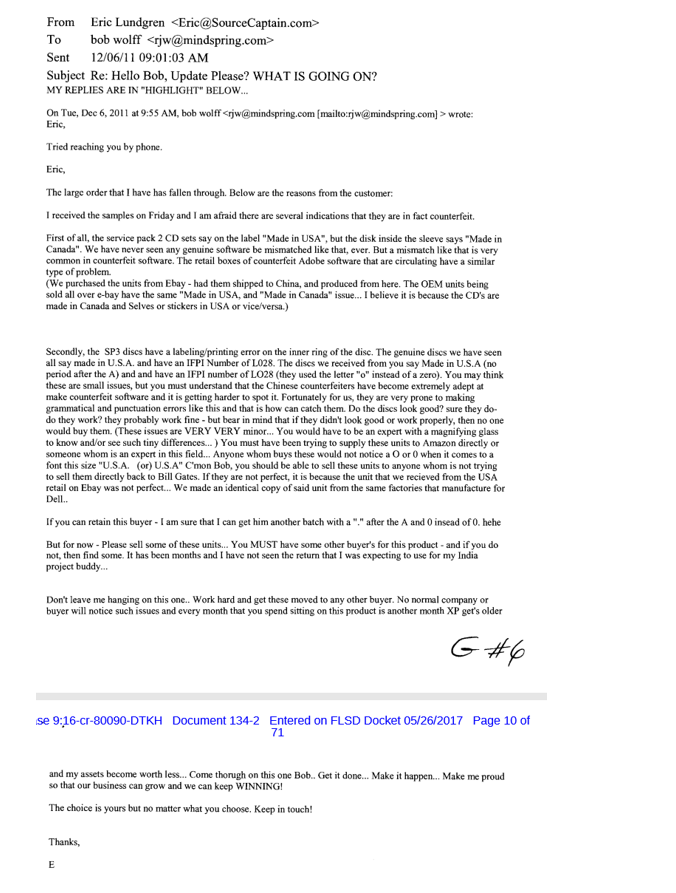
I have no idea how anyone, after reading this e-mail, can conclude that he was not trying to scam buyers into believing they were buying something other than counterfeit material, unawares, and then sell it to customers who were equally unaware they were buying counterfeits.
"Work hard and get these moved to any other buyer. No nomral company or buyer will notice such isuses and every month you spend sitting on this product is another month XP get's older and my assets become worth less." "I have not seen the return that I was expecting to use for my India project buddy." Those are Lundgren's _own words._ And nobody who read the article you wrote and linked to would have that context. They would, in fact, have your words to the opposite.
You don't understand Criminal Law if you believe that statement is true. Above a certain threshold, the sentence is more of a precedent and deterrence.
https://www.ussc.gov/guidelines/2015-guidelines-manual/2015-...
The value of the goods matters a great deal. The sentencing documents go into detail on it. The 11th court judge writes that the previous sentencing range, which he affirmed, was "largely based on a calculation that valued the infringed goods at $700,000." That put it in the range of 37-46 months, and prosecutors had threatened more early on when valuing the discs at $299 each. The plea deal took it down to 15.
The issue I and others have been trying to highlight is that as you say that Microsoft overstated the value, not a little, but a lot, and also contrary to the basic facts of the matter. Essentially he committed one crime and was sentenced for another.
He was selling recovery discs with no licenses, which are free for anyone to create on their own or for refurbishers to burn as many as they'd like of. They pay Microsoft for bulk licenses then print as many discs as they need.
Lundgren never sold or attempted to sell licenses, which of course create the value of the product. The discs were worth the convenience cost of however much a shop would pay to not have to print them themselves. No Microsoft sales were harmed, if a license was needed Microsoft is the only place to get it, these discs are for re-installation purposes.
Microsoft in this case convinced a judge that a "copy" of Windows is worth the same whether it is licensed or not. That's not true, and as if it weren't enough that this misrepresentation of the facts took the day in court, a guy is going to prison for 15 months because of it — the sentence was directly affected by the value determined by Microsoft's $25-per-disc assertion. If the discs were valued accurately he might have had a fine and probation, or a month in jail.
I wrote another post talking about this earlier:
https://techcrunch.com/2018/04/25/how-microsoft-helped-impri...
and for what it's worth regarding the $80K and $28K payments, Lundgren's account of it is the first was for all kinds of stuff his Source Captain company manufactured over there for refurbishing purposes (old hard drive cases, CD caddies, weird screws) and the second never took place because the goods were never sent — all confiscated in the raid on Wolff's place.