We aren't "declining" in productivity. We've continued to increased productivity at the same historic rate as previous industries. (http://www.bls.gov/lpc/prodybar.htm)
We are accomplishing this productivity gain with less people. Increased productivity allows for companies to increase their output with less people.
As Peter Drucker predicted, if these productivity gains aren't matched in the service and knowledge worker sectors, then we'll see an increase in social tensions and class warfare. No one can deny the social acrimony that continues to surface in the news.
This will be the challenge of the 21st century. What to do with a nation that doesn't require a majority of its workforce employed in moving or making things.
http://www.federalreserve.gov/releases/g17/current/default.h...
http://www.federalreserve.gov/releases/g17/current/ipg1.gif
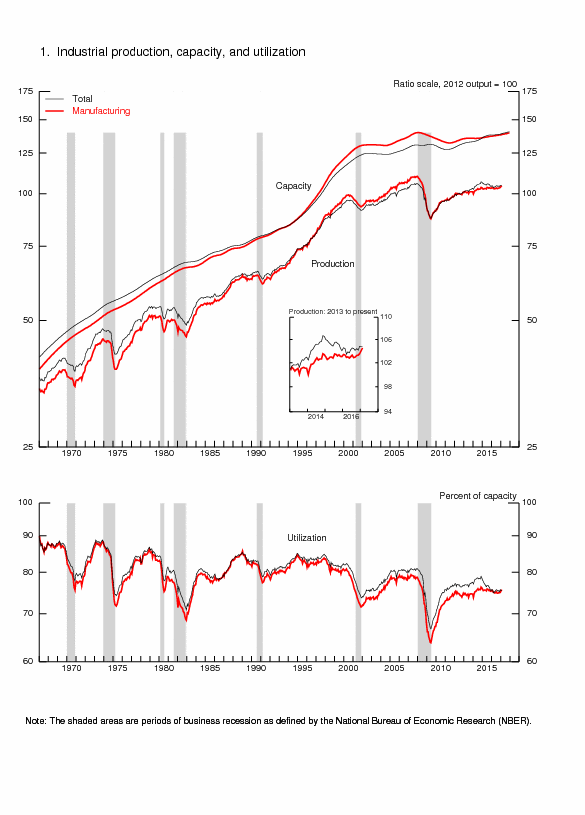
And other pretty charts in section G.17 Release Tables
When economic measures seem out of whack with observed reality, one should question what the numbers really mean.
You're also forgetting that consumer products are but a portion of total manufacturing output - industrial goods are also an extremely large segment of the market, and one where we have not yet lost the lead to the Chinese.
Hands-on work like sewing and hand assembly gets done in Asia where there is a good supply of cheap labor, but that doesn't mean that plenty of stuff doesn't get built in the USA, often with extensive help from robots and computers.
Heck most smart phones have more computational power than a 1980 computer.
So yes, the US has grown richer (money != wealth).
Since the 80s median family income has increased by about 1/3, adjusted for inflation:
http://en.wikipedia.org/wiki/File:United_States_Income_Distr...

Build a graph from that data and you'll be very surprised, I guess.
1980 -- $1.3 trillion
2006 -- $12.8 trillion
[edit]: Oh, there's a graph actually: http://globalpolicy.org/images/charts/SocialEconomicPolicy/t...

Your analogy, corrected:
Today Bob's parents borrowed $100 from Alice and Bob earned $5 on his own. Bob thinks he became $5 richer, Alice is owed $100, and Bob's parents now have more debt.
Whatever, I'm done with that thread, as HNers don't seem to approve :)
Regarding the statistics of manufacturing supposedly growing they are misleading. I don't have time to explain why they are misleading but if you dont believe me you can just visit Detroit, or Flynt Michigan, or even Philadelphia.
Moreover, the problems of Detroit and Flynt are not entirely encompassed by the decline of local manufacturing jobs.
The fact that Flynt and Detroit and Philladelphia are empty shells of their former selves is not because the goods they made are still being made in America but more efficiently, but because the goods they made are being made somewhere else.
I cannot parse this, what is your meaning?
Edited in original.
No, that can't be it. Surely the order of magnitude difference in living cost, lack of safety and labor law has nothing to do with it. Surely it is the "weird pretentiousness of American workers".
"Pretentiousness" is a good term, especially given David Brooks's "did not want their children regressing back to the working class, so you saw an explosion of communications majors and a shortage of high-skill technical workers." But high-skill technical work is also much harder than teaching and the newer "high touch" "professions", so I think "wussiness" may be as good a term, depending on what influences predominated.
He wrote an entire article about how Americans are "abandoning" manufacturing without ever mentioning offshoring. If you read his article you would think that the American decline in manufacturing has something to do with some weird pretentiousness of the American workers and nothing to do with the millions of manufacturing jobs leaving the country.