2) Hrm. I guess maybe? As I understand it, the reason for a client token is to have stateless servers, so the server doesn't need to look up a valid token upon every request--which scales better. In my case, the API endpoint is for something that doesn't (and won't) get a lot of traffic, so I can probably get away with a 256-bit random token over TLS? Since it's over TLS, there probably aren't MITM attacks to sniff the token and replaying it--so it's probably ok? Are there other considerations I'm not aware of?
Generally: don't do encrypted tokens. If you must: don't do JWT for this. Just secretbox a thing and be done with it, or use PASETO[0].
Can you point to a RTFM on why not? I'm sure it's a big list of reasons but where can I read about the biggest one?
A lot of the implementations _aren't even faster_, but the laundry list of security bugs they have caused is very real. Suddenly you get to worry about irrevocable tokens in order to solve scaling problems you don't have.
A good intro is: http://cryto.net/~joepie91/blog/attachments/jwt-flowchart.pn...
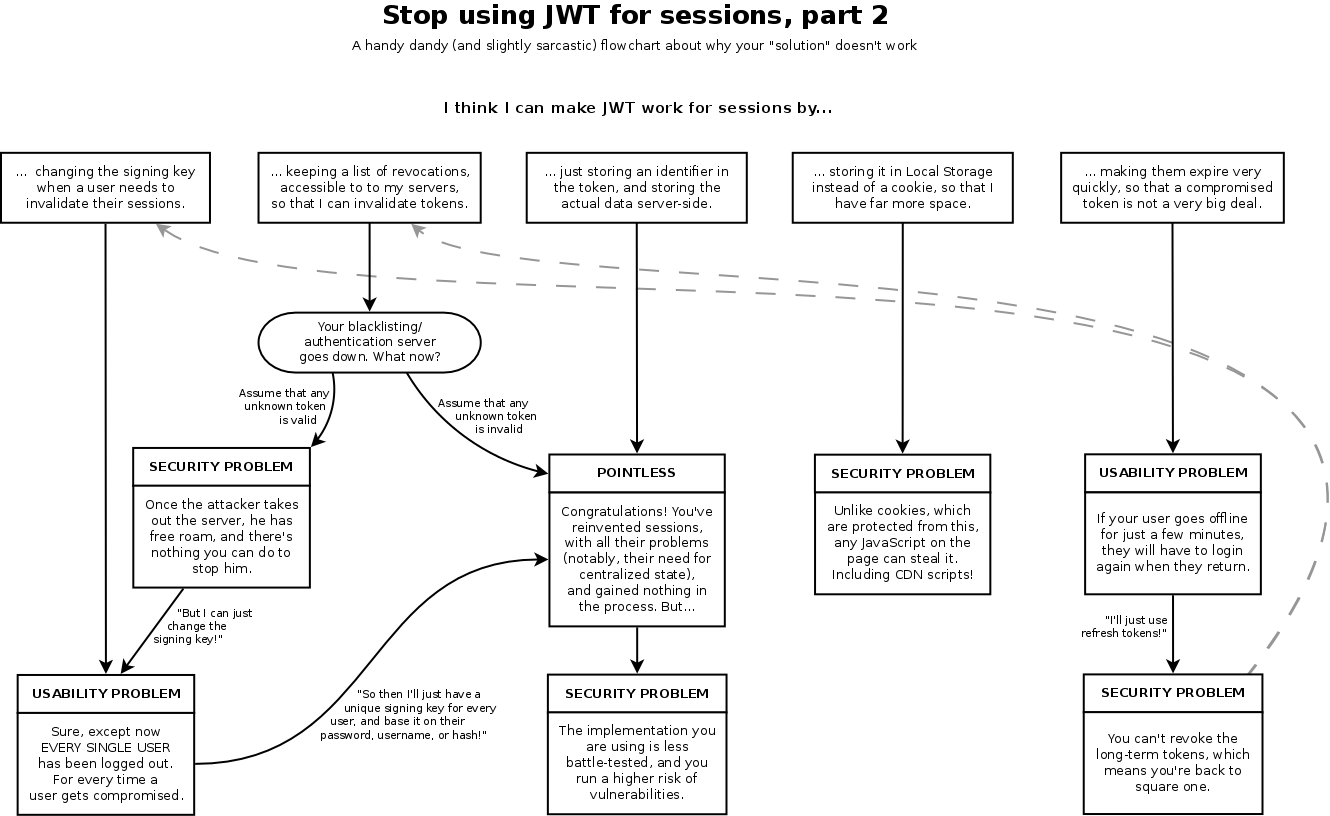
2) Are you entirely convinced you actually need client tokens? In particular, can you get away with a 256-bit random token and store the session in a database?
3) Re: HMAC input malleability: yep, concat and HMAC is fine. Serializing JSON or whatever is also fine. You're usually providing the tag (that's what the output of HMAC is called) verbatim next to the message, so you generally don't care about e.g. canonical serialization.