News for hackers. Stuff that matters.
Re:Why Japanese web design is so different (2013) by emodendroket on Monday January 29, 2018 @12:50AM (#16255573)
Yeah but that is tiring to read. They have the dots over letters for emphasis too.
Re:Why Japanese web design is so different (2013) by alphonsegaston on Monday January 29, 2018 @01:01AM (#16255613)
Dakuten(what you call “dots over letters”) are used to modify the way consonants are pronounced, not for emphasis, e.g to turn the character for “Ka”(カ) into “Ga”(ガ).

And the usage of katakana in the way the parent describes isn’t “tiring.” It follows almost the exact same pattern as words are italicized in English, where a word or phrase is represented differently from the surrounding text. Less common/standardized, but not tiring.

EDIT:

My bad on the bouten/dakuten confusion. Apologies.
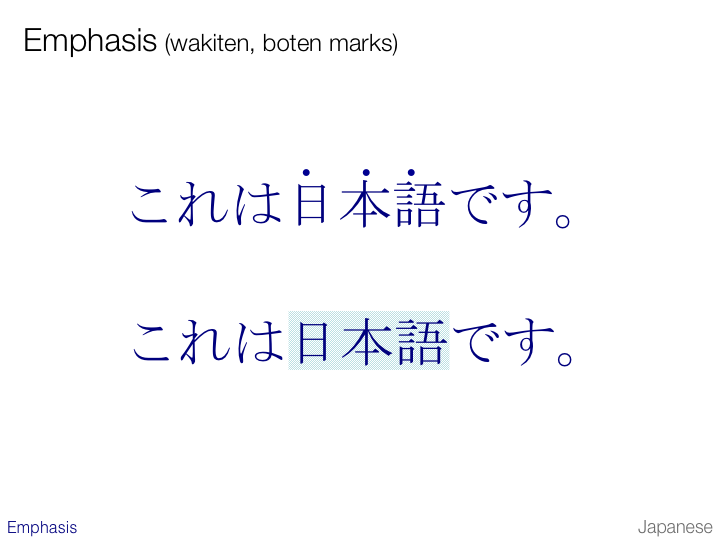
Re:Why Japanese web design is so different (2013) by chch on Monday January 29, 2018 @01:09AM (#16255638)
I believe GP is talking about boten/wakiten, not dakuten :)

https://r12a.github.io/scripts/tutorial/images/misc.png

Re:Why Japanese web design is so different (2013) by xelxebar on Monday January 29, 2018 @01:21AM (#16255677)
As @chch mentions, the parent probably meant bouten/etc. I couldn't find an English article on it, but the Japanese Wikipedia page has examples and some cool CSS styling info that's related:

https://ja.m.wikipedia.org/wiki/圏点

As for katakana, it really does depend. For common or short words, people usually don't have a problem, but if you throw a whole katakana sentence at a Japanese person they will often stumble and reading speed noticably decreases.

Re:Why Japanese web design is so different (2013) by cooper12 on Monday January 29, 2018 @01:12AM (#16255650)
I think they're referring to bōten or wakiten: https://japanese.stackexchange.com/a/1737/22682
Re:Why Japanese web design is so different (2013) by fenomas on Monday January 29, 2018 @01:18AM (#16255667)
GP was talking about 圏点/傍点, not dakuten.

Their point about katakana was also correct - normally a word is either written in katakana or it isn't, regardless of emphasis. Using katakana for emphasis happens but it's not common, and would get tiresome very quickly.