The policy for National Education in France is to have as little difference as possible between schools. Parents cannot readily choose the school their children go to, as well (unless they switch to a private school, but this is marginal, and it costs money) so it makes sense to have them all have the same rules.
I see no reason for a school in one city to allow cell phones, while one in another city bans them. Children are the same humans with the same broad needs and behaviours in the whole country.
I didn't put this in my original comment, but I think what really got under my skin from the article was:
"The minister said the ban was also a “public health message to families”, adding: “It’s good that children are not too often, or even at all, in front of a screen before the age of seven."
Which takes it from "as little difference as possible between schools" to "we have an opinion about how you should raise your kids and we'll use laws to send that 'message'". Yes, there are already plenty of reasonable and good laws place limits and requirements on parents. This just seems way over the line.
Well, nation-wide rules for education are written as laws in the "Code de l'éducation", maybe it's different in other countries but as long as it's legally binding for the schools I don't think it's very important whether it's called a law, a directive or an executive order.
Policies that are not laws are decrees from the local authorities, but they only have the power to enact rules that are directly relevant to their level (like, the local region can forbid children from going outside during hurricanes in Réunion, but not to forbid cellphones in Brittany).
> we have an opinion about how you should raise your kids and we'll use laws to send that 'message'
Yes, that's the universalist basis of the French National Education. It has been working well enough for the last two centuries and I don't see anything wrong with it.
First, my impression is that you still have the right to send your children to a private school where this won't be enforced. So it's not a law, it's a policy passed at the national level for the public schools, which are organized from the national level.
Secondly, passing the law at the national level deals with the situation where a school gets "bullied" into not passing the policy to begin with. For example, parents might prioritize being able to coordinate pickups in real-time over their children's education (I'm not implying bad intent: they just might not recognize the negative impact of their children's mobile use during class time) and thus pressure a school to not ban mobile use during class time.
Personally I think your own definitions of what are reasonable and what are not are skewed. You think it's over the line to claim that "children are not too often, or even at all, in front of a screen before the age of seven"??? What could a five or six year old possibly be doing on a smart phone aside from watching videos and playing games? Why do middle schoolers need access to their phones during lunch - what do they gain from it?
I'm not French though, so someone will have to double check me on the claim that this is actually a national policy for public schools rather than an actual law.
> I'm not French though, so someone will have to double check me on the claim that this is actually a national policy for public schools rather than an actual law.
As far as I understand it, they have not yet decided which legal way they will use to enforce that but it will most probably be in the "Code de l'éducation", so applicable to private schools as well.
Private schools have different funding, some liberty in choosing what they teach in addition to the nation-wide requirements, and more freedom in choosing the pupils they accept, but most policies do apply to them. The basic idea in France is that all children are supposed to get the same education, no matter where they are and what their parents want (with some leeway regarding regional culture and language). Children are future citizens rather than just property of their parents.
It's very clear here that the ban is intended to be for all children, not just public school children. Private schools are really anecdotal in France anyway, outside of a few regions (like mine in the rural West where almost 50% children used to go there, though it's been declining).
Then again, I think the difference really stems from a deep ideological disagreement on the priority of freedom from the government vs. freedom of the government. So it's no surprise that this doesn't make sense to us Americans
Regarding your comment on the trouble you'd get in when breaking the rules as a young pupil: I think the authority of teachers (even here in Europe, but I could imagine even more so in the USA) has diminished a lot in recent years. I see this as problematic, but I think it's a good alternative to the disproportionally great authority that teachers used to have over their students just a few decades ago.
  A: Sir, you can't smoke in here.
  B: But I'm not smoking; this is a vaporizer.
  C: I smell butter.
     Does that fluid have diacetyl in it?
     I don't want popcorn lung.
  D: Propylene glycol asphyxiates sea life.
  E: I have a fragrance allergy.
     Is that eugenol?
     I feel my airway closing up....
  B: But I have a nicotine addiction!
A: Use gums or patches, or GTFO.I'm surprised that someone who grew up in the 80s near Chicago calls cigarettes cancer-sticks. The Illinoisans I'm familiar don't seem particularly histrionic to me. Guess you've found your place to call home in California.
It seems like that because it should be common sense but it's not and therefore it needs to be enforced by law.
https://mir-s3-cdn-cf.behance.net/project_modules/1400/5ab76...
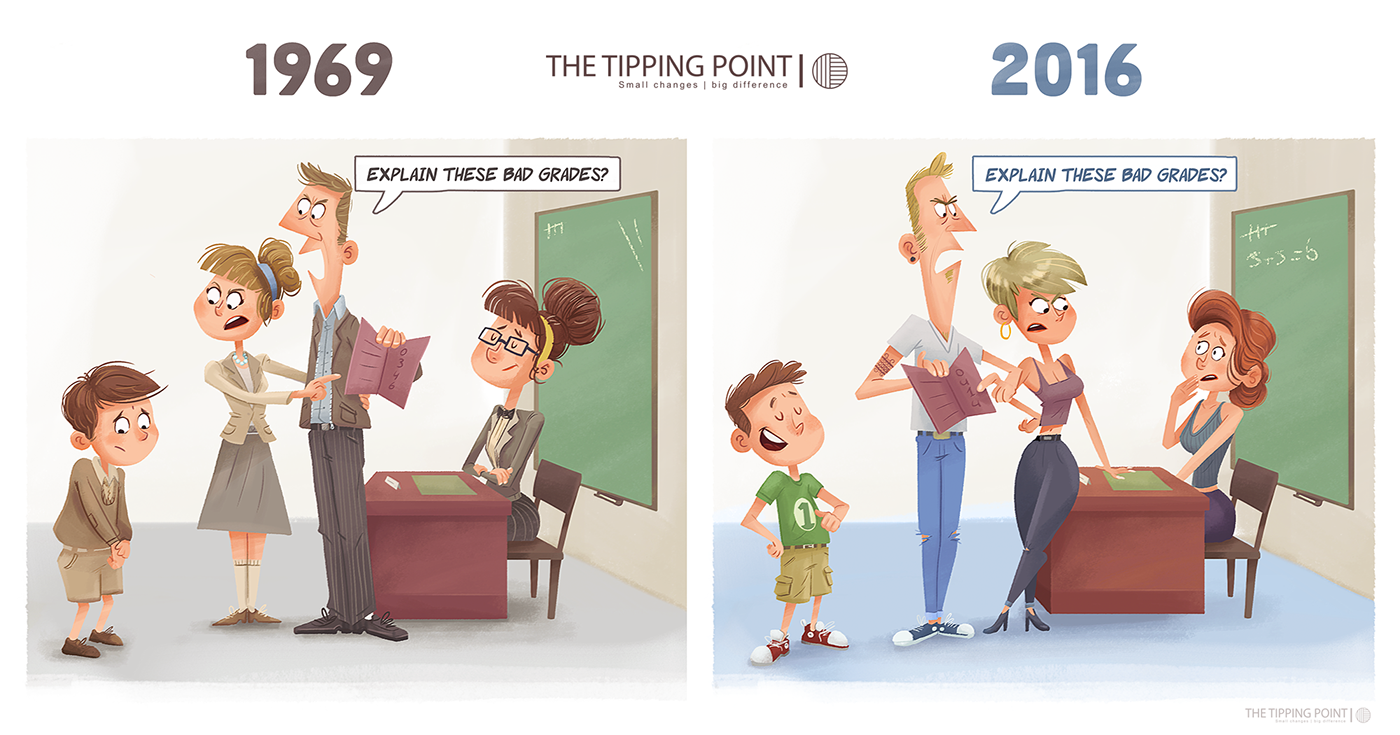
Some old people love to grouse about how Things Were Better Then, and how Children Used To Respect Authority. It's been that way for millennia.
You ever read Heinlein? Back in the 1950s, his "Have Spacesuit Will Travel" complained about how schools were too touchy-feely, intent more on having students feel good than providing a good education.
I don't know if things were better then but (as a kid in the 70's) we certainly respected authority because the threat of physical violence was a real one.
I am not saying that was a good thing by the way, just explaining.
True, but it didn't matter because the worst thing that could happen to you as a child would to be kidnapped by smugglers, tied up and left in a cave to die.
Thankfully though, it was OK for kids to carry knives back then so you could always escape and run away...
Remember, the 1950s and 1960s was the era of "Spock babies", that is, children raised by parents following the advice of Benjamin Spock. Quoting the Wikipedia article about his book:
> By the late 1960s, Spock faced widespread criticism for condoning an overly permissive parenting style. Many commentators blamed Spock for helping to create the counterculture of the 1960s. Critics believed the current youth were rebellious and defiant in part because they had been brought up by Baby and Child Care.
I argue that this is another example of why that cartoon doesn't give a good representation of school in 1969.
I like the policy, but as I get older, I wonder why we have so many laws that control so much of what we can and can't do. I agree this one's pretty benign, but it still seems like an excess of authority.
When I was in school, if I distracted another student or played on my calculator, I'd get in trouble. Despite the lack of law banning talking, the school wasn't impotent to enforce discipline.