1. You have to get users to clickthrough to get your ad revenue, but you also need enough content in the RSS to encourage them to click at all. It feels like you put effort into this thing that prevents users from spot checking your website, which reduces your revenue. And you're hosting the RSS feed, too, so it costs bandwidth!
2. Twitter is easier to use (for you and your audience), is where the audience is, and is "good enough".
Twitter has advantages beyond just the links being shared - the tweets themselves are often interesting to me, and the list of people I follow has been carefully built over time to the point it would be annoying for me to switch again now.
I'm sure these are great options for others though, but I don't think I'm alone in using Twitter as a kind of curated RSS replacement.
I intended to have it track all links from people you follow too, to give a curated list of links, but Twitter was aggressively making changes to restrict their API so this became impossible.
Protocols and an open web over walled gardens.
Personally, I think the main reason RSS failed to get bigger adoption was a UX problem. Clicking on RSS and getting a page of code is just too confronting for most people. Thus it never managed to get the same adoption as other republishing buttons like Pin, Like or Share.
The related UX problem is that major browsers didn't have a built-in reader, so there is nothing with which to discover RSS.
To use RSS, you have to get some add-on like Brief for FireFox, or third-party app for Android. Or else use some website like Google Reader (I think that's dead now?).
Before you do that, in the first place, you have to know what the heck RSS is, and what are the benefits: why should you be installing this additional stuff for interacting with some hidden aspect of the web.
Browsers need to make it discoverable by alerting users, like by bringing up a bubble: "Hey, user! This web page's updating listings are available in a condensed RSS feed [learn more.] You can register the feed into my built-in feed reader, and then not only browse the items conveniently, but be alerted of new ones, search through the items, and delete ones you don't want."*
When we were recently looking, on Craigslist, for a bunch of different types of items simultaneously, I showed my wife RSS. From the beginning: how it is the condensed version of a web-site, and how you need a program to deal with it (went through an installation of Brief on Firefox). Then how you add feeds to the reader, and go look at them through the Brief toolbar button, etc. Then configuration: explaining how Brief just surfs the RSS periodically the same way that a human being refreshes a web page, and that the frequency can be configured, as well as how long the items are stored.
So after that she was using it daily, no problem, and mostly liking the convenience of just checking the feeds for what has dripped in, and being able to erase the duds, as if it were an e-mail inbox.
I think the button for RSS was shown by default in the past, but now you have to add it to the browser UI manually (presumably, it was hidden because no one used it).
I think the problem is in monetization, that's why FB and Twitter stopped offering them, and Google killed GReader too. It's not a coincidence that Twitter is having trouble monetizing, when it's the new way to get news. As a publisher and as a reader RSS makes perfect sense, but how do you build a generic infrastructure in between the two as a utility? This is essentially the question.
I suspect that most sites that have RSS feeds don't expose them intentionally. They just used some framework which automatically creates it. If they knew, they'd put an end to it. "What, someone can grab a list of our items without seeing the main page at all? Turn that shit off!"
Even though the items do contain links that beckon the user to that site, it still minimizes their interaction.
Even if you're ad-supported, I'm more likely to visit you if you have an RSS feed. Not to mention any non-profit or academic website could let people follow new developments easier.
How is going to a 3rd party site like Google Reader (yes, it's dead and damn Google for killing it) any less discoverable than going to WaPo or Facebook? I make a conscience effort to go consume these sites. I made a conscience decision to consume my information from Google Reader. Or it's replacement.
RSS buttons are (were?) right along side Facebook, Twitter, Google+ buttons 10 years ago. Not that difficult.
If Facebook suddenly announced an RSS component to their service, people would use it. I know when Google reader dropped their Google Reader service, there was a hue and cry about it. Google said the usage numbers were flat. I suspect in great part because Google's lessor products come and go all the damn time. If the product is not integrated into Gmail or YouTube, 99.9% of their user base does not know of the service's existence.
Facebook is discoverable because people invite you there, sites link to it, and you're often prompted to "log in with your Facebook account" into every damn thing you visit. People talk about Facebook; you hear it on the news, etc.
Facebook per se isn't discoverable. If Zuck had just registered "facebook.com", the domain, and put a server there and waited without promoting it, there would be no Facebook.
I still hold massive butthurt towards Google for abandoning Reader. It marked a pivot away from open technology platforms. Perhaps people don't know about RSS because Google / FB / Twitter prefer you not use it? These giants encourage passive consumption and discourage DIY curation of content. If I can currate my own content lists, I bypass their ad revenue generating framework, picking and choosing only those things I want to read. They receive no information about why I choose that specific article to read. I've made it a priority to trim my usage of Google to the extent possible. I dream of someday abandoning Gmail.
Good article from back in the day about the whys and wherefores of Google Reader's demise.
https://gigaom.com/2013/07/03/google-readers-shutdown-the-ri...
https://www.askdavetaylor.com/0-blog-pics/safari-rss-view.jp...
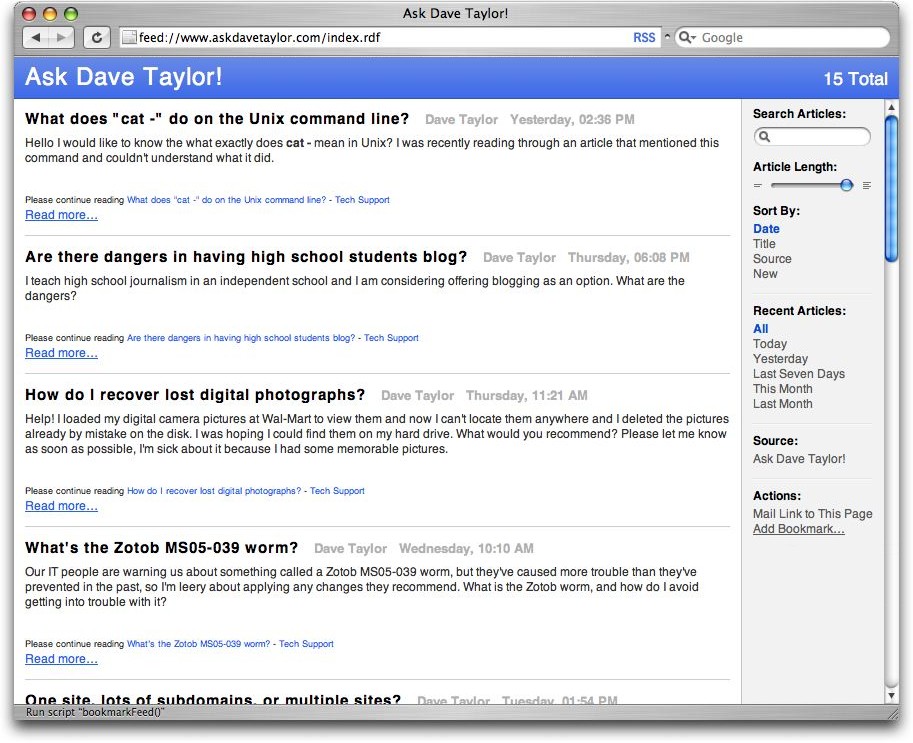
I used to use this A LOT back in the day, often finding it preferable to many site's native UIs.
What killed it for me personally though wasn’t the slow death of widespread RSS, but weirdly Twitter. Twitter can be a great news link replacement for RSS if you used RSS the way I did, as the links the people you follow share have been curated by those people themselves. I started to find a much better “hit rate” for content I wanted to read by seeing what influencers in industries I have an interest in share, rather than the hosepipe of stories that RSS was providing. I found I was still getting all the content I wanted without having to wade through all the noise, at which point I just stopped using RSS altogether.
I do however agree it is another sad indicator of a dying open web though.
Sure, it's XML. And had I been the one to design it from the start, I would have gone with JSON. But come on.
RSS has been losing ground because, deep down, people love the algorithms. I personally hate how algorithms artificially mangle content that I would have seen anyway if my "timeline" was chronological; it's annoying to me to have stories from hours or days prior to appear near the top of my feed because everyone has already seen the same thing by now and new comments are worthless/unseen after a givens tory is ~1.5 hours old.
and the XML wraps html-formatted articles, so unless you hate yourself, you'll need to be embedding a browser for rendering, which means bundling a browser too (even on certain browser embed providing platforms like win32, since it still uses IE11 as its browser embed)
of course its easy to generate RSS.
- - -
and thats nevermind the whole impossibility of getting all articles without a daemon on a separate server, especially for high-volume feeds
and the XML wraps html-formatted articles, so unless you hate yourself, you'll need to be embedding a browser for rendering, which means bundling a browser too (even on certain browser embed providing platforms like win32, since it still uses IE11 as its browser embed)
of course its easy to generate RSS
He didn't say that - just that people find JSON exciting. There are many things that have been rewritten in JSON just to become popular again, or things people have done long before but are exciting because they're now JSON.
What are some examples of concepts written for JSON that became more successful than their predecessor?
From RSS reader developer perspective (I'm author of BazQux Reader https://bazqux.com) problem with RSS/Atom is that there are many feed generators (and even handwritten feeds) each with its own understanding of standard or without understanding at all. And good feed reader need to handle many quirky issues to support all kinds of feeds.
With new feed format there will still be old bugs and problems (duplicating IDs, missing IDs, new IDs for the same posts, duplicated posts, misconfigured web servers, servers down and so on). And new format needs to duplicated efforts like MediaRSS for extended information about podcasts (which JSON Feed is missing).
Problem with RSS is not a format (end users won't read XML/JSON anyway) but needs of average user, time to setup, vogue, no profit for big players and so on. People, not tech problem.