You mean regressive policies that hurt the poor, right?
The War on Poverty marked the end of the decline in the American poverty rate. The social welfare state gradually sapped American industrial vitality and the labour productivity growth that had been fueling wage gains across all income classes for decades.
https://poverty.ucdavis.edu/faq/what-current-poverty-rate-un...
https://static01.nyt.com/images/2013/01/16/us/politics/16fiv...

https://static01.nyt.com/images/2013/01/16/us/politics/16fiv...

You said something about the regressive policies that hurt the poor. You haven't shown any evidence for this claim.
If social programs reduced poverty these aren't the stats you'd see.
Cutting the Poverty Rate from about 22% to about 12% is hurting the poor. Got it.
More extreme poverty began to increase decades into the War on Poverty, when social programs were far larger than they were at the beginning.
And in addition, there has been a major increase in single parenthood, which a lot of research indicates is largely a result of government low income subsidies making single parent households more economically viable. Single-parent households are associated with much worse socioeconomic outcomes that increase future poverty, incarceration and government dependency.
So my conclusion is that these policies are most likely harming the poor, by wiping out the poverty reduction that would otherwise be happening, and moreover, that there is very good reason to doubt that they're "progressive".
>>Cutting the Poverty Rate from about 22% to about 12% is hurting the poor. Got it.
The poverty rate was declining before the War on Poverty began. There's no reason to conclude that it is responsible for the continuation of that trend for a decade longer. There's plenty of reason to blame it for the cessation of that trend of declining poverty rates, rising wages and low rates of single parenthood.
Probably worth asking if you assert that American corporate taxes are the highest in the world: sometimes there are just major, major reality-based differences in the discourse and it's useless talking any further. I know I can't believe some of your axioms here, unfortunately.
[1] https://en.wikipedia.org/wiki/Corporate_tax_in_the_United_St...
Excerpt: In 2014 the United States had the third highest general top marginal corporate income tax rate in the world at 39.1 percent (consisting of the 35% federal rate plus a combined state rate), exceeded only by Chad and the United Arab Emirates However, the average corporate tax rate in 2011 dipped to 12.1%, its lowest level since before World War I, largely due to the great recession and a bonus depreciation tax break.
https://www.brookings.edu/wp-content/uploads/2016/07/22_wage...
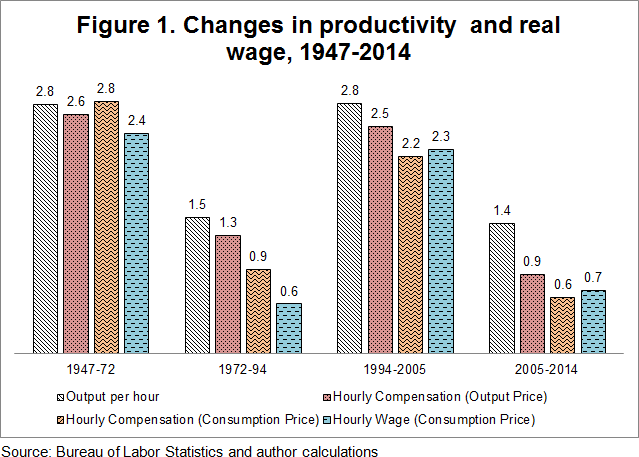
* For 1947-1972 it fell behind output by 0.2% per year, which sounds small, but that's 4.6% for the entire period.
* In 1972-1994 workers fell behind by another 4.1%
* In 1994-2005 (half the time) workers fell behind by another 2.9%
* In 2005-2014 (even less time) workers fell behind by another 4%
Over the entire span, workers' compensation has only increased 85% as much as productivity. More importantly, the gap is growing, not shrinking. Even using yearly figures to make differences look small, then grouping those numbers into oh-so-convenient unequal intervals, can't turn this into evidence of your original claim that wages have kept pace with productivity growth.
85% is a very high level of correlation. The original comment claimed:
>>But labor productivity growth doesn't cause any wage gains anymore,
Labour productivity growth obviously does cause wage gains. The data shows that the primary cause of the slowdown in wage growth has been a slowdown in labour productivity growth, not a decline in labour's share of revenue.
It's possible for both the original claim and your counterclaim to be untrue. Two lies don't make a truth. The original claim of no relationship is untrue. So is your "tracking very closely" counterclaim. There's a relationship, but it's not very strong and it's growing weaker.
> Labour productivity growth obviously does cause wage gains.
Cause? Without qualification? Not so fast, hoss. Sometimes productivity growth translates into wage increases. Other times either can change independently. The whole point - what those data really show - is that the relationship has been weakening.
85% is a strong correlation. I even posted the graph for others to make up their own mind. Calling my statement a lie, when it's based on your own subjective determination of what constitutes a close correlation, is hostile and unfair.
>Cause? Without qualification? Not so fast, hoss. Sometimes productivity growth translates into wage increases
Wage growth can only come from productivity growth on any sustained basis, so yes, the latter caused the former.
To quote the top-level comment that started this thread (and which was apparently OK with everyone): bullshit. Wage growth can come increased availability of resources or funds, from regulation, from many sources besides productivity growth. Productivity growth can actually drive wage decreases, e.g. when automation makes jobs obsolete and its practitioners end up doing menial work instead. Typesetting is an example that has affected my own family. To pick another one, do you suppose that all of the long-term increase in finance-industry wage growth has been because of productivity? That repealing Glass-Steagall, or tax laws favoring certain investment vehicles and funneling trillions into mutual funds had nothing to do with it? That would be naive. The people making all that money certainly know better.
If that claim is the basis of your argument or economic beliefs, then I feel sorry for you because you're building on quicksand.
First you accuse me of lying when I was being completely honest, then you call another claim of mine "bullshit". You're being rude. Please stop if you want to carry on the discussion.
There are countries out there (including America) where you can get long-term stay papers or citizenship by simply investing into the country. You're essentially "buying" your way in. Most of the necessary amounts are probably "peanuts" for the celebrities and tech-leaders we have today.
However, if you're suggesting that Silicon Valley CEOs are in favor of libertarian free trade, I think I agree more with the article and disagree with you. Silicon Valley CEOs loyalty is not to free trade, it's to their globalist lifestyle and outlook on life. Indeed, most of these people seem to be hardcore monopolists, and with no shame for it either.