American police are significantly more dangerous than most European police forces because of this. The lives of those killed by police are deemed not to matter.
It's not something intrinsic to the nature of police, it's a set of local - often hyperlocal - policy choices.
> European police
> It's not something intrinsic to the nature of police
Perhaps it's something intrinsic to the nature of police inside a hegemonic or imperial regime where the stakes of meaningful political upheaval are much higher (and the price of a frightened populous lower).
edit: Curious about the downvotes: is it a controversial assertion that police act differently in the context of empire?
There's the potential for a lot more people to get killed, now the tactic of driving cars into crowds has been borrowed from Islamist terrorist by white supremacists.
> governance of, high-violence subpopulations like (southern) Italians, the Irish, and Africans.
There's your racism and colonialism right there. You could call it hegemonic and imperialist as well if you like.
I'll summarize for you: an evil white supremacist found a crowd of counter-protesters and drove into them. They didn't drive into a crowd of white supremacists.
https://www.unitycville.com/contact/
Heather Heyer, the woman killed by the driver of the vehicle, was a local resident that was part of the counter protest.
You can fuck right off with calling people standing up for their entirely reasonable beliefs in an open society "SJWs".
It's strange, isn't it, how that somehow involves bandana face masks and baseball bats?
This is just a troll right, you aren't putting forth such sloppy reasoning in a serious way are you?
(If you don't understand what I'm getting at: applying responsibility for extreme actions to huge groups of people is ridiculous)
Does that apply to the white nationalists as well, or just the half of the mob you view as on your side?
(If you are confused, all the people talking about their right to free speech and free assembly are taking a nuanced stance on things...)
Be reminded that we had a revolution less than two and a half centuries ago.
And a very tumultuous last few decades. I think that MLK represented a very real possibility of meaningful political upheaval.
> 2) American police have a much longer history of dealing with, and adapting their policies to the governance of, high-violence subpopulations like (southern) Italians, the Irish, and Africans.
This is obviously true. The current character of professional, paramilitary police in the USA is traceable in no small part to slave patrols.
Another difference is that the command structure of American police is different even than other common law countries - police (as distinct from sheriffs) are ranked in a paramilitary totem rather than a constabulary structure, have wide discretion in contrary to Peelianism, and in some cases are afforded greater arrest powers than the citizenry at large.
"The Know-Nothings were right."
Then they call you a conspiracy nut so society ostracizes you and ignores your observations
I am not this - I am very optimistic about the human condition. However...
> govts are created to protect the wealthy and wars are instigated to generate more wealth
I think this is obvious at this point.
And I also think that our species is entering an age in which we'll be able to do without these lifeboats.
Soon as you figure out someone's motivation their actions become obvious.
Edit: if precincts got paid based on customer satisfaction we'd see an overnight change making the police force unrecognizable. Crazy how money do that.
Developers live in a world of scrum, points, and delivering value. I think whoever pays for the officers salary should be the "product owner" of the police department.
Like what, the local governor/censor/consul/manor lord?
As an American, it is shocking and appalling to see that we have recreated a version of debtors prison.
And then the party in power tries to eliminate the thing that lets middle-aged startup founders/small business owners get health insurance so they can cut taxes on the top 0.5% of income earners.
I fault both parties for the ridiculous situation we're in regarding health care. The ACA was doomed no matter who won the last election. Not because of how it was structured, but because it didn't address the core cost problems.
Not defending Trump's actions. But, at best, he's damaging an already dying system.
As for costs, I don't know your state or situation but that does seem high. In Illinois for an individual plan with BCBS (PPO, larger of their provider lists) I'm paying under 500 non subsidized though if the exchanges still exist next year I expect it to rise $50-100.
Edit: clarity
This is a very effective system, but it requires real buy-in from everyone involved, for things that are very much counter-intuitive to us as people. It also has a great deal of overhead and extra cost that must be accepted globally, and cutting corners cannot be tolerated even for the occasional cases where you may be convinved something is reasonable and safe.
Medicine could also benefit from an attitude that doesn't blame the individual but looks for ways to avoid problems later.
It's just our totally useless perception of risk along with some other unfortunate qualities of humans. Trains are very safe but when something happens it's usually lots of casualties, destruction and press coverage (same for planes). Many many more people die from car crashes but you'll never see root cause analysis there, instead you have police falling over each other trying to blame whichever party is dead.
(Not entirely lacking as I think safety regulations do take into account statistical models of accident risk in terms of regulatory requirements on things like frame impact absorption)
Most issues have a reproducible reason, so it's likely that the same problem will happen on many many planes and kill a whole lot of people.
For the comparison, cars are risk free. What happens when your car is broken? You just can't go anywhere. It's not like people are falling off the sky in pack of a few hundreds at a time.
-- Ex aerospace engineer.
You will realize the problem the first time you try to brake, likely on the first turn or the first light.
For the comparison, imagine a brake failure on a plane.
A plane can already take a mile to stop with working brakes. How many buildings and trees do you think it will take to substitute to the brakes?
Reverse thrust on your engines is one of them, spoilers are another (not only do they increase the effectiveness of the brakes by putting more of the aircraft weight on them, but they also increase drag), and even if the aircraft gets to the end of the runway, at most international airports they have an overrun area called a runway safety area which is essentially like driving your car into a sand bank.
EDIT: Picture: http://theinfrastructureshow.com/images/70.jpg
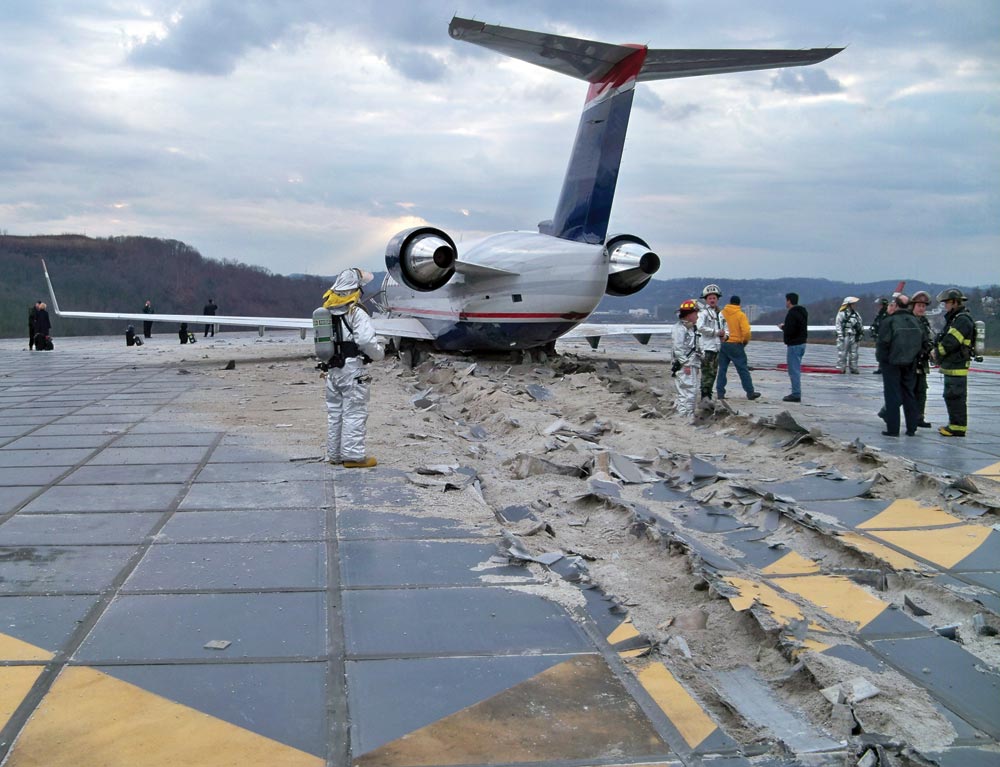
Complete nonsense, unless you tautologically define "serious" to mean "fatal".
You know, to even get your private pilot's license, you have to pass a simulated engine-out. Fixed-wing craft are perfectly capable of gliding without power.
Complete engine failure is mostly risky in two situations, over water and low altitude. Ask Sully about having both happen at once and still no deaths!
(Edit to add sources)
Commercial flights with engine failures in the past 30 years w/o fatalities: https://en.m.wikipedia.org/wiki/British_Airways_Flight_9 https://en.m.wikipedia.org/wiki/Air_Transat_Flight_236 https://en.m.wikipedia.org/wiki/Eastern_Air_Lines_Flight_855 https://en.m.wikipedia.org/wiki/Gimli_Glider https://en.m.wikipedia.org/wiki/Hapag-Lloyd_Flight_3378 https://en.m.wikipedia.org/wiki/Scandinavian_Airlines_Flight... https://en.m.wikipedia.org/wiki/US_Airways_Flight_1549
Commercial flights with engine failures and fatalities (one fatality, a flight attendant): https://en.m.wikipedia.org/wiki/Garuda_Indonesia_Flight_421
If your airplane engine stops working you're not going to be able to get off the ground in the first place.
You can rationalize different ways you could help ensure your own survival in maritime or police incidents. Despite that you often can't.
So people are supportive of extraordinary measures, regulation, because of all that.
When I wondered out loud once why such an approach isn't taken for other services and industries, a friend of mine - born forty with cynicism to spare - said "Rich people fly."
Perhaps the same approach to incidents in the maritime environment, and incidents involving the police, isn't taken because somehow the people most affected are seen as somehow not really worth the time and effort. It's not the rich people, the people in power, who are affected.
I really hope that's not true, because if it is, nothing will change.